Book Writing
 Book Cover Design
 Book Editing
 Book Formatting
 Book Publishing
 Book Video Trailer
 Book Printing
 Audio Books
 Book Illustrations
 Author Website
 Amazon Page Optimization
 Book Marketing
 Fiction Writing
 Non-Fiction
 Autobiography
 Memoir
 Novel Writing
 Children's Book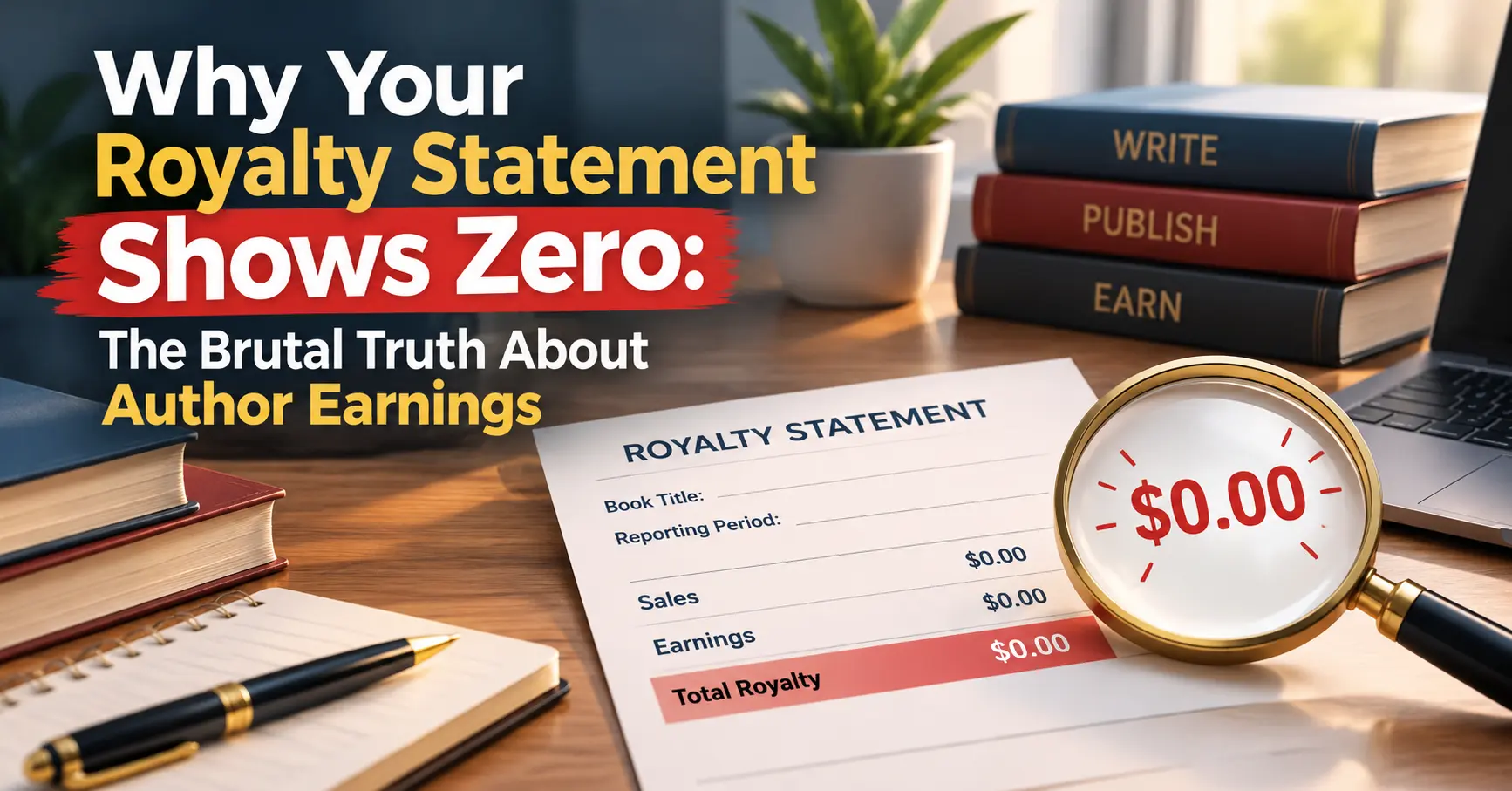
I have talked to writers who signed their first book deal absolutely glowing with excitement, only to spend the next two years wondering why their royalty statements kept showing zero. Here is everything they wished someone had explained beforehand.
Let me be straight with you. Publishing is an industry that runs on excitement and dreams, and it does a remarkably good job of selling both. What it does less well is sitting down with a new author and walking through the actual money side of things before anyone signs anything.
So let us do that now. No jargon, no hand-waving, just an honest look at how royalties work, what you can realistically expect to earn, and where the system tends to surprise people who were not expecting it.
Whether you are weighing a traditional deal, considering self-publishing, or just finishing your manuscript and starting to wonder about all of this for the first time, this is the guide I wish existed when I started researching this topic.
What a Royalty Actually is and Why the Definition Matters More than People Think
A royalty is a cut of every sale. Each time someone buys your book, a percentage of that money is supposed to come back to you. Simple enough, right?
Here is where it gets slippery. There are two very different ways publishers calculate that percentage, and they produce very different results.
Some contracts calculate your royalty as a percentage of the retail price, meaning what the book costs on the shelf. Others calculate it as a percentage of net receipts, which is the amount the publisher actually receives after the retailer takes their share. And retailers take a big share. A bookstore typically gets 40 to 50 percent off the cover price before the publisher sees a cent.
“A 15% royalty on retail and a 25% royalty on net can land you in almost the same place financially. The number without the base it is calculated on means almost nothing.”
This is not a minor technicality. It is the kind of thing that can make a contract look more generous than it is if you are only reading the percentage and not what it is a percentage of. Always ask. Always find out which base applies before you feel good about any rate you are offered.
The Gap Between Publishing Paths is Bigger than Most People Realize
Here is the honest snapshot. Your royalty rate is not set by some industry standard. It shifts completely depending on how your book gets into the world.
Traditional (hardcover)
8 to 15%
of cover price, negotiated per contract
Self-pub eBook on KDP
35 to 70%
of list price, based on your price tier
Hybrid Publishing
20 to 50%
varies a lot depending on the company
Audiobook (ACX / publisher)
10 to 25%
depends on exclusivity and deal terms
The Truth About Traditional Publishing Royalties
Ten to fifteen percent on a hardcover. Six to eight percent on a paperback. Around twenty-five percent on eBooks, though that is off net receipts, not the cover price. Those are the numbers you are typically looking at in a traditional deal.
But here is the thing almost every first-time author fixates on instead: the advance. A publisher offers you money before the book even comes out. It feels like a vote of confidence. It feels like proof that you made it. And it is real money, money you get to keep no matter what.
What it is not, though, is a bonus. It is a loan against future royalties. Until your book earns back every dollar of that advance through sales, your royalty statements will keep reading zero. That process is called earning out, and the uncomfortable truth is that a lot of books never do it. Not because the publisher failed them, not because the author did anything wrong, but because selling enough copies to pay back even a modest advance is genuinely hard.
None of this makes a traditional deal a bad deal. An advance gives you financial breathing room. It signals market confidence. A good publisher brings real resources to your book. But it does mean that “I got a book deal” and “I am now earning royalties” are two very different things, and the gap between them can be years.
Self-Publishing: Better Percentages, Much Harder Everything Else
Amazon KDP gives you 70 percent royalties on eBooks priced between $2.99 and $9.99. Below or above that window and you drop to 35 percent. For print on demand, your royalty is whatever remains after printing costs are subtracted from your list price. Compared to 10 percent in a traditional deal, this sounds almost too good to be true.
It is not too good to be true, but there is a catch the percentage does not advertise. Self-publishing means you are responsible for everything. Editing, cover design, formatting, marketing, discoverability. None of that comes with the deal because there is no deal. There is just you, your manuscript, and an upload button.
Something worth sitting with: The self-published authors genuinely earning a living from royalties almost always have one of two things. Either a large existing audience they built before publishing, or they publish frequently in a genre with hungry, loyal readers and they treat it like a full-time job. A single book uploaded with no marketing plan behind it, even at 70%, can sell almost nothing. The royalty rate is not the hard part. Getting people to find your book is.
Let us Actually do the Math on Advances
This is where things get real, so stick with me for a minute.
A worked example
Say your publisher offers you a $12,000 advance. Your hardcover retails at $26 and your royalty rate is 10%, so you earn $2.60 per copy sold.
To earn out that advance, you need to sell 4,615 copies. Every royalty statement before that number shows zero owed to you, because the advance already covered it.
The average traditionally published debut novel sells somewhere between 1,000 and 3,000 copies in its first year. Do the math on that and you start to understand why so many authors never see a royalty check beyond the advance they received at signing.
Again, not a disaster. You kept the advance. But if you went into the deal imagining passive royalty income flowing in for years, the reality can feel deflating. Going in with accurate expectations protects you from that.
The Stuff that Actually Determines your Earnings
Your royalty rate is just one number in a much bigger equation. Here are the things that actually move the needle on what you take home.
Genre shapes your ceiling more than almost anything else. Romance readers are famously voracious. So are cozy mystery fans, thriller readers, and certain corners of fantasy. If you write in one of those categories and you publish consistently, the numbers can work in your favor in ways they simply cannot in slower-moving genres, even if the writing in those slower genres is objectively better.
Format matters in ways people underestimate. The same royalty percentage applied to a $28 hardcover and a $9.99 eBook produces very different per-sale income. Audiobooks have become a serious category and can add real money, especially if you negotiate to keep those rights rather than bundling them into a broader deal.
And then there is marketing, which is the piece most authors do not want to think about but probably should. A publisher markets your book, sometimes aggressively and sometimes barely at all. A self-published author markets their own book, which takes time, skill, and often money. Either way, a book nobody knows about does not sell, regardless of the royalty rate sitting underneath it.
Subsidiary Rights are the Thing Mmost New Authors Overlook Entirely
When you write a book, you do not just create one product. You create a bundle of rights. The right to publish in English. The right to publish in translation. The right to adapt it for film or television. The right to produce an audiobook version. The right to serialize it. Each of those is a separate thing that can be licensed to a separate buyer for a separate fee.
Traditional publishers will typically want some or all of those rights as part of your deal. A good literary agent earns their commission largely by fighting to keep as many of those rights with you as possible, because each one you hold is a deal you can make independently later.
Translation rights alone can generate income from dozens of countries. A Japanese publisher, a German publisher, a Brazilian publisher, each deal carries its own advance and its own royalty stream running parallel to your English language sales. Film options, even ones that never result in an actual film being made, pay real money just for the option itself.
“Some authors earn more from a single foreign rights deal than they ever earned from the original book’s royalties. Rights are not a footnote. They are often the main event.”
When does the Money Actually Show up?
Traditional publishers pay royalties semi-annually, meaning twice a year. The reporting period ends, the accountants do their work, and several months later a statement and a check (or a bank transfer) arrive. If your book sold well in February, you might not see that reflected in your account until October. It is slow in a way that can feel maddening, especially if you are watching your sales rank update in real time on Amazon.
Self-publishing platforms are faster. Amazon KDP pays monthly, roughly 60 days after the sales month closes. Still a delay, but measured in weeks rather than half-years.
There is also something called a reserve against returns that most new authors discover only when they notice their payment is lower than expected. Because physical bookstores can return unsold copies to publishers, publishers routinely hold back a portion of your earned royalties as a buffer against those returns. That held amount is released gradually over future payment cycles. It is industry standard. It is also genuinely annoying the first time you encounter it without knowing what it is.
A habit worth building early: Track your own sales separately from whatever your publisher or platform reports to you. The data is usually available in dashboards and reporting tools. Errors on royalty statements are rare but they do happen, and authors who catch them are almost always the ones who were already paying attention to their own numbers before the statement arrived.
What Income from Writing Actually Looks Like for Most People
The honest version of this conversation acknowledges that most authors do not support themselves from royalties alone, at least not for a long time. Industry surveys consistently show a median author income that most people would not consider a living wage. That is not a secret or a scandal. It is just the math of a creative industry with far more supply than demand.
But medians hide real variation. The authors who do build sustainable income from their writing almost always share a few things. They write more than one book, because a single title almost never produces enough on its own. They build an audience gradually and consistently, not just around launch day. They pay attention to which rights they hold and look for opportunities to license them. And they treat the business side of writing as something worth understanding rather than something to hand off entirely or ignore.
There is a real group of self-published authors earning six figures from royalties, mostly in genre fiction, mostly through prolific output and smart platform building. There is another group earning sustainable income through traditional deals built on strong subsidiary rights and backlist sales rather than a single hit. Neither path is easy and neither is guaranteed, but both are genuinely real.