Book Writing
 Book Cover Design
 Book Editing
 Book Formatting
 Book Publishing
 Book Video Trailer
 Book Printing
 Audio Books
 Book Illustrations
 Author Website
 Amazon Page Optimization
 Book Marketing
 Fiction Writing
 Non-Fiction
 Autobiography
 Memoir
 Novel Writing
 Children's Book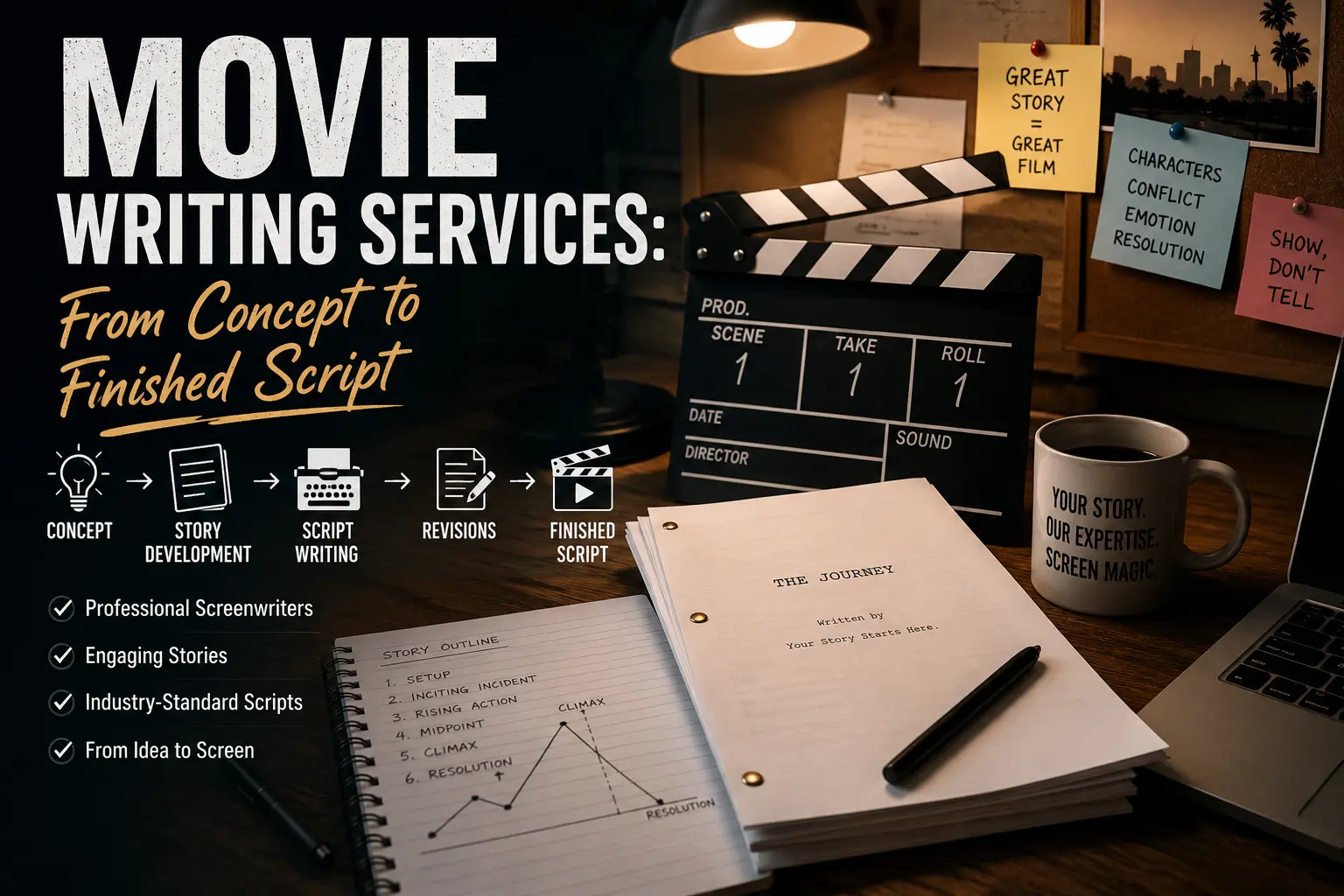
My buddy Danny spent three years on a screenplay in his spare bedroom. Three years, on nights and weekends, convinced the whole time he had the next great indie hit locked away in that laptop. He didn’t. And it wasn’t because his idea was bad. He just had zero clue how to structure a script the way producers actually expect one to look. His cousin kept nagging him to look into movie writing services, and eventually he gave in. Four months later, working with an actual professional screenwriter, that 140 page ramble had turned into something tight enough that two production companies agreed to read it.
I bring up Danny a lot because his situation isn’t rare at all. Plenty of people are carrying around a genuinely good story, maybe even a full outline scrawled on napkins or the back of a grocery receipt, but getting that from “cool idea” to an actual usable screenplay is a completely different skill. It’s the gap between telling your friends a great story over beers and writing something a director, a full cast, and a crew of forty people can actually pick up and shoot.
So here’s what these services really do, roughly how the process tends to go, and whether hiring one is even the right move for what you’re working on.
What Movie Writing Services Actually Involve
Say “movie writing services” to most people and they picture someone typing dialogue based on whatever rough idea you hand over. Honestly? That’s maybe a tenth of what actually happens.
It usually starts with development. Before anyone writes a single line of dialogue, a good screenwriter sits with you and really picks apart the concept. What’s the central conflict. Who’s your protagonist and what do they actually want underneath everything else. What’s the theme buried under the plot mechanics. Skip this step and you get exactly what plagues so many amateur scripts, an interesting premise that just wanders around without ever really going anywhere.
Then comes structure, and this is probably the single biggest thing separating a professional script from a hobbyist one. Movies follow pacing patterns audiences have absorbed without even noticing, almost like a rhythm baked into how we watch stories. Three act structure, or something more layered depending on genre, tells you roughly where your inciting incident should land, where the midpoint twist needs to hit, where the climax has to pay off emotionally. Writers who’ve done this for years just feel it. They’ve read hundreds of scripts, the great ones and the terrible ones, and they know exactly why some stories keep you glued to the page while others go flat by page forty.
Writing comes after that, obviously, but even here there’s a lot more back and forth than people expect walking in. Dialogue has to sound natural coming out of an actor’s mouth, not just look fine sitting on a page. Scene descriptions need to be visual without turning into paragraphs, because scripts get read fast, sometimes producers only glance at your first ten pages before deciding whether you’re worth their time at all.
And then there’s formatting. I honestly didn’t know how much this mattered until Danny explained it to me. Industry standard screenplay format isn’t a style preference, it’s basically a gate you have to get through. Wrong margins, sloppy scene headings, bloated action lines, any of that and your script might get tossed before anyone’s even absorbed the actual story. A professional service handles this without even thinking about it. Second nature at that point.
The Typical Process From First Call to Final Draft
Danny’s experience actually tracks pretty closely with what most people go through, so let me just use his project as the example here.
It started with a consultation call. Nothing fancy, just talking through his rough idea, the movies that influenced him, the tone he was chasing. From there his writer put together a treatment, basically a short document laying out plot, characters, and structure before a single script page existed. This step matters more than people realize going in, because catching problems at the treatment stage is cheap and painless. Catching them after fifty pages of finished dialogue is neither of those things.
Once Danny signed off on the treatment, actual drafting began. His writer worked in chunks, sending over the first act for notes instead of disappearing for three months and dropping a finished script on him out of nowhere. That back and forth kept things pointed where Danny wanted while still letting the professional shape it using their own instincts.
Danny’s timeline at a glance:
Consultation call to discuss the idea and tone. A written treatment covering plot, characters, and structure. First act drafted and reviewed before moving forward. Full first draft completed. Two rounds of revisions, one focused on structure, one on polish. Total time from start to finish, about four months.
After the full first draft landed, they went through two rounds of notes. Round one hit the big stuff, pacing that dragged in the middle, a subplot that frankly wasn’t earning its screen time. Round two was more about polish, tightening dialogue, cutting scenes that didn’t need to exist, sharpening the ending so it actually landed emotionally instead of just fizzling out.
All in, the whole thing took roughly four months for a feature length script. Shorter projects move faster, naturally. A ten minute short can sometimes wrap in a couple of weeks.
Why People Choose Movie Writing Services Over Going It Alone
Some people assume hiring a pro means handing your creativity over entirely, like you stop being the “real” writer the second someone else touches your pages. That’s not really how it plays out once you’re actually in it.
Most movie writing services work collaboratively, not as some hands off black box you feed an idea into. You’re still the source of the story, the characters, the whole world underneath it. What you’re actually paying for is craft and structural knowledge, the kind that takes years of trial and error to build on your own. Kind of like hiring an architect for your dream house. You still know exactly how you want it to feel and function every day. The architect just makes sure it doesn’t collapse and actually meets code.
There’s a business angle here too, worth mentioning. If you’re hoping to sell your script down the line, or attract investors, a professionally structured screenplay signals to industry people that you actually get the medium. A script riddled with formatting mistakes and rambling scene descriptions gets read completely differently than one that already looks vetted. Is that fair? Not really. But that first impression carries an enormous amount of weight in an industry drowning in submissions on any given Tuesday.
Then there’s time, which honestly might be the biggest factor of all. Danny spent three years alone before bringing in help. Four months with a professional got him further than those three years combined. That’s not a talent problem. He was learning screenwriting from scratch while also trying to execute his specific story at the same time. Bring in someone who already has the craft down, and that learning curve just vanishes.
What to Look for Before Hiring Someone
Not every writer fits every project, so a little vetting upfront saves a lot of grief down the road.
Ask for samples in your actual genre. Someone brilliant at tight, tense horror might completely whiff on the comedic timing your rom com needs. Genre voice matters more in screenwriting than people usually expect.
Ask how they handle notes too. Some writers get pretty rigid once drafting starts and don’t want much outside input mid process. Others build several feedback rounds into the package as standard. Neither is wrong exactly, but know which one you’re signing up for before any money changes hands.
Get ownership and credit sorted early, before things get messy. Will you get co-writer credit? Does the service keep any rights to the finished script? These questions matter a lot more once a project starts gaining traction, so sort it out at the start rather than mid project.
And ask about turnaround and communication style. Some writers vanish for weeks between drafts. Fine for some clients, maddening for others. If you want regular check ins, make sure that’s actually part of the deal rather than something you’re just hoping happens.
Is Hiring a Movie Writing Service Worth It for Your Project
Depends a lot on where you’re starting from, honestly. Strong story, zero screenwriting background? Professional help can save you years of frustration and dramatically improve your odds of ending up with something usable. Already trained and just want a second set of eyes or some structural notes? A lighter consultation probably makes more sense than a full ground up package.
Quick gut check before you hire anyone:
Do you have a clear story but no idea how to structure it. Do you want your script to actually be read by producers or agents. Is formatting something you’ve never dealt with before. Do you have a budget that allows for professional development. If most of these are yes, a movie writing service is probably worth the investment.
Budget plays into it too. Full development, from concept through a polished final draft, can run anywhere from a couple thousand dollars for something short to a lot more for a feature with an experienced writer attached. Worth being upfront about your budget early, since most professionals can scale their involvement instead of pushing the same rigid package on everyone who calls.
Conclusion
At the end of the day, movie writing services exist to close the gap between a good idea and a script that actually works the way the industry expects a script to work. Danny’s screenplay eventually got optioned by a small production company, something that felt flat out impossible during those lonely three years in his spare bedroom. The story itself never changed. What changed was having someone next to him who knew how to shape it into a form the industry could actually recognize and take seriously. If you’ve got a story worth telling and you’re stuck on turning it into something that reads like a real screenplay, that kind of help might be exactly what gets your project out of a drawer and onto a screen someday.