Book Writing
 Book Cover Design
 Book Editing
 Book Formatting
 Book Publishing
 Book Video Trailer
 Book Printing
 Audio Books
 Book Illustrations
 Author Website
 Amazon Page Optimization
 Book Marketing
 Fiction Writing
 Non-Fiction
 Autobiography
 Memoir
 Novel Writing
 Children's Book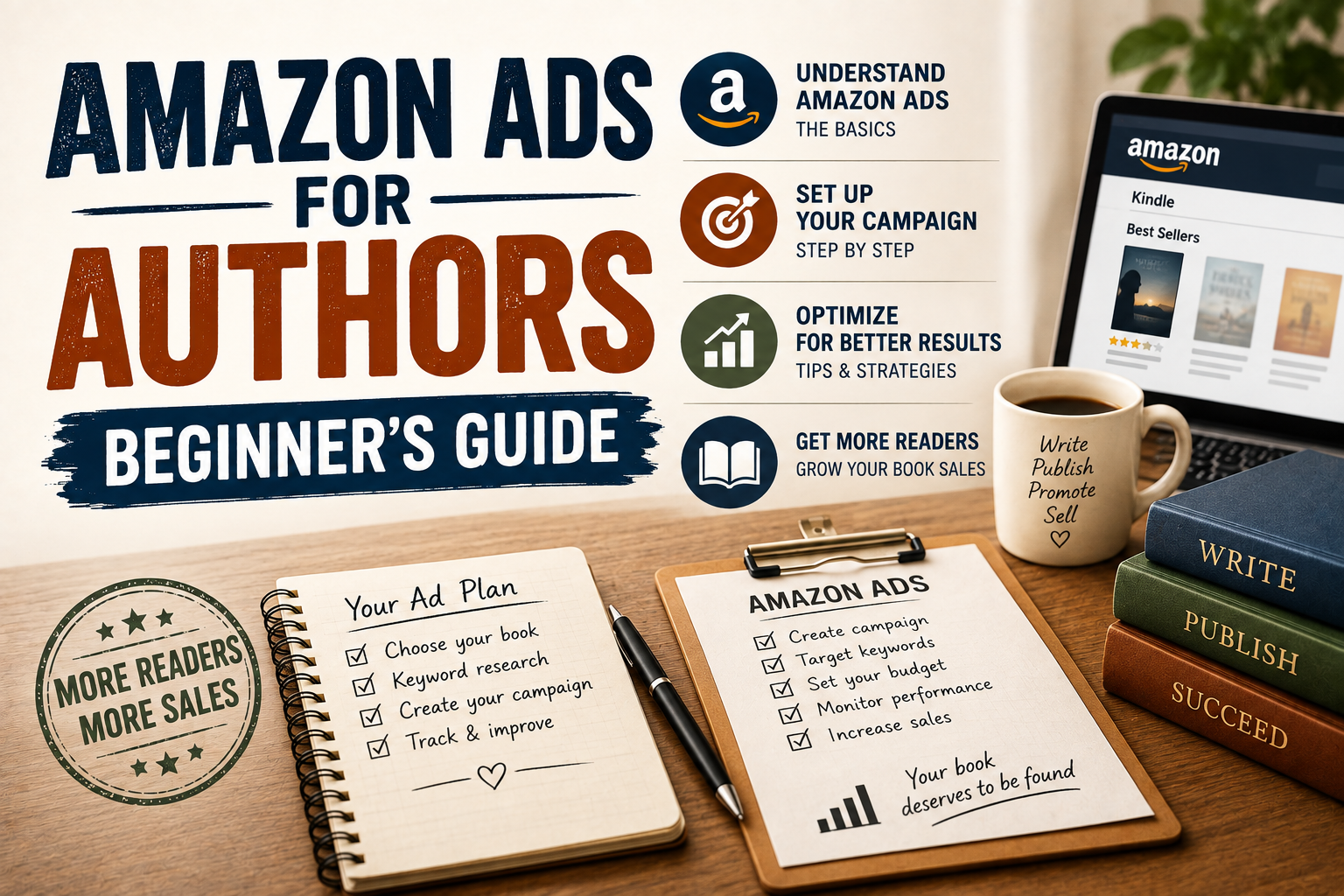
So you published your book. Maybe you told your friends, posted about it, waited by your phone for the sales notifications to start pouring in. And then… crickets. If that stings a little to read, I get it. It happens to nearly everyone, including plenty of genuinely talented authors. Writing the thing was hard enough. Getting total strangers to notice it? That’s a whole separate skill nobody warns you about in any writing class. This is where Amazon ads for authors actually earn their keep, and once you get past the initial learning curve, they work far better than most people assume going in.
I want to walk you through this the way I wish someone had walked me through it, no jargon, no pretending it’s harder than it is. Think of this as the Amazon book ads beginner guide you’ll actually finish reading.
What Are Amazon Ads for Authors, Anyway
You know how sometimes the first few book results on Amazon feel a little too on the nose for whatever you typed? A lot of those aren’t organic at all. They’re paid placements that authors and publishers bought through Amazon’s ad system. Longtime self published authors still call the whole thing AMS, short for Amazon Marketing Services, so you’ll hear people say AMS ads for authors constantly, even years after Amazon quietly renamed it.
How it works is refreshingly simple. You pay a small amount each time somebody clicks your ad. Click turns into a sale? Great, you’re already ahead. Click doesn’t convert? You’ve still put your cover in front of a real, live reader, and honestly sometimes that’s the whole point. People rarely buy the first time they see something. They notice it, forget it, see it again, and eventually buy.
Okay, But Why Bother Advertising on Amazon
Here’s something that took me embarrassingly long to actually appreciate. Amazon isn’t really a “store” the way we usually picture stores. It behaves more like a search engine full of people whose wallets are already open. Someone typing “gritty small town thriller with a female sheriff” isn’t casually browsing. They want a book. Today. Maybe tonight.
Compare that to scrolling Instagram or TikTok, where buying anything is basically an accident that interrupts your scrolling. That single difference is a big reason book advertising on Amazon tends to beat a lot of other advertising channels for authors, especially in genre fiction, where readers are hunting rather than waiting to stumble onto something.
The Ad Formats You’ll Actually Run Into
Before getting into how to run Amazon ads for books, it’s worth knowing what you’re even choosing between, because the options aren’t as overwhelming as the dashboard first makes them look.
Sponsored Products. Start here. Seriously, just start here. These show up in search results and on other similar books’ pages, blending in so well that most shoppers can’t tell they’re ads at all. You pick keywords yourself, or let Amazon’s algorithm pick for you, and your cover slots right into the results.
Sponsored Brands come next, and honestly they’re more useful once you’ve got more than one title out. They show a little banner with your name and a few of your books, usually sitting right above the normal search results. If this is your debut, don’t worry about these yet. Come back once you’ve built a small backlist.
Then there’s Lockscreen advertising, which pops up on Kindle devices when the screen is locked. Not a beginner favorite, but if your ideal reader is the type who owns an actual Kindle (not just the app), it can genuinely surprise you.
How to Run Amazon Ads for Books Without Losing Your Mind
Alright. Steps. This is probably why you clicked on this in the first place, so let’s not waste more time.
One, confirm your book is eligible inside the advertising console. If you went through KDP, this usually sorts itself out within a day or two of your book going live. Occasionally it takes a bit longer. Don’t panic if it’s not there instantly, it usually shows up.
Two, open your KDP dashboard, or go straight into Amazon Advertising if you’re managing more than one book. Start a new campaign. For your first attempt, just pick Sponsored Products. No need to overcomplicate day one.
Three, and this one confuses more people than it should, choose between automatic and manual targeting. Automatic means Amazon’s system chooses keywords based on your book’s own metadata. It’s a genuinely smart place to begin, because it hands you real performance data before you start guessing on your own. Manual targeting means you pick the exact keywords or competing titles yourself. Save that for once you actually have some numbers to work from.
Four, set a daily budget. People ask me all the time what’s “safe.” Honestly? Even a few dollars a day is enough to start gathering real information without risking your rent money. Scale up later, once you can see which keywords are actually earning their spot.
Five, the “writing” part is almost nonexistent here. Sponsored Products basically just display your cover, title, price, and star rating. Which, by the way, is exactly why your cover and blurb matter so much before you even think about running ads. No amount of clever ad copy fixes a cover that isn’t pulling its weight.
Six, launch it, then walk away for at least a week. I know, easier said than done. The urge to refresh the dashboard every hour is real. Resist it. Campaigns need time to collect enough clicks before any of the numbers actually mean something.
Amazon PPC for Self-Published Authors Is Its Own Beast
If you’re traditionally published, a marketing team is probably handling most of this for you. But Amazon PPC for self-published authors is a different situation entirely, because it’s just you, alone with a dashboard, making every single call yourself, from budget to keyword choices to whether that one stubborn campaign is even worth keeping alive.
There’s a real upside though. Nobody understands your genre and your readers the way you do. The tradeoff is time. Doing this well means checking in regularly, even if it’s only ten or fifteen minutes a week, just to see which keywords are pulling their weight and which ones are quietly bleeding your budget for nothing.
One habit worth building early: keep an eye on your Advertising Cost of Sale, usually shortened to ACoS. It’s basically a ratio showing how much you spent on ads versus how much revenue those ads actually brought back. Lower usually means more efficient, though what counts as “good” really depends on your goal, whether you’re trying to break even, grow readership for an ongoing series, or push a brand new release out the door.
Getting More Out of Amazon Marketing Services for Authors
Once the basics are up and running, a few habits separate the authors who stick with this from the ones who quit after one underwhelming month messing with Amazon marketing services for authors.
Keyword research matters more than most beginners assume. Instead of guessing, actually look at what readers type. Amazon’s own autocomplete in the search bar is free and weirdly accurate for surfacing real search phrases.
Your product page plays a bigger role in ad performance than most people want to admit. A shaky cover, a confusing blurb, or barely any reviews can quietly sink an otherwise well targeted campaign, because people click, look, and just leave. Before pouring money into ads, take a hard, honest look at your description and cover. Ask a few trusted readers for blunt feedback, not the polite kind.
Negative keywords deserve more credit too. If your ad keeps popping up for searches that clearly have nothing to do with your book, exclude them. There’s no reason to pay for clicks that were never going anywhere useful.
Amazon Keeps Changing the Rules, So Keep Up
Amazon tweaks its advertising system constantly, adjusting targeting options, bidding tools, reporting dashboards, all of it. What worked great a year ago might need a small tweak now, and that’s just how it goes on any major platform, not something unique to Amazon. Authors who stay consistently profitable tend to check in on their campaigns, and on Amazon’s updates, every so often, rather than setting something up once and ignoring it for half a year.
The same idea applies to whatever you’re reading online about advertising, including this very post. Search engines have gotten noticeably better at rewarding content written from real, hands on experience rather than generic advice recycled a hundred times over. If you’re researching Amazon ads for authors anywhere, look for writing from people who’ve actually run campaigns and made their own mistakes doing it. That kind of firsthand knowledge tends to surface the small, oddly specific details that purely theoretical guides always seem to leave out.
Final Thoughts
Nobody figures out how to run Amazon ads for books in one sitting, and honestly that’s fine. Every author now running profitable campaigns once stared at the exact same blank dashboard you might be staring at right now, wondering where to even click first. Start small. Be honest with yourself about the numbers. Adjust slowly instead of overreacting to one bad day.
Whether this is your first campaign ever or you’re fine tuning one that’s already live, the fundamentals barely change. Know your reader. Choose keywords with some actual intention behind them. Keep your budget realistic. Give your campaigns enough breathing room to actually tell you something useful. Ads won’t save a book that isn’t ready. But paired with one that is? They can genuinely be the difference between a title that quietly disappears and one that keeps finding new readers, month after month, long after launch day has come and