Book Writing
 Book Cover Design
 Book Editing
 Book Formatting
 Book Publishing
 Book Video Trailer
 Book Printing
 Audio Books
 Book Illustrations
 Author Website
 Amazon Page Optimization
 Book Marketing
 Fiction Writing
 Non-Fiction
 Autobiography
 Memoir
 Novel Writing
 Children's Book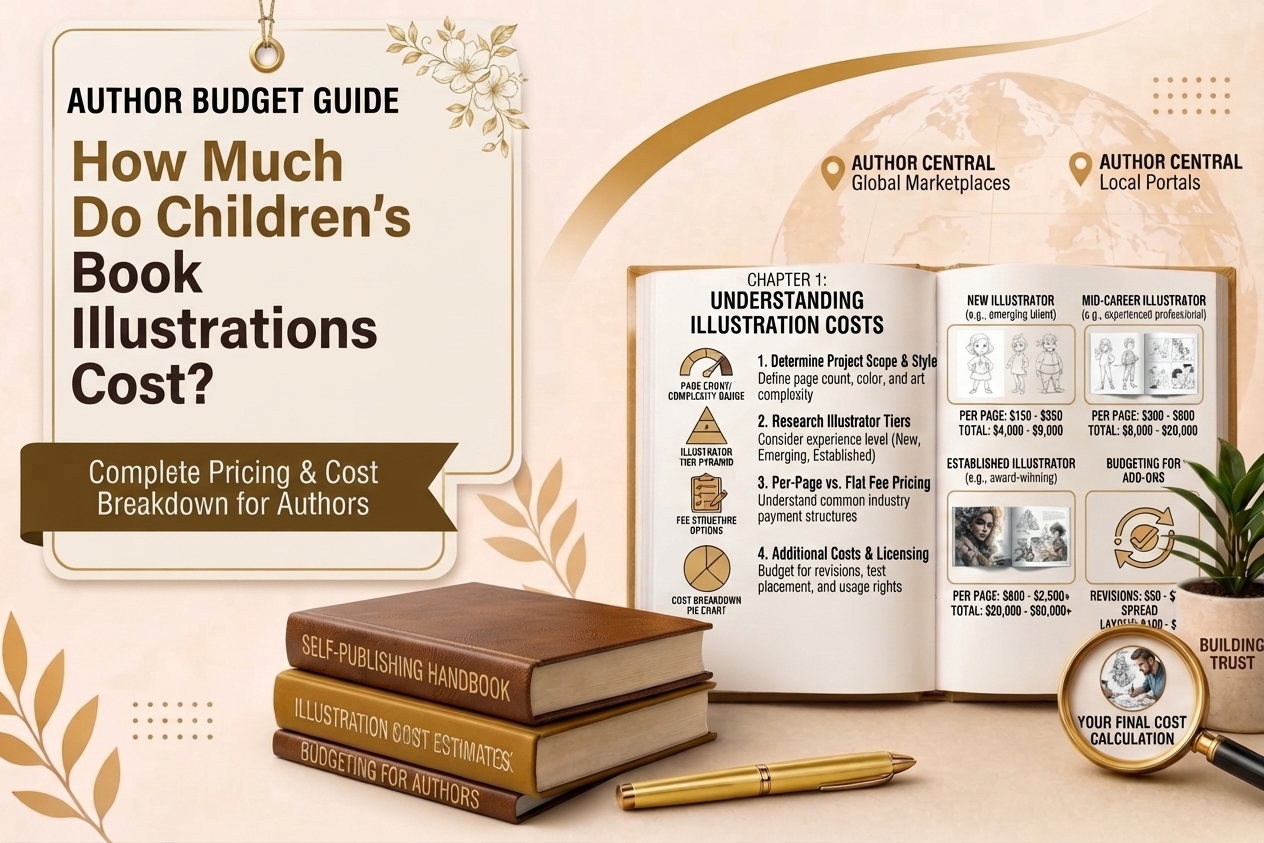
You finished writing your children’s book. That part took months, maybe longer, and now you’re finally at the stage where you need to figure out the illustrations. So you start asking around. You do some research. You reach out to a few illustrators. And then the quotes start coming in and suddenly nothing makes sense anymore.
One person responds within the hour offering to do the whole book for $400. Another sends a beautifully designed proposal explaining that their process starts at $8,000. A third has a Fiverr listing that says $150 per illustration and five star reviews and you genuinely cannot tell whether that’s a steal or a disaster waiting to happen. You’re staring at these numbers wondering if these people are even doing the same job.
They are. Sort of. But the differences in what you’re actually getting are enormous and the price reflects that, even when it’s not obvious on the surface. Once you understand what’s actually driving the cost, everything starts making more sense and you stop feeling like you’ve wandered into a market where the prices are just made up.
This guide walks through all of it. What actually determines illustration cost, what different budgets realistically buy you, where to find illustrators worth hiring, and the mistakes that quietly drain author budgets without producing better books.
Why Children’s Book Illustration Pricing Varies So Much
Hiring an illustrator is nothing like hiring someone to fix your gutters or clean your carpets. Those are relatively standardized jobs where the main variables are experience and location. Illustration is something else entirely. It’s a deeply personal craft where style, experience level, project complexity, and what rights you’re actually purchasing all play significant roles in what the work is genuinely worth. And the gap between the cheapest and most expensive option in this market isn’t a small one. It’s vast.
Think about what you’re actually comparing when you look at different quotes sitting side by side. A picture book for toddlers featuring bold, simple shapes and bright colors is a fundamentally different project from a middle grade novel that needs intricate character-driven artwork spread across sixty pages. An illustrator who finished art school eight months ago and is trying to build their first real portfolio is in a completely different position from someone who has been working professionally for fifteen years and whose books you can find at any Barnes and Noble. An illustration you’re licensing for a small print-on-demand run is a completely different commercial arrangement from one going into a traditionally published book with international distribution rights.
Every single one of those differences shows up in the price. The variation isn’t noise or confusion. It’s actually telling you something specific. The trick is learning to read it.
The Main Factors That Determine Illustration Cost
Before you can put together a budget that makes sense or decide whether a quote is reasonable, you need to understand what’s actually driving illustration costs. There are six things that matter more than anything else.
Illustrator Experience and Reputation
This is the single biggest driver of price differences across the entire market, and it’s the one that’s easiest to underappreciate. An illustrator who is two years out of school and actively building their portfolio will charge far less than someone who has been working professionally for a decade, whose style you’d recognize in a bookstore, and whose previous books have actually sold. Experience brings speed. It brings reliability. It brings professional communication habits and the ability to handle complications without things falling apart. When you pay more for someone experienced, you’re not just paying for more polished artwork. You’re paying for the confidence that comes from knowing they’ve been through this before and know how to manage the parts that get difficult.
Illustration Style and Complexity
This one catches a lot of authors off guard because it’s easy to fall in love with a particular style without really stopping to think about what it takes to produce it. A loose, expressive watercolor style with simple backgrounds and limited detail takes considerably less time than a richly detailed digital illustration with complex scenes, multiple characters interacting, layered environments, and intricate texture throughout. More complex styles cost more because they require more hours, demand a higher skill ceiling, and put more pressure on the illustrator when revisions come up. If you’ve been drawn to highly detailed illustration work, that preference needs to be factored into your budget before you start reaching out to anyone.
Number of Illustrations
A standard 32-page picture book typically needs somewhere between 14 and 17 full-page spreads plus a cover illustration. At any price per illustration, that adds up faster than most first-time authors expect. Chapter books for older readers need fewer full illustrations but often include spot art scattered through the text, chapter headers, and small decorative elements that each require time. More illustrations means more cost, and many illustrators price per illustration rather than as a flat project fee, which at least gives you some flexibility in scoping the project if budget starts to feel like a real constraint.
Full Color vs Black and White
Full-color illustrations cost more to produce and significantly more to print. That double hit matters more than a lot of authors realize until they start getting printing quotes. Some children’s books use a combination of both thoughtfully, with full-color spreads reserved for the moments that need them and simpler black and white elements elsewhere. Understanding your printing and distribution plan before you hire anyone helps you make smarter decisions about where your illustration budget genuinely needs to go versus where you could pull back without the book suffering for it.
Rights and Licensing
This is the one most authors don’t fully think through until it becomes an actual problem. When you hire an illustrator, you’re not automatically purchasing outright ownership of the artwork. You’re buying the right to use it in a specific way. An illustrator might charge one price for illustrations going into a self-published print-on-demand paperback with limited distribution and a meaningfully higher price for the exact same illustrations going into a traditionally published book sold internationally. What you’re actually licensing matters enormously and needs to be understood and documented clearly before anything gets signed.
Timeline and Turnaround
Rush costs money. An illustrator who has five or six months to work through a picture book at a comfortable pace will price differently from one being asked to complete the same project in six weeks. Building a realistic timeline into your project planning is one of the simplest and most consistently underused ways to keep illustration costs from climbing unnecessarily.
| Factor | Lower Cost Scenario | Higher Cost Scenario |
| Illustrator experience | Early career, actively building portfolio | Established professional with real published track record |
| Style complexity | Simple, bold, graphic, limited detail | Detailed, textured, complex environments throughout |
| Number of illustrations | 12 to 15 spot illustrations | 32 full-page spreads plus cover |
| Color vs black and white | Black and white or limited palette | Full color on every single page |
| Rights | Self-published, limited distribution | Traditional publishing, international rights |
| Timeline | 4 to 6 months | 4 to 6 weeks |
Standard Price Ranges by Project Type
Picture Books for Ages 3 to 8
Picture books are the most illustration-intensive format in children’s publishing and the one where the financial reality tends to hit first-time authors hardest. A standard 32-page picture book needs 14 to 17 full-page spreads plus a cover. Even at the more modest per-illustration rates, that’s a real investment and the numbers deserve to be looked at honestly before you commit.
| Experience Level | Per Illustration | Full Book Estimate | What to Realistically Expect |
| Student or early career | $50 to $150 | $800 to $3,000 | Portfolio building, quality varies significantly, limited professional track record |
| Mid-level professional | $200 to $500 | $3,500 to $10,000 | Consistent quality, reliable communication, some published work behind them |
| Experienced professional | $500 to $1,500 | $10,000 to $30,000 | Strong portfolio, published credits, proven process from start to finish |
| Top-tier or renowned | $1,500 and above | $30,000 and above | Industry recognition, high demand, traditional publishing standard throughout |
Board Books for Ages 0 to 3
Board books have fewer pages and generally simpler illustrations than picture books, which brings the total project cost down. That said, per-illustration rates don’t always drop as significantly as you might hope because the craft and execution requirements are largely the same regardless of how many pages there are.
| Project Scope | Price Range | Notes |
| 10 to 14 pages, simple style | $1,500 to $5,000 | Where most self-published board book budgets realistically land |
| 10 to 14 pages, detailed style | $4,000 to $12,000 | Higher complexity or more experienced illustrator |
Chapter Books and Middle Grade
Chapter books for readers aged 6 to 12 typically need fewer full illustrations than picture books but usually include chapter opening art, spot illustrations, and small decorative elements scattered through the text that each take time to produce.
| Illustration Type | Price Range | Typical Quantity |
| Full-page chapter illustrations | $150 to $800 each | 6 to 15 per book |
| Spot illustrations or chapter headers | $50 to $300 each | 10 to 30 per book |
| Cover illustration | $300 to $2,000 | 1 per book |
| Full chapter book package | $2,000 to $15,000 | Varies significantly by scope |
Cover Illustration Only
Some authors commission a cover separately from interior artwork, particularly for chapter books where the interior illustration needs are minimal.
| Experience Level | Cover Illustration Range | Notes |
| Early career | $150 to $400 | Portfolio building, limited track record |
| Mid-level professional | $400 to $1,000 | Good portfolio, reliable delivery |
| Experienced professional | $1,000 to $3,000 | Strong published credits, polished process |
What You Get at Different Price Points
This is the section that can save you from decisions you’ll be undoing eighteen months from now.
Under $1,000
You’re most likely working with a student, a hobbyist, or someone very early in their career. The work can genuinely be charming and completely fine for a personal project, a family gift book, or a very limited self-published run where reaching a broad retail audience isn’t really the goal. The risks are real though and worth going in with your eyes open about. Communication may be inconsistent. Revisions may be handled poorly or not honored at all. Timelines have a habit of stretching well beyond what was discussed. And the finished product may not come close to the standard that retail distribution actually requires. None of that is a reason to rule this price point out entirely. It is a reason to be completely honest with yourself about what you’re getting into.
$1,000 to $5,000
This is where a lot of first-time self-publishing authors land for their debut book and there is genuinely strong work available in this range, particularly from illustrators who are building their reputation and pricing below where they’ll eventually end up. The quality can be excellent. The difference between a good experience and a frustrating one at this level comes down almost entirely to how carefully you evaluate the illustrator before you commit to anything. Do not skip the evaluation process just because the price feels more accessible.
$5,000 to $15,000
At this level you’re working with established professionals who have published work, consistent processes, and a track record you can actually investigate before you hire them. The quality is reliably commercial grade and the working experience tends to be smooth and professionally managed throughout. This is the range most serious self-publishing authors are aiming for when they’re producing a book intended for real retail sales and want to stand genuinely behind the finished product.
$15,000 and Above
Top-tier professional territory. The illustrators working at this level are the ones whose books appear in traditionally published catalogs from major publishing houses. If you have a traditional publishing deal, the publisher handles this cost. If you’re self-publishing at this level, you’re making a significant financial commitment that requires careful advance planning and a very honest picture of how you’ll recoup the investment over time.
Where to Find Children’s Book Illustrators
Online Platforms
Reedsy is a curated marketplace of publishing professionals including illustrators who have been vetted for quality and professionalism before being accepted to the platform. Pricing sits toward the mid to upper range but what you’re getting in terms of reliability and quality typically justifies it.
Fiverr has illustrators at every price point imaginable. The lower end of the market is very well represented here. Quality varies enormously which means thorough portfolio review is not optional before you hire anyone, full stop.
Upwork operates similarly to Fiverr but tends to feel more professionally structured overall. You can post your project as a job listing and receive proposals, which lets you compare options and pricing side by side before committing to anyone specific.
Dribbble and Behance are portfolio platforms rather than hiring platforms, but they’re genuinely excellent for discovering illustrators whose style stops you mid-scroll. You find someone whose work appeals to you, then reach out to them directly about your project.
Industry-Specific Resources
Society of Children’s Book Writers and Illustrators (SCBWI) is the professional organization for people working in children’s publishing. Their illustrator directory and member community are among the most valuable resources available for finding illustrators who specifically understand children’s books and the unique demands of the format.
Illustration agencies represent professional illustrators and act as a layer of quality management and professional oversight between you and the artist. Working through an agency adds to your cost but also adds a level of accountability and quality assurance that can be worth every penny on a larger, more significant project.
| Source | Best For | Price Range | Vetting Level |
| Reedsy | Mid to upper range professionals | $3,000 to $20,000+ | Pre-vetted by platform |
| Fiverr | Budget-conscious projects | $100 to $3,000 | Self-vetting required |
| Upwork | Range of experience levels | $500 to $15,000 | Self-vetting required |
| SCBWI directory | Children’s book specialists | $2,000 to $20,000+ | Industry credentialed |
| Dribbble or Behance | Style discovery, direct outreach | Varies | Portfolio-based |
| Illustration agencies | Top-tier professionals | $10,000 and above | Agency vetted |
Traditional Publishing vs Self-Publishing: How It Changes the Math
This distinction matters more than a lot of first-time authors realize going in. There’s a specific mistake that happens at the intersection of these two paths and it’s worth understanding before you spend a penny.
Traditional Publishing
In traditional publishing the publisher chooses the illustrator and pays for everything. As the author you typically have little or no say in who illustrates your book. The publisher owns the illustrations and controls how they’re used going forward. You receive a royalty on sales but the illustration costs are entirely the publisher’s problem, not yours.
What this means practically is that if landing a traditional publishing deal is your actual goal, commissioning your own illustrations beforehand is almost always unnecessary and often counterproductive. A strong, well-written manuscript with a compelling concept is what agents and publishers want to see. Showing up with pre-commissioned illustrations can actually suggest to publishers that you don’t quite understand how the industry works. That’s not the first impression you want when you’re trying to land a deal.
Self-Publishing
When you self-publish, you are the publisher. Every illustration cost comes out of your own pocket. The artwork belongs to you according to whatever agreement you reach with the illustrator. You have complete creative control over every aspect of how the book looks and feels. The flip side is that the financial responsibility is entirely yours and the math of self-publishing a heavily illustrated full-color children’s book needs to make sense on paper before you commit to any budget.
| Factor | Traditional Publishing | Self-Publishing |
| Illustration cost | Covered entirely by publisher | Paid entirely by author |
| Creative control over illustrations | Publisher makes the decisions | Author makes the decisions |
| Rights to illustrations | Publisher owns them | Author owns per agreement |
| Revenue model | Royalty on net sales | Full margin minus all costs |
| Break-even consideration | Not the author’s concern at all | Absolutely critical to plan for in advance |
Rights, Royalties, and What You’re Actually Paying For
This is the part of hiring an illustrator that most authors least expect to have to think carefully about. It’s also the part that causes the most problems when people don’t think about it carefully enough before the work begins.
Paying an illustrator does not automatically mean you own the illustrations. What you own, and what rights you have to use the work, depends entirely on the agreement you make. There are three main types of arrangements and each one carries meaningfully different implications.
Work for Hire
Under work for hire you pay a flat fee and in return you own all rights to the illustrations completely and outright from that point forward. The illustrator cannot use the images without your permission, cannot license them to anyone else, and has no ongoing financial stake in your book whatsoever. This is the most complete form of ownership available and it’s what most self-publishing authors should ask for explicitly and confirm in writing.
Licensed Use
Some illustrators prefer to license their work rather than sell it outright. Under a licensing arrangement you’re paying for the right to use the illustrations in a specific way, for a specific period, in specific territories. The illustrator keeps ownership and may be able to license the same work to other parties for other uses. Licensed arrangements are more common at the higher end of the market and with illustrators who work primarily with traditional publishers.
Royalty Sharing
Some illustrators, particularly those working with first-time authors operating on tighter budgets, will accept a reduced upfront fee in exchange for a royalty on book sales. This can genuinely help when your upfront budget is a real constraint. The trade-off is an ongoing financial relationship with the illustrator that requires careful documentation and ongoing management. Think that through properly before you agree to it.
| Rights Arrangement | Author Ownership | Upfront Cost | Ongoing Obligation |
| Work for hire | Full and complete ownership | Higher upfront fee | None whatsoever after payment |
| Licensed use | Use rights only, not ownership | Moderate fee | May include renewal terms |
| Royalty sharing | Shared commercial rights | Lower upfront fee | Ongoing royalty payments |
Hidden Costs Most Authors Don’t See Coming
The quoted illustration fee is almost never the whole financial story. Several additional costs have a way of showing up mid-project and catching authors completely off guard. Knowing about them before you start means you can plan for them rather than absorbing them as unwelcome surprises.
Revision Rounds
Most illustrators include a defined number of revision rounds in their quoted price, usually two or three. Revisions beyond that number are typically charged at an additional rate. The best way to keep revision costs from climbing is to be specific and consolidated in your feedback from the very beginning, rather than sending scattered thoughts over several separate messages across several days.
Character Design and Style Development
Before the actual page illustrations begin, most professional projects kick off with a character development phase where the main characters are designed, refined, and approved. Sometimes this phase is included in the overall project quote. Sometimes it’s charged separately. Ask upfront before you assume it’s covered.
Cover Illustration
Interior illustrations and cover illustration are frequently quoted separately, especially for chapter books. A quote for interior work does not automatically include a cover unless the proposal says so explicitly. Assume nothing.
Print-Ready File Formats
When the illustrations are finished you need them in the correct format for your printing method. Print-on-demand services have specific resolution and color profile requirements that differ from files sized for web display. Make sure your contract specifies that you’ll receive print-ready files in the formats you actually need, not just web-resolution images that won’t work once you try to go to print.
Full-Color Printing Costs
A heavily illustrated full-color picture book costs significantly more per copy to print than a standard text-only book. Depending on your printer and the quantity you’re ordering, full-color printing can add anywhere from $3 to $8 per copy. That directly affects what you need to charge at retail and what your actual margin ends up being. Work out the printing economics before you commit to your illustration budget. Not after.
| Hidden Cost | Typical Range | How to Get Ahead of It |
| Extra revision rounds | $50 to $200 per additional round | Ask about revision policy before you sign anything |
| Character design phase | $200 to $1,000 | Ask explicitly whether it’s included in the quote |
| Cover illustration | $300 to $2,000 | Confirm in writing whether cover is part of the deal |
| Print-ready file preparation | $100 to $500 | Specify required file formats clearly in your contract |
| Full-color printing premium | $3 to $8 extra per copy | Factor this into your retail pricing before you commit to a budget |
How to Evaluate an Illustrator Before Hiring
Seeing someone’s work and deciding you love the style is one input into a good hiring decision. It’s not the whole thing and treating it like it is has cost a lot of authors a lot of money. A professional illustration project is a significant commitment of both money and time, and doing your homework properly before anything gets signed protects you from problems that are considerably harder to fix once the project is in motion.
Look at the Whole Portfolio
Not the curated highlights on their front page. The whole thing, including older work and pieces that aren’t being featured prominently. Do they have real experience with children’s books specifically? Can they draw consistent characters across multiple pages? This is one of the most technically demanding skills in children’s book illustration and one of the most important to nail. A character who looks noticeably different from spread to spread breaks the reading experience in ways that feel small to adults and enormous to children. Does the full range of their portfolio give you genuine confidence they can deliver the specific look your book needs?
Watch How They Communicate
This one is genuinely underrated and worth paying close attention to. How an illustrator communicates before you hire them is one of the most reliable previews you’ll get of how they’ll communicate when the project is fully underway and things inevitably get complicated. Do they respond in a reasonable timeframe? Do they ask thoughtful, specific questions about your project rather than just shooting back a price immediately? Does their proposal look like it was put together by someone who takes their work seriously? Poor communication before a contract almost always gets significantly worse after one.
Ask for References and Follow Up on Them
Ask for references from previous clients, ideally authors who have worked with them on children’s book projects specifically. Most illustrators who do professional-quality work are genuinely happy to provide these. Reading reviews on Reedsy or Upwork alongside those direct references gives you a fuller picture of what working with this person is actually like day-to-day versus what their portfolio makes it look like.
Read the Contract Carefully Before You Sign It
A professional illustrator works from a clear written contract. If someone is willing to start work without one, or on the basis of an informal email exchange, treat that as a warning sign regardless of how much you love their artwork. The contract needs to spell out scope of work, timeline, payment schedule, revision policy, deliverables, and rights arrangement. All of it, explicitly, in writing, before a single illustration begins.
| Evaluation Factor | What You’re Looking For | Warning Signs Worth Taking Seriously |
| Portfolio | Consistent characters, children’s book experience, clear range | Only a handful of samples, no children’s book work visible |
| Communication | Prompt, professional, asks thoughtful specific questions | Slow to respond, vague or evasive about their process |
| References | Previous children’s book clients, positive genuine experiences | Reluctant or unable to provide references |
| Contract | Clear, comprehensive, covers all key terms explicitly | No contract offered, informal arrangements only |
| Payment structure | Staged payments tied to real project milestones | Full payment demanded upfront before any work is shown |
Common Mistakes Authors Make When Hiring Illustrators
Falling for a Style and Overlooking Everything Else
This happens to nearly everyone at least once. You come across an illustrator’s work, you love it immediately and completely, and you hire them without adequately checking whether they can actually deliver a professional result on time and within the agreed scope. Style matters enormously. So does reliability. So does communication. So does the ability to see a project through from the initial sketches to the final print-ready files without things going sideways. Those qualities don’t show up in a portfolio. They’re just as important as the artwork itself.
Underbudgeting and Hoping the Rest Works Out
Hiring the cheapest available option and crossing your fingers that the quality will somehow be good enough is one of the most reliably expensive mistakes in self-publishing. Poor illustrations can genuinely damage a good book before it ever gets a fair chance in front of readers. If your budget genuinely cannot support quality illustrations right now, it’s worth waiting until it can rather than rushing to publish something you’ll be quietly embarrassed by and want to replace within a year or two.
Not Pinning Down the Rights in Writing
Assuming you own the illustrations because you paid for them, without a clear written agreement about exactly what rights you’re receiving, is a mistake that tends to surface at the worst possible moment, usually right when you need to do something with the illustrations that nobody thought to discuss beforehand. Get the rights arrangement explicitly documented in writing before any work begins. No exceptions, no matter how trustworthy the illustrator seems.
Skipping the Contract Because It Feels Awkward
Working without a formal contract because the illustrator seems like a good person or because raising the subject feels uncomfortable is a risk that has genuinely cost many authors significant sums of money. A straightforward written contract protects both you and the illustrator. It makes the project run more smoothly because everyone knows exactly what’s expected and what happens if something changes. Any reluctance to work from a formal contract is itself useful information about what you’re dealing with.
Giving Vague Creative Direction
Illustrators produce their best work when they have specific, clear information about what you’re looking for. Vague briefs produce illustrations that miss what you had in your head, which leads to expensive revision rounds or, in the worst case, a finished project that doesn’t feel like your book at all. Time invested in writing a genuinely detailed creative brief before the project starts pays itself back many times over before the final files are delivered.
| Mistake | Why It Actually Costs You | What to Do Instead |
| Style over everything else | Unreliable delivery, blown timelines, poor communication | Evaluate portfolio, communication, and references with equal weight |
| Underbudgeting | Poor illustrations that hurt the book before it gets a chance | Wait until your budget genuinely supports quality |
| Unclear rights | Legal complications, can’t use illustrations as you intended | Get rights arrangement in writing before any work begins |
| No contract | No protection when something goes wrong | Always work from a proper written agreement |
| Vague creative brief | Misaligned illustrations, expensive revision rounds | Invest real time in a detailed brief before the project starts |
Building Your Illustration Budget: A Practical Framework
Step one: Settle your publishing path before you do anything else. Are you self-publishing or actively pursuing a traditional publishing deal? If traditional publishing is the goal, stop here. You don’t commission your own illustrations for a traditional submission. If self-publishing, keep going.
Step two: Define your book’s format and scope precisely. How many pages? Full color throughout or a combination of color and black and white? Full-page spreads, spot illustrations, or both? Nailing these details down before you approach any illustrators means the quotes you receive are actually describing the same project rather than talking past each other.
Step three: Understand your printing costs before you lock in any budget numbers. Full-color printing for a picture book is significantly more expensive per copy than printing a text-heavy paperback. Those costs directly affect your retail price and your margin. The numbers need to work before you commit, not after you’ve already spent your entire budget on illustrations.
Step four: Set a budget range you can genuinely commit to. Be completely honest with yourself about what you can actually afford rather than what you hope things might cost in the best-case scenario. Building a budget around optimistic assumptions rather than realistic ones is how authors end up cutting corners on the parts of the project that matter most.
Step five: Research and shortlist three to five illustrators. Find people whose style genuinely works for your specific book and who appear to operate in your budget range. Review their portfolios carefully and reach out with a clear, specific description of your project. Vague outreach produces vague responses.
Step six: Request formal proposals and compare them properly. Not just the headline price. What does each quote actually include? What’s the timeline? How many revision rounds? What rights are you getting? Is the cover included or separate? Make sure you’re comparing like with like before you start drawing conclusions about which offer is better value.
Step seven: Choose your illustrator and get everything in writing. Pick the person who represents the best combination of quality, professionalism, and value for your specific project. Sign a clear, comprehensive written contract before any work starts. Not after. Before.
Step eight: Build a contingency into your total budget. Add 10 to 15 percent on top of your illustration budget for things you didn’t anticipate. Something unexpected comes up on almost every project. It’s much easier to absorb when you planned for it than when it lands as a complete surprise mid-project.
Conclusion: Getting the Illustrations Your Book Deserves
For picture books especially, the illustrations are not a secondary element supporting the text. They are half the book. They’re what young readers look at first, what catches their attention before a single word gets read aloud, and what stays with them long after the specific story details have faded. A child who loves a picture book loves it because of how it looks just as much as what it says. Getting the illustrations genuinely right matters enormously if you want your book to actually connect with the readers it’s meant for.
The good news is that quality doesn’t automatically mean spending a fortune. There are genuinely talented illustrators working at every price point and a thoughtful hiring process, a proper written contract, and honest expectations about what different budgets can realistically produce will take you further than a large budget spent carelessly on the wrong person.
Take your time with this decision. Do your research properly and thoroughly. Be real with yourself about what you can actually afford right now rather than what you wish you could. And approach the illustration process as what it actually is, which is a genuine creative collaboration between your words and someone else’s visual imagination. Give your illustrator what they need, which is clear direction, enough time, consistent communication, and whatever budget you can honestly bring to the project, and you give yourself the best possible chance of finishing with something you’re genuinely proud to put your name on.