Book Writing
 Book Cover Design
 Book Editing
 Book Formatting
 Book Publishing
 Book Video Trailer
 Book Printing
 Audio Books
 Book Illustrations
 Author Website
 Amazon Page Optimization
 Book Marketing
 Fiction Writing
 Non-Fiction
 Autobiography
 Memoir
 Novel Writing
 Children's Book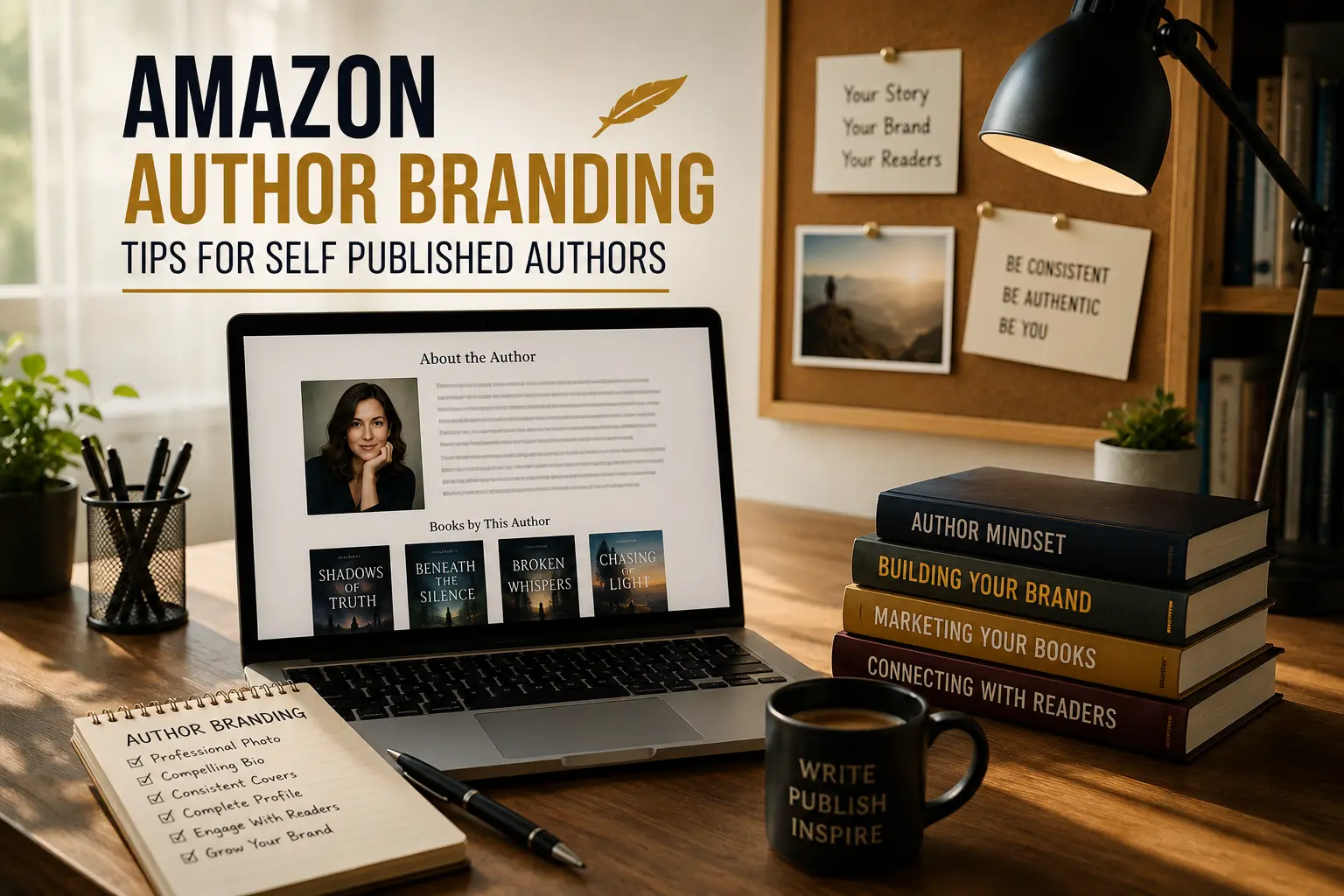
I remember the exact moment Amazon author branding actually clicked for me as a real thing I needed to care about. I’d just published my second book, went to check my Author Central page out of curiosity, and found a blurry photo from two years earlier, a bio mentioning only my first book, and basically zero connection between the two titles sitting right there on my shelf. It looked like two different people had accidentally been shoved onto one page. That was my wake up call.
Most self published authors pour everything into writing and editing, which, fair enough, that’s where the actual book lives. But then the Amazon presence gets treated like an afterthought, something you’ll “get to eventually.” I get why. You finish a manuscript and you’re running on fumes. Fussing over a bio or figuring out category rules feels like homework nobody assigned. Except your Amazon page is often the first real impression a reader gets of you, sometimes before they’ve even opened the sample chapter.
So let’s actually get into what works. Some of this I learned by doing it right the first time. Some of it I learned by messing it up first and fixing it later.
Why Your Author Page Deserves More Attention Than You’re Giving It
Think about how people actually browse on Amazon. They land on a book through search, a recommendation, or scrolling a category. Cover catches their eye, blurb holds their attention, and then a lot of readers click straight through to the author name. That click lands them on your Author Central page, and whatever’s there either builds confidence or quietly plants doubt.
A page that feels put together tells a reader you’re serious about this, that the book they just found isn’t some one off project you abandoned the second it went live. This is honestly the whole foundation of solid Amazon author branding.
Readers who like your book are way more likely to check your backlist too, but only if that backlist is easy to find and looks intentional. Everything else kind of depends on getting this piece right first.
I’ve talked to authors convinced that sales come purely down to covers and keywords, and sure, those matter a ton. But I’ve also watched two authors with equally strong books get noticeably different results, and the difference came down to one page feeling deliberate while the other looked forgotten. Readers notice that, even if they couldn’t tell you why.
Getting Your Author Central Profile Actually Right
Let’s get specific here, because “make your page good” isn’t advice anyone can use.
Start with the photo. Current, clear, decently lit. Doesn’t need to be some polished headshot with studio lighting, but it should look like an actual current photo of an actual person, not a stock image or something dug up from an event a decade ago. People connect with faces. A real photo builds trust in a way graphics just can’t replicate.
Your bio matters more than people give it credit for. Skip the resume style rundown of credentials. Write it like you’re talking to someone at a bookstore who just asked, so what do you write about anyway. Mention your genre, why you’re drawn to it, maybe one small personal detail that makes you stick in someone’s memory. If you write cozy mysteries because you grew up in a nosy small town where everybody knew everybody’s business, say that. It’s specific. It’s human. It sticks way better than “award winning author of thrilling page turners,” which honestly could describe anyone.
Make sure every book you’ve published actually links back to your profile. Sounds obvious, but I’ve seen authors with five titles out where only two show up under their name because of some tiny formatting mismatch in how their name appears across listings. Check this regularly, especially right after a new release goes live.
Add a blog feed if you’ve got one. Definitely link your social accounts and website too. Amazon lets you connect all of this directly, giving readers an easy path to keep following you past this one purchase.
Building Consistency Across Your Entire Catalog
Once the profile itself is solid, the next layer of Amazon author branding is making sure your books actually feel like they belong together.
If you write in one genre, your covers should read as part of the same family, even across separate series. Doesn’t mean identical covers, but there should be some visual thread, similar fonts, a consistent palette, something recognizable that readers start associating with you specifically. I switched cover designers between book one and book two years back and the shift was jarring enough that a reader actually messaged me asking if both books were really written by the same person. Not the reaction you’re going for.
Descriptions matter here too. If you’ve got a signature tone, dry humor, emotional weight, fast paced tension, whatever it is, let that voice show up consistently across how you describe each book. Readers start recognizing your descriptions the same way they recognize your prose, and that familiarity is what builds loyalty over time.
Series branding gets its own mention because it trips people up constantly. Make the numbering obvious. Keep the covers visually connected. Reference where each book sits in the larger story without spoiling anything. A confused reader who can’t tell which book comes first usually just gives up and wanders off to someone else’s series instead.
Using Your Backlist to Reinforce Your Brand
Here’s something a lot of authors just don’t think about. Every new release is a chance to strengthen the branding around your older books too, not only push the new one.
When a new book drops, go back and tweak your older descriptions to mention it, if it fits naturally. Cross promoting within your own catalog costs nothing and keeps readers moving between your titles instead of finishing one book and just leaving your shelf entirely.
Consider adding a short “also by this author” note in your back matter, with a direct link if your platform allows it. I started doing this a few books in and noticed a genuine bump in readers picking up earlier titles they’d otherwise never have stumbled onto. Small addition, surprisingly consistent payoff.
Also worth thinking through, how your genre positioning actually holds together. If you write across multiple genres, plenty of authors do, would readers of one genre naturally follow into the other, or would a different pen name make more sense for that second genre. Not a requirement by any means, just something worth deciding on purpose instead of by accident.
Small Details That Make a Bigger Difference Than You’d Expect
A handful of smaller things round out solid Amazon author branding, and they’re easy fixes once you actually notice them.
Keep your author name spelled identically everywhere, including middle initials, hyphens, whatever stylistic choices you’ve made. Amazon’s system can get genuinely confused by inconsistent formatting, sometimes splitting your books across what look like separate author profiles entirely.
Respond to reviews when it makes sense, through whatever channels are appropriate, and always with grace even when a review stings a little. Readers who see an author engaging thoughtfully tend to feel more invested in whatever that author puts out next.
Update your bio every so often too. A bio still calling your debut your “latest release” three books later just looks neglected, and neglected is pretty much the opposite of what good branding is supposed to say.
Don’t underestimate how much a complete profile does on its own. Fill out every field available. Website, blog, social links, all of it. A half empty profile reads as inactivity even when you’re actually grinding away on your next book behind the scenes.
Conclusion
Amazon author branding isn’t about flashy tricks or spending money you don’t have lying around. It’s mostly consistency, intention, and treating your author page with the same seriousness you treat the actual writing. A current photo. An honest, specific bio. Covers that visually connect. A catalog that clearly reads as the work of one deliberate person. All of this adds up more than most self published writers expect walking in.
I wish someone had told me this before book two. Instead I found out after, back when I finally noticed how disjointed my own page looked. Fixing it wasn’t complicated once I sat down and did it. I’ve kept the habit going with every release since. If there’s one thing to take from all this, it’s this: your author page deserves the same care you gave your manuscript. For a lot of readers, it’s the thing quietly deciding whether they come back for book two.