Book Writing
 Book Cover Design
 Book Editing
 Book Formatting
 Book Publishing
 Book Video Trailer
 Book Printing
 Audio Books
 Book Illustrations
 Author Website
 Amazon Page Optimization
 Book Marketing
 Fiction Writing
 Non-Fiction
 Autobiography
 Memoir
 Novel Writing
 Children's Book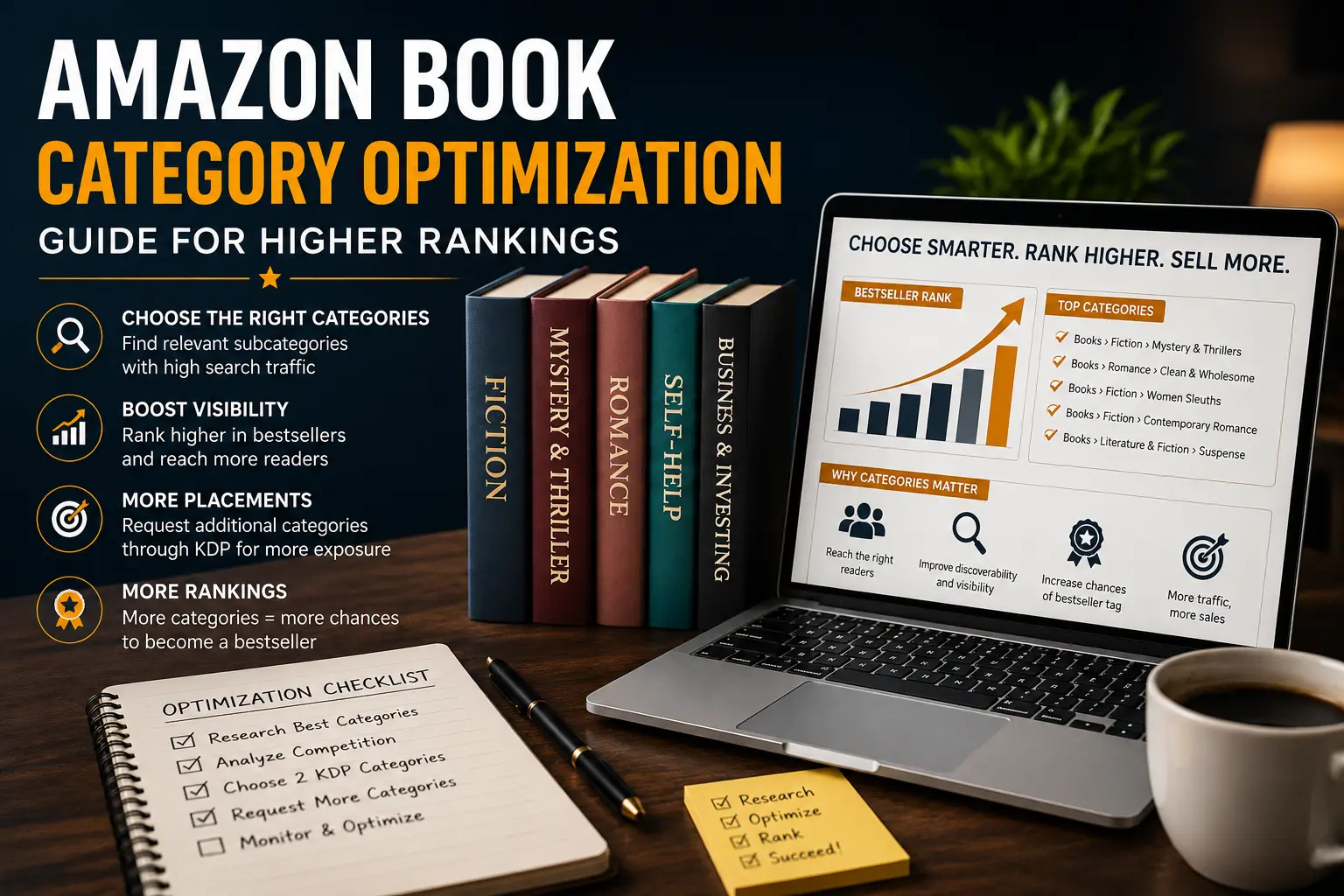
Every author dreams about hitting that orange bestseller banner on Amazon. But here’s the thing nobody tells you until you’ve already published a book or two. Amazon book category optimization often matters just as much as the writing itself, maybe more, when it comes to whether readers ever actually stumble onto your book. You can write something genuinely brilliant and it’ll still sit buried on page six of search results, simply because it landed in a category with fifty thousand competitors instead of five hundred.
I learned this the hard way with my own first book. Picked categories based on what sounded impressive, not on what actually made sense for people finding it. Kind of an embarrassing mistake, honestly, looking back at it now. So let me walk you through what I’ve picked up since then. Some of it from my own trial and error, some of it from swapping notes with other authors who stumbled through this same learning curve, usually the hard way too.
Why Category Selection Changes Everything
Most new authors treat category selection like an afterthought. Something you click through fast during the KDP upload without really giving it a second thought. That’s a shame, because the categories you pick directly shape how visible your book becomes, and how fast it can climb toward a bestseller badge, or whether it climbs at all.
Here’s what surprised me most once I actually started digging into this. Amazon lets you choose two categories during upload. But there’s a way to get listed in up to ten categories total, if you know how to ask KDP support for the extra ones after publishing. Most authors never even try. Which means they’re leaving free visibility just sitting there, untouched.
Quick tip: browse Amazon and check the bestseller rank of books similar to yours before choosing your own categories. A book ranked lower overall but sitting near number one in its subcategory usually signals lighter competition worth targeting.
The categories you pick decide your competition pool, plain and simple. Say you write cozy mysteries and you dump your book into the general “Mystery” category. Now you’re up against tens of thousands of titles, including the massive names that dominate the charts pretty much nonstop. But dig a little into subcategories, something like “Cozy Animal Mysteries,” and suddenly you might only be competing with a few hundred books instead of tens of thousands. Landing a bestseller tag in a smaller, well aimed subcategory? Genuinely doable. Landing one in a giant umbrella category? Basically impossible unless you’re already a known name with a following behind you.
And this, really, is the whole idea behind Amazon book category optimization. It’s not gaming the system, not dishonestly anyway. It’s putting your book where readers who actually want that specific kind of story are going to naturally run into it. Somewhere your book has an actual shot at standing out instead of drowning in noise.
How to Actually Find the Right Subcategories
Finding the right categories takes a bit of detective work. No shortcut around that part, unfortunately.
Start by just browsing Amazon yourself and pulling up books similar to yours. Click into their category listings, see exactly where they land. If a book close to yours in tone and genre is sitting at number three in some subcategory you’ve never even heard of before, that’s worth a closer look. Maybe worth targeting yourself.
Pay attention to the actual bestseller rank numbers too, not just the category label. A book ranked fifty thousand overall but sitting at number two in its subcategory? That tells you the subcategory probably isn’t packed with competition. A book ranked two thousand overall sitting at number one in its category tells a totally different story. One where that category is pulling real traffic, worth chasing.
I’d also point you toward a tool like Publisher Rocket. It pulls category data, shows rough search volume alongside competition levels for different keywords and categories. Not free, no, but if you’re serious about actually selling books rather than publishing and hoping for the best, it pays for itself pretty quick once you see the difference.
One thing I’d genuinely warn against, and I mean this, don’t pick a category just because it sounds fancy or impressive. I once watched an author shove their cozy romance novel into a business and finance subcategory because they’d read somewhere the competition was thinner there. Made zero sense to actual readers browsing that section. And, shocker, it did nothing at all for their sales.
Requesting Additional Categories Through KDP
Since Amazon only hands you two category slots during upload itself, getting into more means contacting KDP support directly, after your book’s already live. This step trips up so many authors, honestly, just because nobody bothers mentioning it’s even an option.
Once your book’s published, you can email or use the online contact form and ask for up to eight more categories. That gives you ten total placements. You’ll need the exact category path, and these get pretty granular the deeper you go. Something like Books, Literature and Fiction, Mystery Thriller and Suspense, Mystery, Women Sleuths. Not just some vague genre name tossed out.
This is, in my opinion, one of the most underused tricks in Amazon book category optimization. More categories, more shots at a bestseller badge, more chances your book surfaces for readers already browsing the exact subgenre they love. Costs nothing but a bit of digging and one email.
A Real World Example That Actually Worked
I know a fellow author who writes clean romance novels, nothing explicit, aimed at a pretty specific crowd of readers. She’d started out with her book sitting in just two broad categories, general Romance and general Contemporary Fiction. Sales were pretty flat those first couple months after launch, understandably frustrating for her.
After some digging, and honestly a little nudging from me, she asked for placement in extra subcategories like Clean and Wholesome Romance, plus a few other narrower spots that actually matched her writing and her readers far better. Within about three weeks she hit a bestseller tag in two of those smaller categories. That little orange banner alone brought a noticeable bump in organic clicks, since readers browsing trust that tag and click almost without thinking twice.
Her overall ranking didn’t shift hugely. But her visibility within the niche she actually writes for? Massive improvement. And that’s really the whole point here. You’re not trying to beat every single book on Amazon. You’re trying to become the obvious pick within the specific little pocket of readers already hunting for exactly what you write.
Common Mistakes That Hurt Category Rankings
I’ve watched authors trip over the same handful of mistakes again and again, so let me spare you the trouble.
Picking categories that don’t match your book’s actual content is probably the biggest one I see. Some authors figure stuffing their book into an unrelated, low competition category will trick the algorithm into ranking it higher. Might work for a quick bestseller tag, sure. But readers who click expecting one thing and get something totally different leave negative reviews fast, and that does way more damage long term than any temporary badge ever helped.
Ignoring keyword relevance between your categories and your book description is another one worth avoiding. Amazon’s algorithm looks at a bunch of signals together, not just whatever category box you checked. If your title, subtitle, description, and backend keywords all scream one genre while your category picks point somewhere else entirely, you’re just confusing both readers and the algorithm at the same time.
Set a reminder to review your book categories every few months. New titles enter your subcategory constantly, and rankings shift with ongoing sales momentum, so periodic check ins keep your book positioned well over time.
Never revisiting your categories after launch trips people up too, and honestly it’s an easy trap to fall into. Publishing a book is exhausting, most authors just want to move on afterward. But Amazon’s category landscape shifts all the time. New books show up in your subcategory constantly, others drop off or get delisted, rankings move around based on ongoing sales momentum. Checking back every few months, adjusting as needed, keeps your book positioned well instead of quietly sliding into irrelevance nobody notices until way too late.
Combining Categories With Other Ranking Factors
Category placement alone won’t carry a book to bestseller status if everything else around it is weak or ignored. Amazon book category optimization works best as one piece of a bigger puzzle, not some standalone fix for a book that’s struggling for other reasons.
Your description needs to actually sell the story, not just summarize the plot in some flat, boring way nobody wants to finish reading. The cover needs to look genuinely professional and match what readers expect from your genre, since people judge covers instantly whether we like it or not. And pricing needs to make sense next to comparable titles in your chosen categories.. And honest reviews, earned over time, help tell both readers and Amazon’s algorithm that your book actually delivers for the people buying it.
Think of category selection as the door readers walk through to find you at all. But once they’re through that door, everything else about your listing still has to hold up and actually get them to click buy.
Conclusion
Getting Amazon book category optimization right takes patience and a decent amount of digging, but it’s genuinely one of the highest leverage things an author can do without spending a cent on ads. Picking the right subcategories, requesting extra placements through KDP support, and checking back in as the market shifts around you, all of that can be the difference between a book that quietly vanishes and one that actually finds the readers who were always going to love it. Won’t fix a weak cover or a description that fails to sell the story, sure. But paired with the rest of your listing working the way it should, smart category choices can genuinely be the push that gets your book the visibility it deserves.