Book Writing
 Book Cover Design
 Book Editing
 Book Formatting
 Book Publishing
 Book Video Trailer
 Book Printing
 Audio Books
 Book Illustrations
 Author Website
 Amazon Page Optimization
 Book Marketing
 Fiction Writing
 Non-Fiction
 Autobiography
 Memoir
 Novel Writing
 Children's Book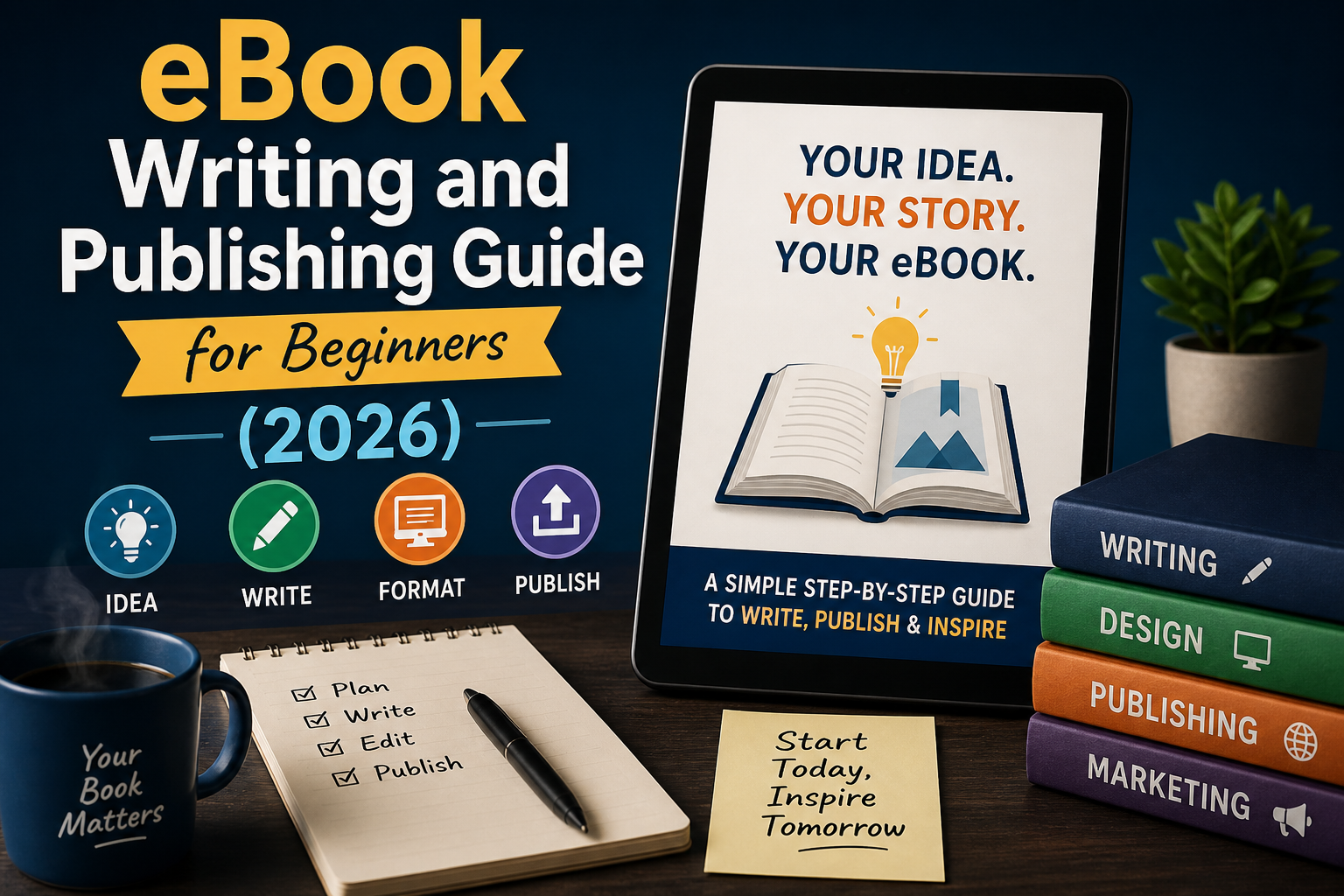
Most people don’t actually have a problem with ideas.
If you think about it, you probably already have one sitting in your head right now. Something you’ve learned, something you’ve experienced, or even just something you’ve been meaning to share.
The hard part is starting.
Not because it’s difficult but because it feels uncertain.
You start asking yourself things like…
What if this isn’t good enough?
What if no one reads it?
What if I just waste time?
And just like that, you delay it.
That’s how it usually goes.
But here’s the thing writing and publishing an eBook today isn’t nearly as complicated as it looks from the outside. It only feels that way because everything online makes it sound like a big process.
It doesn’t have to be.
This guide isn’t here to overwhelm you. It’s here to make the whole thing feel manageable something you can actually sit down and start.
Why eBooks Still Work (Even Now)
You might be wondering if eBooks are still worth the effort.
Fair question.
But if anything, they’ve become easier to work with over time not harder.
There’s no printing. No inventory. No shipping headaches. You create it once, upload it, and that’s basically your entry point into publishing.
And once it’s live, it’s live everywhere.
What makes it even better is the control you have. You can go back and update things. Fix parts you don’t like. Change the price. Improve it over time.
You’re not locked into a final version forever.
That flexibility matters more than people realize especially when you’re new and still figuring things out.
Choosing a Topic (Keep It Simple)
This is where people tend to get stuck for no real reason.
They either try to find a “perfect” idea… or they go so broad that the topic loses direction completely.
You don’t need either of those.
Just think in terms of one thing:
What can you help someone with?
That’s enough.
Not everything you know. Not your entire life experience. Just one clear, useful thing.
For example, instead of something general like:
“Fitness Guide”
You narrow it down:
“How to stay consistent with workouts when you’re busy”
Now it actually speaks to someone.
If you’re unsure, don’t overcomplicate it. Look at what people ask. Look at what already exists. And then think about where you can add something useful even if it’s simple.
That’s usually more than enough to get started.
Before Writing—Take a Few Minutes to Plan
You can jump straight into writing.
A lot of people do.
But usually, they hit a wall somewhere in the middle and don’t know how to continue.
That’s where a basic outline helps not a detailed one, just something rough.
Think of it like sketching before drawing properly.
Where does the reader begin?
What do they need first?
What comes after that?
Once you answer those, the rest becomes easier.
You’re not trying to figure everything out while writing you’re just following something you already mapped.
Writing Your eBook (Don’t Overdo It)
This is probably the part people overthink the most.
They try to sound like “writers.”
You don’t need to.
In fact, the more natural your writing feels, the easier it is to read.
If you imagine explaining your topic to someone in a normal conversation that’s the tone you want.
Not formal. Not overly polished. Just clear.
Some things that actually help:
- Write first, fix later
- Don’t stop to edit every sentence
- Let it be a little rough
There will be moments where it feels slow or unclear. That’s fine. That’s part of writing anything.
The goal isn’t to make it perfect on the first try—it’s to get it done.
Editing (This Is Where It Improves)
Once you’re done with the draft, then you worry about improving it.
And honestly, editing is where most of the real work happens.
You’ll notice things you didn’t see before awkward sentences, repeated ideas, parts that don’t flow well.
That’s normal.
Just go through it calmly:
Does this make sense?
Does this feel clear?
Is anything unnecessary?
Sometimes the best improvement is simply removing a few lines.
Also, if you can, leave it for a while before editing. Even a short break makes a difference. You come back with a clearer head.
Formatting and Design (Don’t Ignore This)
People don’t always talk about this part—but they definitely notice it.
If your eBook looks messy, it feels unprofessional. Even if the content is good.
So keep things clean:
- Consistent headings
- Enough spacing
- Easy to read on a screen
And then there’s the cover.
It might seem like a small detail—but it’s not. It’s the first thing people see. If it looks rushed, it gives the wrong impression instantly.
You don’t need anything fancy. Just something that looks put together.
Publishing on Kindle (It’s Easier Than It Sounds)
A lot of beginners assume this part will be complicated.
It’s actually one of the simplest steps.
You upload your file, fill in your book details, add your cover, and set your price.
That’s basically it.
Once it’s live, your book is available globally. No long waiting time. No approvals. No middle steps.
It’s surprisingly straightforward.
Pricing (You Can Adjust Later)
Pricing feels like a big decision in the beginning.
It really isn’t.
Just look at similar books and stay somewhere within that range. You don’t need to get it perfect.
You can always change it later.
Early on, it’s more important to get readers than to maximize earnings.
Marketing (Where Most People Fall Off)
This is the part many people underestimate.
Publishing your book doesn’t automatically bring readers.
If no one knows about it, nothing happens.
You don’t need complicated strategies, though.
Start simple:
Talk about your topic. Share useful ideas. Mention your book when it makes sense.
That’s enough to begin with.
Consistency matters more than anything here.
Doing It Yourself vs Getting Help
You can absolutely do everything on your own.
It just takes time.
If you’re short on time or want things done faster, you can get help with certain parts—editing, design, formatting.
There’s no single “right” approach.
It depends on what matters more to you at the moment—saving time or saving money.
Final Thoughts
Most people don’t fail at writing eBooks.
They just never start.
They keep waiting for the right moment, the perfect idea, or the confidence to do it properly.
That moment rarely comes.
Your first eBook won’t be perfect. It doesn’t need to be.
But once you finish it, everything changes. You understand the process. You stop overthinking. The next one becomes easier.
So instead of planning endlessly…
Start.