Book Writing
 Book Cover Design
 Book Editing
 Book Formatting
 Book Publishing
 Book Video Trailer
 Book Printing
 Audio Books
 Book Illustrations
 Author Website
 Amazon Page Optimization
 Book Marketing
 Fiction Writing
 Non-Fiction
 Autobiography
 Memoir
 Novel Writing
 Children's Book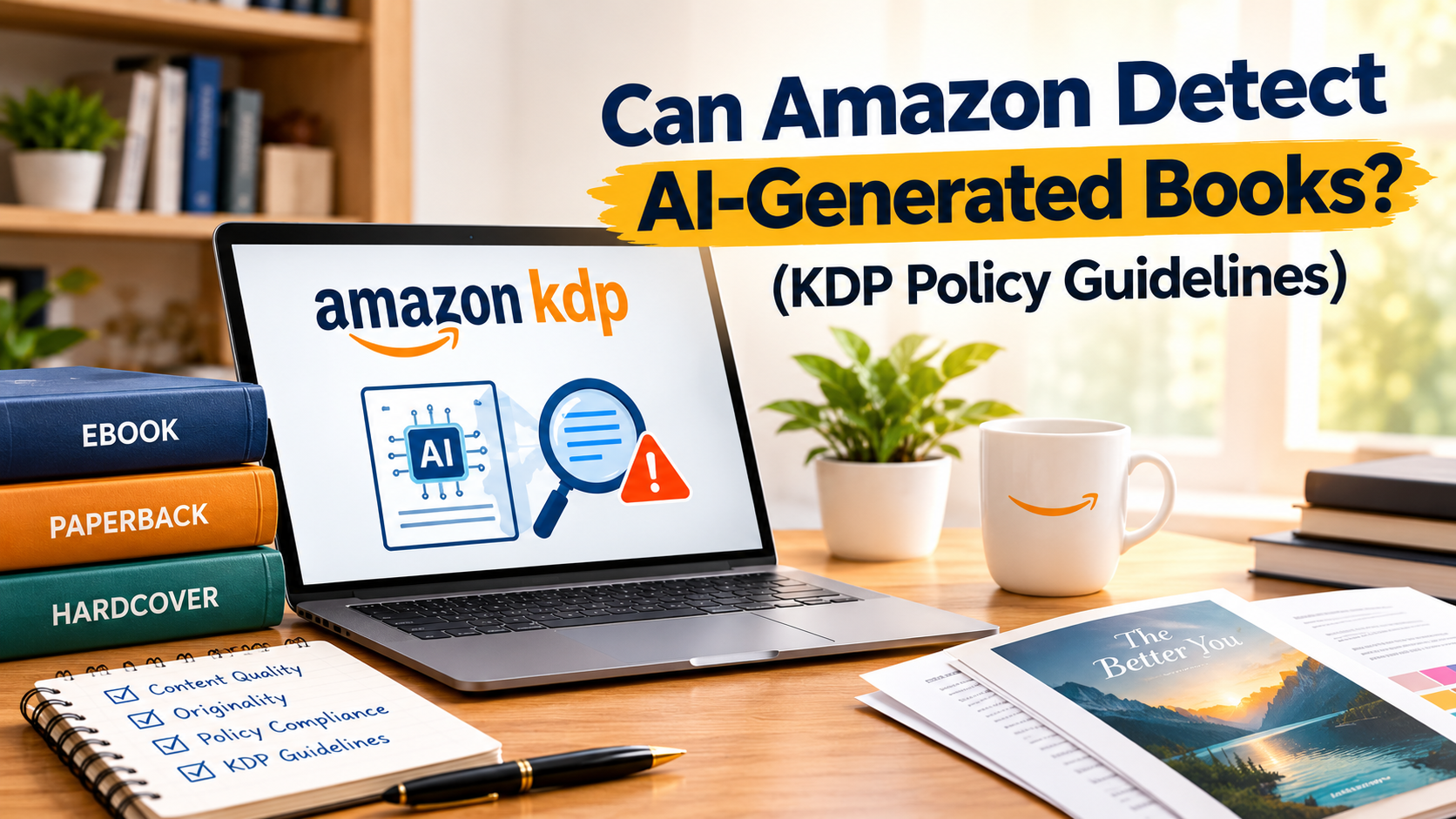
A friend of mine, a first-time author, asked me a question last month that I now hear almost every week: “If I use ChatGPT for my Kindle ebook, will Amazon know?”
Honest answer? Nobody outside Amazon can say for sure. But that’s the wrong question anyway. The better question is what the KDP policy guidelines require you to do, and what happens if you ignore them. That’s what this post covers.
So, can Amazon actually detect AI-generated books?
Here’s the part most blog posts skip. Amazon has never published how it screens books. There’s no official statement saying “we run detector X on every upload.” So anyone who tells you Amazon has a perfect AI detector, or that it has none at all, is guessing.
What we do know is more useful. Amazon asks you to declare AI use during the publishing process. It reviews books for quality and content problems. It also limits how many titles one account can upload in a day, which is a clear sign it’s trying to slow down mass-produced content. And reports from publishers suggest that older titles have been looked at again too, not only new uploads.
Even if you assume detection is imperfect, betting your whole KDP account on that assumption is a bad trade. AI detectors in general are known to make mistakes, flagging human writing and missing AI text. Amazon’s approach leans on rules and reviews rather than a single magic tool. And rules are something you can follow.
What the KDP policy guidelines say about AI
Let’s keep this simple. Under the current KDP policy, Amazon does not ban AI-generated books. It requires transparency.
When you publish a new book, or edit an existing one, KDP asks whether your content contains AI-generated text, images or translations. You answer honestly inside the publishing flow. That’s the core of the KDP AI policy, and as of 2026 it’s still the same basic rule that appeared when Amazon first added these questions in late 2023.
Two things worth knowing right away:
- The disclosure is for Amazon’s records. Readers don’t see an “AI-generated” label on your product page.
- Answering the question doesn’t replace your responsibility for quality, accuracy or copyright. That part stays with you.
AI-generated vs AI-assisted: the line that confuses everyone
This is where most authors get tripped up, so let me slow down.
AI-generated means an AI tool created the text, images or translations that appear in your book. And here’s the catch: it counts even if you edited the output afterwards. If ChatGPT wrote your first draft and you rewrote half of it, Amazon still treats it as AI-generated.
AI-assisted means you created the content yourself and used AI to help polish it. Think grammar checks, brainstorming ideas, tightening a sentence, catching typos. Under the current KDP policy guidelines, you don’t need to disclose that.
A few quick examples:
- An AI tool writes chapters you keep in the book: disclose.
- An AI tool makes your cover or interior illustrations: disclose.
- An AI tool translates your manuscript for a foreign edition: disclose.
- You write everything and use AI to proofread: no disclosure needed.
- You brainstorm chapter ideas with AI but write the text yourself: no disclosure needed.
The line isn’t about how much you edited. It’s about who created the content in the first place. When you honestly aren’t sure which side you’re on, disclose. It’s a private checkbox, and it costs you nothing.
What about ghostwriters and ebook writing services?
This one matters if you hire help. Plenty of authors use an ebook ghostwriter or a professional ebook writing service, and that’s completely fine. Hiring a human writer isn’t the same thing as using AI.
But the rule follows the content, not the label on the service. If the material was produced by an AI tool from scratch, whether you or a freelancer ran the tool, it’s AI-generated and should be disclosed. If a real writer drafted it from your ideas and outline, that’s a human-written book.
So if you’re paying for custom ebook writing, ask directly how the manuscript is produced. A reputable team, like the professional ebook writers you’ll find at services such as The Author Central, should be able to tell you clearly. If the answer is vague, that’s a red flag, because the disclosure question on KDP is yours to answer, and you’ll be the one accountable for it.
What happens if you don’t disclose?
Let’s be direct about the risk. Skipping the disclosure when it applies breaks KDP’s terms. Depending on the situation, that can mean a book being blocked or removed, and repeated violations can put your whole account at risk. Enforcement has reportedly tightened through 2025 and 2026.
Now think about what you’re protecting. A Kindle ebook takes weeks or months to write. Your reviews, your Amazon Author Central profile, your royalties and your backlist all live inside one account. Risking that to avoid ticking a private box makes no sense.
Detection isn’t the only risk. Quality is.
Here’s something I wish more people said out loud. Even a perfectly disclosed AI book can fail. Not because of policy, but because readers can tell.
AI-written text has habits. It repeats structures from chapter to chapter. It sounds confident even when it’s wrong. It uses the same soft, generic phrasing again and again. In nonfiction, especially health, money, law and history, one made-up “fact” can hurt a reader and your reputation with it.
Amazon’s content quality standards apply to every book equally. A repetitive, unedited manuscript can get flagged or collect bad reviews whether or not you ticked the AI box. So the real safety net isn’t dodging detection. It’s making a book that’s actually good.
A safe workflow if you use AI in your book
You don’t have to avoid AI entirely. Plenty of authors use it sensibly. Here’s an approach that keeps you on the right side of the KDP policy:
Decide your role first. Before you start, be clear about what AI will do. Brainstorming and proofreading is one thing. Drafting whole chapters is another. Your role decides your disclosure answer.
Keep records. Save your outlines, drafts and notes. If you’re ever asked about your process, having a paper trail helps.
Fact-check everything. Every date, statistic, quote and claim. AI is famous for inventing sources that sound real.
Rewrite in your own voice. Not because it hides anything, but because your voice is what makes readers come back for your next book.
Get a human editor. A real person reading your manuscript catches the flat, repetitive patterns that software misses. Professional book editing services exist for exactly this.
Check formatting and metadata. Clean Kindle formatting, an honest description and accurate categories all count as quality signals. If your file has spacing errors or a broken table of contents, that hurts you more than any detector would.
Publishing on Kindle Direct Publishing: a quick pre-upload checklist
Before you hit publish on Kindle Direct Publishing, run through this:
- Have I answered the AI question honestly for text, images and translations?
- Did I check the current KDP content guidelines this week, not last year?
- Is every fact in the book verified?
- Are my cover and illustrations original or properly licensed?
- Has a human read and edited the whole manuscript?
- Does the book look clean in Kindle Previewer?
- Does my description promise only what the book delivers?
And please don’t rely on a blog post, including this one, as your final source. Amazon’s KDP Help Center is the official reference, and policy wording can change. Bookmark it and check back every few months.
Final thoughts
So, can Amazon detect AI-generated books? Maybe, maybe not, and Amazon isn’t telling. But you don’t need to solve that puzzle. If you follow the KDP policy, disclose honestly, and put real human effort into the editing, you’re protecting the thing that matters most: your account and your reputation as an author.
AI can be a useful tool. It just can’t carry the whole book for you. Be honest with Amazon, be even more honest with yourself about what you wrote, and give your readers a book that feels like a person made it. That’s the safest strategy today, and it’ll still be the safest one next year.