Book Writing
 Book Cover Design
 Book Editing
 Book Formatting
 Book Publishing
 Book Video Trailer
 Book Printing
 Audio Books
 Book Illustrations
 Author Website
 Amazon Page Optimization
 Book Marketing
 Fiction Writing
 Non-Fiction
 Autobiography
 Memoir
 Novel Writing
 Children's Book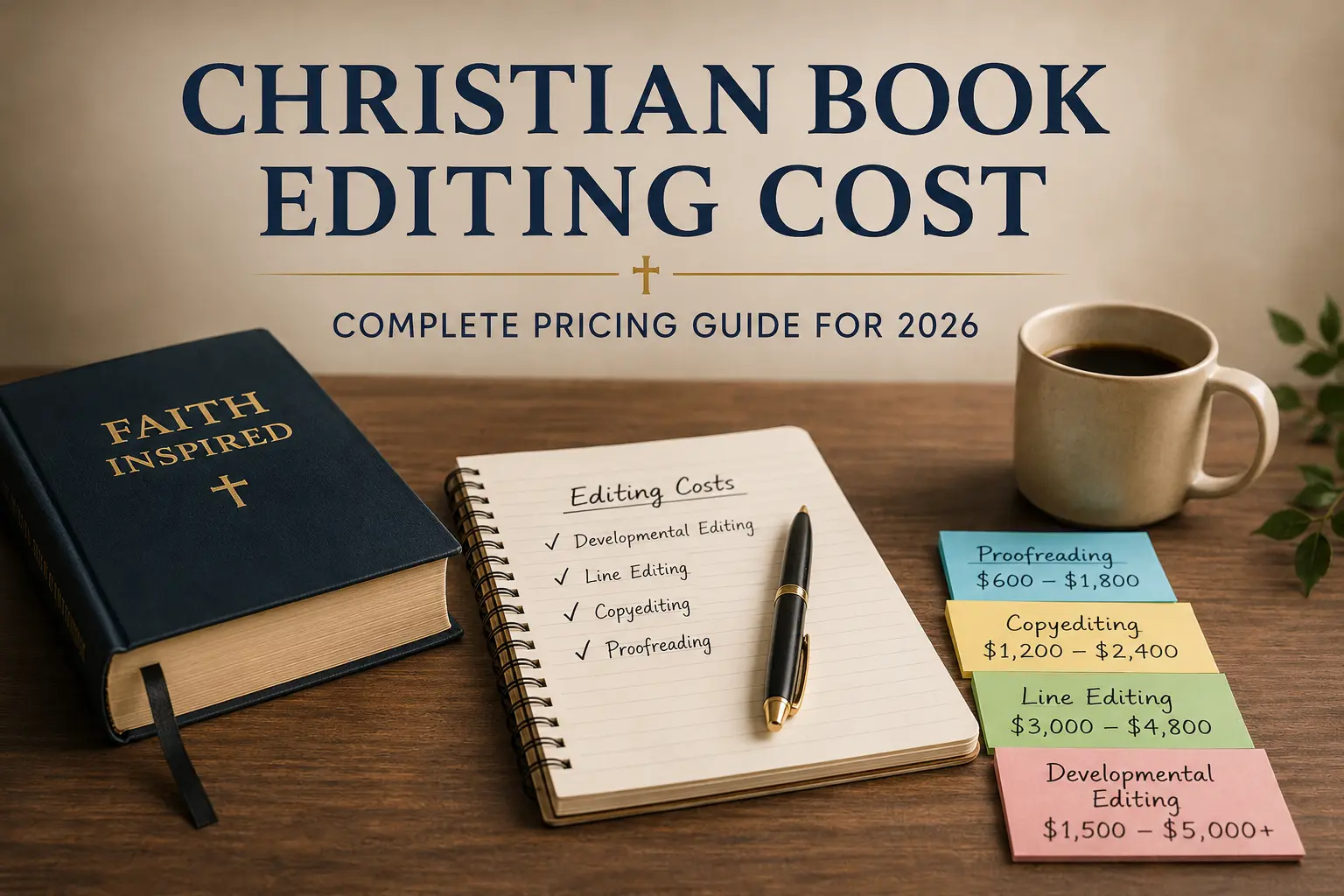
You’ve written a Christian book. Good for you, seriously, that’s not nothing. Maybe it’s a devotional, maybe a memoir about your faith journey, maybe a novel with biblical themes woven through it. Now you’re staring at the word “editing” and wondering what this is actually going to cost you. And if you’ve been digging around trying to figure out christian book editing cost, you’ve probably already noticed the numbers make no sense. They’re all over the map. That’s not some random accident, and by the time you finish reading this, you’ll understand why.
I’ve talked to a lot of authors in Christian publishing circles over the years, enough to know this confusion is real, not something people are imagining. One editor quotes you five hundred bucks. Another quotes five thousand for what’s supposedly the same job. Both call it “developmental editing.” Something doesn’t add up there, right? Let’s pull it apart.
Why Christian Book Editing Cost Varies So Much
Here’s the thing most first time authors don’t realize going in. Editing isn’t one service. It’s actually several different things, all crammed under that same single word, and that’s where most of the pricing confusion begins.
A developmental edit looks at the big picture. Structure, pacing, whether your theology actually holds together, whether your message lands the way you meant it to. A line edit is more about sentence level flow, rhythm, your voice on the page. Copyediting hunts down grammar mistakes, punctuation slips, consistency issues, the small stuff that adds up. Proofreading is the very last pass before publishing, just catching typos and little errors that snuck through everything before it.
Each of these takes different time, different skill, and that obviously affects what you pay. So if someone tells you “I’ll edit your whole book for three hundred dollars” without even asking which type of edit you need, honestly, that’s a bit of a red flag. Either they’re new at this, or they’re planning to give your manuscript a pretty light once over.
There’s also a faith specific side to all this, and it matters more than people expect. Christian books deal with scripture references, denominational nuances, theological accuracy, things a general market editor might just miss entirely or get wrong without realizing it. An editor who specializes in Christian nonfiction or fiction knows how to handle a Romans citation properly. They understand the difference between how a Baptist author might frame something versus a Catholic author. And they won’t accidentally sand your voice down into something flat and generic.
Typical Price Ranges You’ll Run Into
Let’s talk actual numbers. Vague ranges don’t help anyone actually budget.
Proofreading tends to run somewhere between one and three cents per word. For a standard sixty thousand word manuscript, that’s roughly six hundred to eighteen hundred dollars. Copyediting sits a bit higher, usually two to four cents per word, so that same manuscript lands somewhere around twelve hundred to twenty four hundred dollars. Line editing climbs further still, sometimes five to eight cents a word, since it demands more attention and often some actual rewriting.
Developmental editing is where things get expensive. And honestly, once you think about it, that makes sense. It’s the deepest, most time consuming work there is, often billed hourly or as a flat project fee, and quotes anywhere from fifteen hundred to five thousand dollars or more aren’t unusual for a full manuscript. Depends a lot on how much restructuring your book actually needs.
I remember talking to an author, she’d self published a Christian parenting book, who originally budgeted eight hundred dollars total for editing. Just eight hundred, thinking that would cover the whole thing. Once she understood the difference between a developmental edit and a plain proofread, she realized she needed both, and her real budget ended up closer to twenty two hundred. Stung a little, sure. But the finished book was so much stronger for it, she said it herself later.
What Actually Affects the Price Beyond Word Count
Word count matters, obviously. But it’s far from the only thing driving christian book editing cost up or down, not even close.
The condition of your manuscript plays a bigger role than most first timers expect. If your draft is already fairly clean, an editor moves through it quicker, and charges you accordingly. If it needs heavy restructuring, the price climbs, sometimes by a lot. That’s actually why a lot of editors ask for a sample chapter before quoting anything final. They need to see what they’re actually walking into.
Genre and complexity matter too, more than you’d think at first. A straightforward devotional with short daily readings is usually cheaper to edit than, say, a sprawling biblical fiction novel juggling multiple timelines, several point of view characters, and dozens of scripture references that all need checking for accuracy.
And then there’s the editor’s own experience and reputation, which shifts pricing quite a bit. Someone just starting out in freelance editing might charge less simply because they’re still building a portfolio, still trying to prove themselves. A seasoned editor who’s worked with well known Christian publishers, or written their own bestselling devotional, will typically charge more. Honestly, that premium often reflects real value. They catch things a less experienced editor would just walk right past without noticing.
Freelancers Versus Editing Companies
This one affects your wallet quite a bit, so it’s worth breaking down.
Freelance editors generally cost less since there’s no company overhead built into their rates. You’re paying directly for their time and their skill, nothing more layered on top. The tradeoff is that quality varies a lot from one freelancer to the next, so vetting really matters here. Ask for references. Ask for a sample edit. Don’t feel awkward asking to see previous Christian titles they’ve actually worked on, any decent editor expects that question.
Editing companies and agencies tend to charge more, sometimes noticeably more, but you’re often paying for structure and a bit of peace of mind. Multiple editors might look at your manuscript along the way, there’s usually a project manager keeping things on schedule, and a lot of these companies market themselves specifically to Christian and faith based authors, so theological sensitivity is somewhat baked into the process already.
Neither route is objectively better, not really. It comes down to your budget, your timeline, and how much hand holding you actually want along the way.
How to Budget Realistically for Your Book
If you’re trying to pin down a realistic christian book editing cost for your own project, start by being honest with yourself about what stage your manuscript is actually in.
A first draft nobody’s looked at yet almost certainly needs developmental editing before anything else. Jumping straight to a proofread on a rough first draft is kind of like painting a house before the framing’s even done. All that work gets wasted once the structural changes come later anyway, and they usually do come later.
Get quotes from at least three editors before committing to anyone, don’t just go with the first name that pops up. Ask each one exactly what’s included, how many rounds of revision come with that price, and what their turnaround actually looks like in practice. Some editors bundle a copyedit and proofread together at a discount, which can genuinely save you money compared to hiring separately for each stage.
Also, leave yourself a little buffer in the budget if you can manage it. Authors underestimate how much editing their manuscript needs all the time, until an editor actually gets in there and starts digging. Having some flexibility saves you from scrambling for extra funds halfway through the process, which is a stressful spot to be in.
Questions Worth Asking Before You Hire Anyone
Before you sign on with an editor, there’s a short list of questions that can save you a real headache later.
Ask whether they have actual experience with Christian or faith based manuscripts specifically, not just general fiction or nonfiction. It’s also worth checking how they handle scripture citations and whether they’re familiar with different translation preferences, since that trips people up more than you’d guess. A sample edit of a few pages goes a long way too, letting you see their style before you commit any money. And ask directly what happens if you’re unhappy with the final result, because a good editor should already have some kind of revision policy built in, not one they make up on the spot.
Final Thoughts
Understanding christian book editing cost really comes down to one thing. You’re not paying for a single service, you’re paying for a mix of expertise, time, and attention tailored to your specific manuscript’s needs. Prices swing so widely because manuscripts, editors, and project scopes genuinely differ from one book to the next, sometimes wildly so.
The best approach, honestly, is getting clear on what your manuscript actually needs, gathering a handful of quotes, and picking an editor whose experience with Christian content gives you real confidence they’ll treat your message with the care it deserves. Spend wisely here. A well edited book carries your voice and your faith message so much further than a rushed one ever could, and that’s worth paying for.