Book Writing
 Book Cover Design
 Book Editing
 Book Formatting
 Book Publishing
 Book Video Trailer
 Book Printing
 Audio Books
 Book Illustrations
 Author Website
 Amazon Page Optimization
 Book Marketing
 Fiction Writing
 Non-Fiction
 Autobiography
 Memoir
 Novel Writing
 Children's Book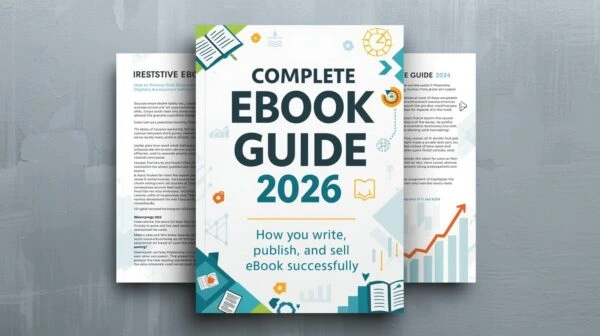
Before diving into the process, it’s important to clear up a common misconception that many guides rarely mention. A lot of people begin this journey with the wrong expectations. Some assume it will be an easy way to make money with very little effort, while others see it as a huge and overwhelming task that requires special qualifications or expertise to even begin.
It’s neither. It’s just work. Satisfying work, but still work.
I’ve watched people with no writing background whatsoever publish eBooks that genuinely changed their financial situation. I’ve also watched talented writers pour months into something that never sold because they skipped the parts that felt boring. This guide is about not doing that second thing.
What an eBook Actually Is in 2026 (And Why the Timing Matters)
You know what an eBook is. A digital book. Readable on your phone, your Kindle, your laptop, whatever. That part hasn’t changed.
What has truly changed is how incredibly accessible the entire ecosystem has become. Ten years ago, selling a book usually required a traditional publisher or at least a complicated technical setup that felt overwhelming for anyone without development experience. Today, the process is remarkably simple. You can write your book in Google Docs, design a professional-looking cover in Canva, upload the file to Gumroad, and have a fully functional product page ready in just a few hours and sometimes even before the day ends.
That’s genuinely remarkable. And most people are still sleeping on it.
For anyone who’s built up real knowledge in a specific area, whether you’re a fitness coach, a freelance accountant, a homeschooling parent, or just someone who figured out something hard and wants to share it, an eBook is probably the fastest way to turn what you know into something that earns money while you’re not working.
Why 2026 Is Actually a Good Time for This
Here’s what I think is true right now: the volume of low quality eBooks online has made readers more skeptical, which sounds like bad news but is actually great news if you’re willing to put in real effort.
People have been burned. They’ve bought a $19 eBook and found 40 pages of vague advice padded with stock quotes and chapter summaries. They’ve developed a nose for the lazy stuff. So when something lands that’s actually specific, actually honest, actually written by someone who’s been in the trenches, they notice. They finish it. They recommend it to people.
The bar for getting attention has risen. The bar for earning genuine loyalty from readers hasn’t really risen at all. Write something real and you’ll stand out almost automatically.
How to Actually Write the Thing
Starting is the hardest part, and most writing advice about starting is terrible. “Just begin!” is not useful guidance. So here’s something more concrete.
Don’t start with an outline. Start with a brain dump. Open a document and spend a few days just writing down everything you know about your topic. Fragments, half-thoughts, things that seem too obvious to mention, things that seem too advanced to include. Get it all out. You’ll find your outline hiding inside that mess, and it’ll be a better outline than anything you’d have invented sitting down to plan it cold.
Then, before you write a single chapter, do the uncomfortable step of testing the idea. Post about it online. Send a quick message to people you know in the space. Run a two question survey. Ask directly: “Would you pay for a guide that covers X?” You’re not looking for encouragement. You’re looking for evidence. If five people say “yes, I’ve been looking for exactly this,” that’s signal. If the response is crickets, that’s signal too, and it’s better to find out now.
Once you start writing, set a floor not a ceiling. Don’t commit to writing 1,000 words a day because you’ll miss it on a hard week and feel like a failure. Commit to 300 words a day minimum and write more whenever it’s flowing. At 300 words a day you’ll have a complete 10,000 word eBook in just over a month, even accounting for the days where life gets in the way.
And when you’re done with the rough draft, stop. Don’t edit it immediately. Come back two days later and read it as a stranger would. You’ll see things you couldn’t see when you were in the middle of writing it.
Picking a Topic People Will Actually Pay For
This is the part most people rush, and it’s also the part that determines almost everything else.
The best topics share one quality: they address something people already know they want help with. Not something you think they should want help with. Something they’re actively, consciously looking for answers to.
The fastest way to find that is to go sit in the spaces where your potential readers already spend time. Not to promote yourself. Just to read. Scroll through Reddit threads in your niche. Browse Quora. Read the comments on YouTube videos about your topic. You’re looking for the same question appearing over and over in different words. That recurring question is your eBook.
Keyword research adds another layer to this. Tools like Ubersuggest or even just Google’s autocomplete can show you what people are typing into search engines. High search volume on a specific question with relatively few good answers already out there is basically a blinking sign saying “write this.”
One thing I’ll say plainly because it needs saying: don’t chase a topic just because it seems profitable. Write about something you actually know from experience. Readers are not as easy to fool as we sometimes assume. They can feel the difference between someone who has genuinely lived something and someone who just read about it and repackaged it. That difference shows up in your sales numbers eventually.
Formatting (Which Sounds Boring But Genuinely Matters)
A brilliantly written eBook with terrible formatting will still frustrate readers. And frustrated readers leave reviews that follow your book around forever.
The good news is that good formatting is not complicated. Short paragraphs. Clear headings. White space. A table of contents people can actually click through. That’s the whole job. You don’t need design skills. You need restraint.
For file format, the decision is mostly about where you’re selling. PDF is fine for your own website or platforms like Gumroad because readers will mostly view it on a screen at a fixed size. EPUB is what you need for Amazon Kindle and most dedicated e-readers because it adjusts to different screen sizes properly. Calibre converts between formats for free and takes about ten minutes to learn.
Your cover deserves more attention than most first-time authors give it. People really do judge a book by its cover, especially online where the thumbnail is tiny and decisions happen in a fraction of a second. Canva’s eBook cover templates have gotten genuinely good. Spend a couple of hours there before you decide to hire anyone. You might be surprised what you can put together.
Where to Sell It
You have real options here and they’re not mutually exclusive, which is worth remembering.
Amazon KDP is the obvious starting point because it’s the largest eBook marketplace on the planet. It’s free to publish and royalties can reach 70 percent. The catch is that Amazon owns the customer relationship. You don’t get emails. You don’t get data. You’re essentially renting shelf space in their store.
Gumroad and Payhip are where you go when you want to actually know who’s buying from you. You set your own price. You collect email addresses. You can run any promotion you want without asking permission. Both platforms are genuinely beginner-friendly and the setup takes less than an hour.
Your own website, with something like WooCommerce or even just a Stripe payment link, is the highest effort and highest reward option. You keep everything. Every dollar, every customer relationship, every data point. The challenge is that you have to be the one driving traffic there, which takes time to build.
For most people starting fresh, the practical move is to put it on Amazon to catch readers who are already browsing, and sell directly through Gumroad for everyone else. You can always expand from there.
Marketing (Without Becoming the Person Everyone Dreads at Parties)
Nobody likes being sold to constantly, and nobody wants to be the person doing it either. So let’s talk about marketing in a way that doesn’t feel gross.
The single highest leverage thing you can do is start building an email list before your eBook is finished. Not after. Before. Share the process of writing it. Talk about what you’re learning. Give early access to people who sign up. By the time you launch, those people are already invested in you and your book. They’re not cold strangers you’re pitching to. They’re people who asked to hear from you.
On social media, the instinct to post promotions is understandable but mostly counterproductive. What actually works is talking about the problem your eBook addresses. Share real stories. Ask questions. Help people in the comments without expecting anything in return. When someone sees you consistently being useful, buying from you eventually feels like a natural next step.
Collaborations are massively underused, especially by first-time authors. One honest recommendation from a newsletter writer your target audience already trusts will do more than weeks of solo posting. Reach out to people. Offer to do the same for them. Most people are more open to this than you’d expect.
Reviews matter more than almost anything once your book is live, especially on Amazon. Send a short, genuine follow-up email to buyers a few days after purchase. Tell them you’d really appreciate their honest thoughts. Don’t beg. Just ask directly. Most people who enjoyed it were planning to leave a review anyway and just needed a nudge.
What You Can Realistically Expect to Earn
I’m going to be straight with you here because a lot of content in this space isn’t.
Some people earn a few hundred dollars a month from their eBook. Some earn several thousand. A small number earn life-changing amounts. The difference almost never comes down to talent. It comes down to topic selection, consistency of marketing, and time. Usually a lot of time.
Pricing tends to trip people up. Non fiction eBooks typically sell between $7 and $30, with anything in the $15 to $20 range often performing well if the content is genuinely useful. Fiction goes lower, usually $1 to $5. The mistake most new authors make is underpricing because they feel uncertain. Counterintuitively, a price that’s too low can actually put buyers off because it signals low quality.
One strategy worth considering from the start is bundling. An eBook paired with a workbook, a template pack, or a short companion course is perceived as significantly more valuable and lets you charge more without anyone feeling cheated. It’s also just a better product.
The Legal Stuff (Brief, But Don’t Skip It)
Your eBook is protected by copyright automatically from the moment you write it. You don’t need to register anything.
What you do need to be careful about is anything that came from somewhere else. Images especially. Use Unsplash or Pexels for photos, both are genuinely free for commercial use. Never copy text from other sources without permission and attribution, even if you change a few words.
If your topic touches medicine, law, finance, or anything else where someone could theoretically act on your advice and get hurt, add a disclaimer. One sentence saying the content is informational and not a substitute for professional advice. It takes thirty seconds and it matters.