Book Writing
 Book Cover Design
 Book Editing
 Book Formatting
 Book Publishing
 Book Video Trailer
 Book Printing
 Audio Books
 Book Illustrations
 Author Website
 Amazon Page Optimization
 Book Marketing
 Fiction Writing
 Non-Fiction
 Autobiography
 Memoir
 Novel Writing
 Children's Book
![How Much Money Do You REALLY Need to Publish a Book in 2026? [Cost Breakdown]](https://theauthorcentral.com/blog/wp-content/uploads/2026/10/2026-Book-Publishing-Cost-Breakdown.png)
Every few weeks somebody asks me the same thing, usually in a slightly nervous voice: “Okay, but how much is this actually going to cost me?” And I always want to say “it depends,” because it does. But that answer is useless when you’re trying to decide whether to book an editor or just hit publish and hope.
So I’ll do it differently. I’ll tell you about Dana.
Dana isn’t a real person. She’s a composite of a few authors I’ve come across, with the numbers nudged so nobody’s identifiable. She’d finished a 65,000-word memoir about growing up in her family’s bakery, and she wanted it out on Amazon, paperback and ebook, by spring. Her budget, as she put it, was “a couple thousand? Maybe?”
Here’s where it went.
She spent about $1,500 on editing. Mostly a copyedit, around $1,100, and then a $400 proofread at the end. She skipped the developmental edit, and honestly I’d have pushed back on that, but it was her money. Her editor did a two-page sample first, which is such a good habit that I wish more people asked for it.
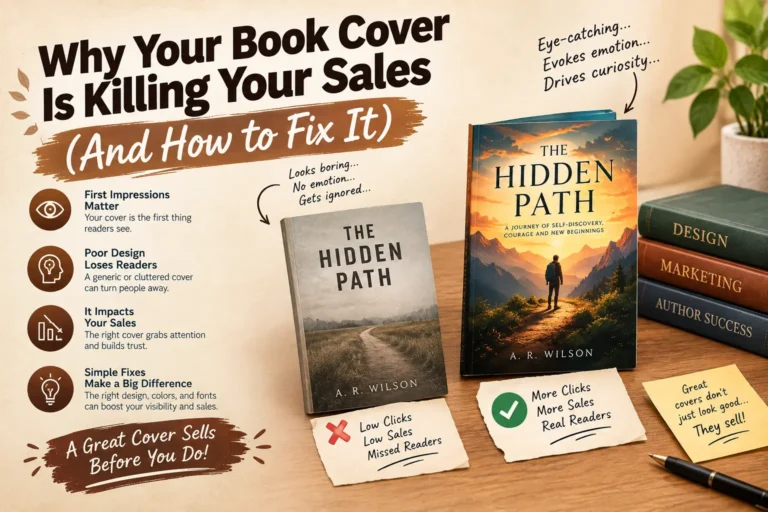
The cover cost $600. She’d been eyeing a $40 cover from a marketplace, and then she lined it up next to ten bestselling memoirs and went quiet. You could see the difference from across the room. So she hired a designer who does memoir covers for a living, and got a full wrap, front, spine and back.
Formatting was $300 for both the ebook and print files. Her own ISBN was another $125. (Amazon gives you a free one, but then Amazon is the publisher of record, and she didn’t love that. In the US a single ISBN has cost about that much, though you should check the current price.) A proof copy and a box of author books for the launch party came to $170. And she put roughly $400 into marketing, a simple author site, review copies for a handful of readers, and some small ads she paused after two weeks.
Total: around $3,100. Nothing ambushed her, which sounds minor and isn’t.
Is That Normal?
More or less, yes. If you read the cost guides floating around this year, most of them put a professionally produced self-published book somewhere between two and six thousand dollars, give or take. Some guides say less. Some say a lot more. They flatly disagree with each other, which tells you something about how much of this is guesswork, so I’d be suspicious of anyone quoting a single precise number.
The real range is wider than that. You could publish a ebook for a few hundred dollars if you did nearly everything yourself. You could also spend ten thousand without trying, once you add an audiobook, a hardcover and a paid publicity push.
Where Dana Could’ve Saved
She didn’t have to do it all. A shoestring version of her book might be: edit it yourself as hard as you can, pay for one proofread, buy a premade cover, format with free software, use KDP’s free ISBN, spend nothing on marketing. That can come in under a thousand. Sometimes well under.
And it works, people do it. I just don’t think it’s free, exactly. The costs move somewhere else. A manuscript nobody else has read has holes you can’t see, because you’ve read it forty times and your brain auto-corrects. A premade cover that almost fits your genre can quietly sink sales, and you’ll never get an invoice telling you so.
Where She Could’ve Spent More
The other direction is just as real. Same memoir, but with a developmental edit (these can run from the high hundreds into the thousands), an audiobook, a hardcover edition and a publicist, and you’re at eight or ten thousand before anyone flinches.
Is that foolish? Not necessarily. It depends what the book is for. If it’s a family legacy project, sales might not matter at all. If it’s the front door to your consulting business, a bigger budget might be smart. The mistake is drifting into it by accident.
Why Editing Takes The Biggest Bite
In nearly every cost guide I’ve read, editing and cover design together eat most of the budget, and editing is usually the bigger of the two.
It comes in layers. Developmental editing deals with structure and pacing, the “does this book actually work” questions. Line editing and copyediting fix sentences, grammar and consistency. Proofreading is the last sweep for typos. Editors mostly charge per word or per hour, so your 80,000-word monster costs more than somebody’s 25,000-word ebook. Obvious, but people forget.
My honest opinion, and you can disagree: if you can only afford one professional, hire the editor. Readers will forgive a plain cover faster than a messy first chapter.
The Cover And The Thumbnail
A cover has a weird job. It has to look great large, but most of the time it’s the size of a postage stamp in a search result. Premade designs can cost under a couple hundred dollars. Custom work from an experienced designer tends to run from several hundred to a little over a thousand, and illustrated covers climb from there.
One thing trips up almost everyone the first time. A paperback needs a full wrap, not just a front image, built to exact measurements from KDP’s cover calculator. Get the dimensions wrong and Amazon bounces the file. We’ve written about how to fix that in our guide on KDP cover bleed errors, which is worth a read before you pay for anything.
Formatting, Which You Only Notice When It’s Bad
Nobody praises good book formatting. They just don’t notice it. But open a badly formatted ebook on your phone, with text jumping around, chapter titles in random fonts and a table of contents that goes nowhere, and you’ll feel it immediately.
The cheap route is software. Kindle Create is free, and tools like Atticus and Vellum are one-time purchases. A professional formatter usually costs a couple hundred to a few hundred dollars for a standard book. Children’s books and image-heavy layouts cost more, because every page becomes its own design problem.
What Amazon Charges (Hint: Nothing Upfront)
People find this hard to believe, so I’ll say it plainly. KDP doesn’t charge to publish your book.
You pay for printing, and Amazon takes it out of each sale. The print cost depends on page count, trim size and whether the inside is black-and-white or color. Color gets pricey quickly, which is why a full-color picture book can leave you with a thin royalty per copy. Open the royalty calculator early, try a few prices, and do it before you fall in love with a page count.
Traditional And Hybrid, Without The Sales Pitch
Traditional publishing is “free” in the sense that you don’t pay upfront. The publisher covers editing, design and distribution, and sometimes pays an advance. You pay in other ways: you usually need an agent, you give up control and rights, your royalty per copy is smaller, and the whole process can take a year or two.
Hybrid sits in a murky middle. You pay a fee, they provide services. Some hybrid publishers are excellent and upfront about everything. Others are expensive vanity presses with nicer branding. Ask who owns the rights, what exactly is included, and what happens if you’re unhappy. And anyone who guarantees a bestseller? Walk away.
The Stuff Nobody Puts On The Invoice
Extra revision rounds beyond what’s included. Rush fees. Changing your page count or trim size after the cover’s done, which can mean paying for a new cover. Stock image licenses. Shipping on proof copies. That subscription you signed up for once and forgot about.
Ask every provider, in writing, what’s covered and what isn’t. It takes five minutes and can save you hundreds.
What If You Haven’t Written It Yet?
Dana had a finished manuscript. Plenty of people don’t, and that adds a whole extra line.
Ghostwriting prices swing enormously with length, subject and the writer’s experience. A short ebook might run a few thousand dollars, while a full nonfiction book or memoir can cost far more. A full-service book writing service will often bundle writing, editing, formatting and publishing support, so the headline price looks bigger but you’re not juggling five freelancers who’ve never met. The Author Central, for one, handles book writing, editing, cover design, formatting, publishing and marketing in a single place, which suits people who’d rather not project-manage their own book.
AI tools can trim some cost on outlines and rough drafts. Just don’t expect magic. An AI draft still needs a human editor, a proper fact-check and your actual voice.
So What Should You Budget?
If you want a number, here’s how I’d think about it. Start with what you’d be okay losing, because most books take a while to earn their money back, and some never do. Then protect editing and the cover before you spend a cent elsewhere. Formatting is where I’d save. Marketing can start small and grow only when something’s working.
And get itemized quotes. Every deliverable, every revision round, every rights clause, in writing.
How Dana’s Story Ended
Her book came out that April. It didn’t become a bestseller, and I won’t pretend it did. But the cover looked like it belonged on a shelf, the editing held up, and she slept fine. That’s a pretty decent definition of a well-spent budget.
So how much does it cost to publish a book in 2026? For most people who want it done properly, somewhere in the low-to-mid thousands, with plenty of room either way. Decide what matters to you, protect the big two, and get everything in writing. And if you’d rather have a team carry it from manuscript to live Amazon listing, The Author Central’s writers, editors and designers can help.