Book Writing
 Book Cover Design
 Book Editing
 Book Formatting
 Book Publishing
 Book Video Trailer
 Book Printing
 Audio Books
 Book Illustrations
 Author Website
 Amazon Page Optimization
 Book Marketing
 Fiction Writing
 Non-Fiction
 Autobiography
 Memoir
 Novel Writing
 Children's Book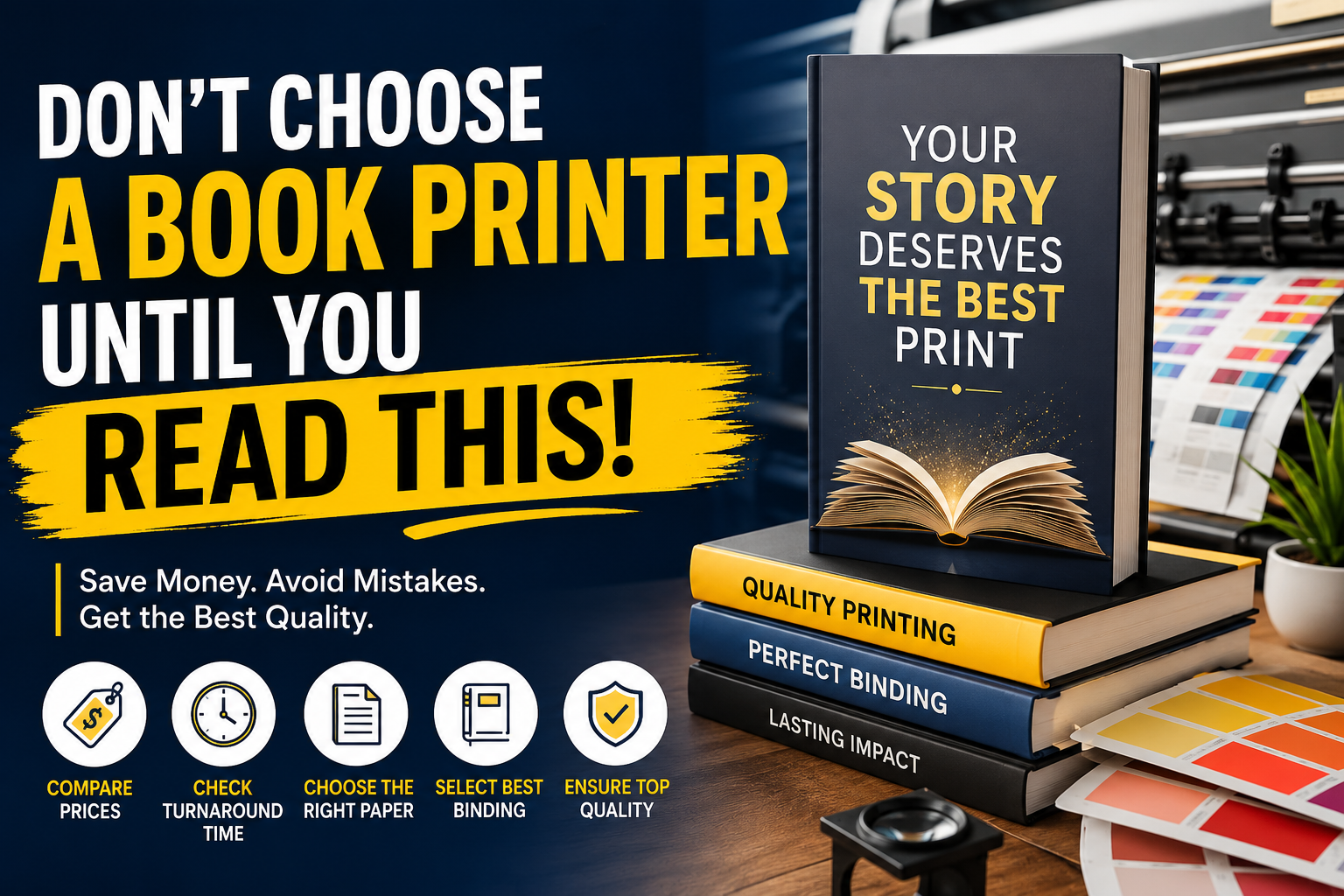
Choosing a printer feels like it should be the simple part. You already did the hard work, the writing, the rewriting, the editing rounds that made you question your life choices, and now you just need someone to put the thing on paper. That is honestly what I thought the first time I went looking for book printing services, and that casual attitude led me into a series of mistakes that cost me real money and real time. I am not writing this as some kind of expert. I am writing it as someone who got it wrong more than once and eventually figured out what I should have known from the beginning.
Not All Printers Serve the Same Type of Customer
The first thing that tripped me up was not understanding that printers are not all trying to serve the same customer.Some are set up for large publishers printing thousands of copies at a time. Other providers focus on print on demand services, producing books only when an order is placed. You can also find printers that specialize in short runs for independent authors who need a few hundred copies for events, signings, or review distribution. And some are general print shops that technically can do books but are really in the business of flyers and business cards. I had no idea this distinction existed when I started out. I just searched for a printer, picked one that looked professional, and assumed that was fine. It was not fine.
Why Comparing Quotes Matters
My first print run came out okay but I later found out I had been overpaying by a noticeable margin. I only discovered this because a friend who also self-publishes casually mentioned what she paid per copy for a book similar to mine. The number she said was lower than what I had been paying and I felt genuinely annoyed at myself. Not at the printer, they charged what they charged, but at myself for never once checking whether other book printing services were offering better rates for the same thing. That conversation pushed me to actually start comparing, and it changed how I approach every print order now.
Getting multiple quotes before committing to anything is the single habit that has saved me the most money in this whole process. And I know it sounds obvious. Everyone knows you should shop around. But in practice, authors often find one printer that works, breathe a sigh of relief that the books came out looking decent, and then just keep going back to the same place forever. I completely understand why. Learning a new printer means new file templates, new submission portals, new people to email when something is confusing. It feels like effort when you are already juggling everything else that comes with publishing a book. But that comfort zone has a price and it shows up every time you place an order.
Know Your Book Specifications Before Requesting Quotes
Before you ask anyone for a quote, know exactly what you need. I cannot stress this enough. Your trim size, your final page count, whether your interior is black and white or color, what kind of paper you want, your binding type, your cover finish. If you go into a conversation with a printer without these details locked in, the quote they give you is basically made up. It will be based on their assumptions about what your book probably is, and their assumptions might have nothing to do with your actual project. Early on I was comparing quotes that were not even for the same product because I had not done the basic work of nailing down my specs first. The comparison was completely useless.
Don’t Overlook Turnaround Times
Turnaround time is something I genuinely did not take seriously until it burned me badly. I found a printer with a lower price than what I had been paying and I was excited about it. I asked about their timeline and they gave me a number that sounded fine to me. What I did not do was ask enough follow up questions to understand exactly what that number meant. It turned out their definition of turnaround involved calendar time that I had mentally translated into business days. My books arrived more than a week after my launch date. I had planned an in-person event around having physical copies available and I had to show up empty handed and explain to people that the books were on their way. It was awkward and frustrating and completely my fault for not pinning down the timeline properly before placing the order.
Print Quality Can Change Over Time
Print quality is another thing you cannot assume will stay consistent with a printer you have used before. I had a printer I genuinely liked. First order was great. Second order came back with covers that were slightly off in color compared to what I had approved in the proof, and a handful of copies had pages that were not sitting quite straight inside the binding. It was not terrible but it was noticeable to me. I found out later that they had started routing overflow work to a secondary facility during a busy period and the quality control there was not as tight. Now I always order a small test batch when I have not used a printer recently, just to check that things are still where I expect them to be before I commit to a larger quantity.
Choosing the Right Paper Stock
Paper choice is one of those things that sounds like a minor detail until you hold two books side by side on the same paper.
Standard White Paper
Standard white is perfectly fine for most books.
Cream Paper
Cream paper is softer on the eyes and gives fiction a warmer feel that a lot of readers actually appreciate even if they could not tell you why.
Coated Paper
Coated paper is for books with a lot of images because it makes colors look richer and sharper.
The thing is, different book printing services offer different paper options and price them differently, so it is worth asking specifically rather than just taking whatever the default is. I once ended up with a paper stock I did not love because I never thought to ask what else was available.
Understanding Binding Options
Binding is a decision that matters more than first time authors usually realize.
Perfect Binding
Perfect binding is what most paperbacks use and it is what readers expect when they pick up a standard novel or non-fiction book.
Saddle Stitching
Saddle stitching works for shorter pieces but starts to look cheap on anything over about 80 pages.
Case Binding
Case binding is hardcover and the cost jumps significantly.
Coil or Spiral Binding
Coil or spiral binding is for workbooks and things that need to lie completely flat.
Make sure the printer you are considering actually offers the binding type your book needs. Not all of them do every option, and finding that out after you have already gotten deep into the quoting process is annoying.
Cover Finishes That Make a Difference
Cover finish is something I did not pay much attention to on my earlier books and I wish I had.
Gloss Finish
Gloss is shiny and vivid and tends to grab attention on a display table.
Matte Finish
Matte is softer and currently very popular, especially in literary fiction and personal development.
Soft Touch Matte Finish
Soft touch matte is in a different category entirely. It feels almost like velvet and it makes a book look genuinely premium.
Not every printer carries it and it costs more, but if your cover design suits it, it is a finish that people comment on without you having to say anything. If you have a specific finish in mind, ask about it early because not all book printing services stock every option.
Avoid Costly File Preparation Mistakes
File preparation is where quiet expensive mistakes happen. Every printer has its own requirements for how files need to be set up, things like bleed, safe zones, embedded fonts, image resolution, and color profiles. A generic template you found on a design blog is not the same as the actual template from the specific printer you are using. I submitted files to a new printer once using a template from a previous printer and the margins were slightly off. They caught it before printing but it delayed my order and added stress I did not need. Use the exact template and specifications your printer provides, not a close approximation.
Why Customer Service Matters
Customer service is something I actively evaluate now when I am considering a new printer. The question is not just whether they do good work when everything goes right. The question is what happens when something goes wrong. Because something always goes wrong at some point. A damaged shipment, a color that printed off, a delay that was not communicated clearly. How a printer handles those moments tells you more about working with them than their sample portfolio does. I have stayed with printers whose prices were not the absolute lowest because their communication was honest and they fixed problems without making me argue. I have also left printers whose actual print quality was fine because dealing with their customer service team was exhausting.
Factor Shipping Costs Into Your Decision
Shipping costs have fooled me more than once when I was comparing book printing services. You look at the per unit price and one printer looks clearly cheaper, then the shipping quote comes in and suddenly the math is different. International printers can look very attractive on unit price but once you add shipping, import fees, and the longer lead time, the value is not always there unless you are ordering very large quantities. A printer that is slightly more expensive per copy but is located closer to you and ships quickly might actually be the better financial decision overall, especially when you factor in the reduced stress.
Final Thoughts
There is no universal right answer when it comes to picking a printer. The best choice depends entirely on your book type, your budget, your timeline, and how much hands-on involvement you want in the process. What I know for sure is that the decision deserves more thought than most authors give it on their first book. Take the time to compare, ask the questions that actually matter for your specific situation, and do not let comfort or convenience be the only reason you stay with a printer. Your book is worth the extra few hours it takes to get this part right.