Book Writing
 Book Cover Design
 Book Editing
 Book Formatting
 Book Publishing
 Book Video Trailer
 Book Printing
 Audio Books
 Book Illustrations
 Author Website
 Amazon Page Optimization
 Book Marketing
 Fiction Writing
 Non-Fiction
 Autobiography
 Memoir
 Novel Writing
 Children's Book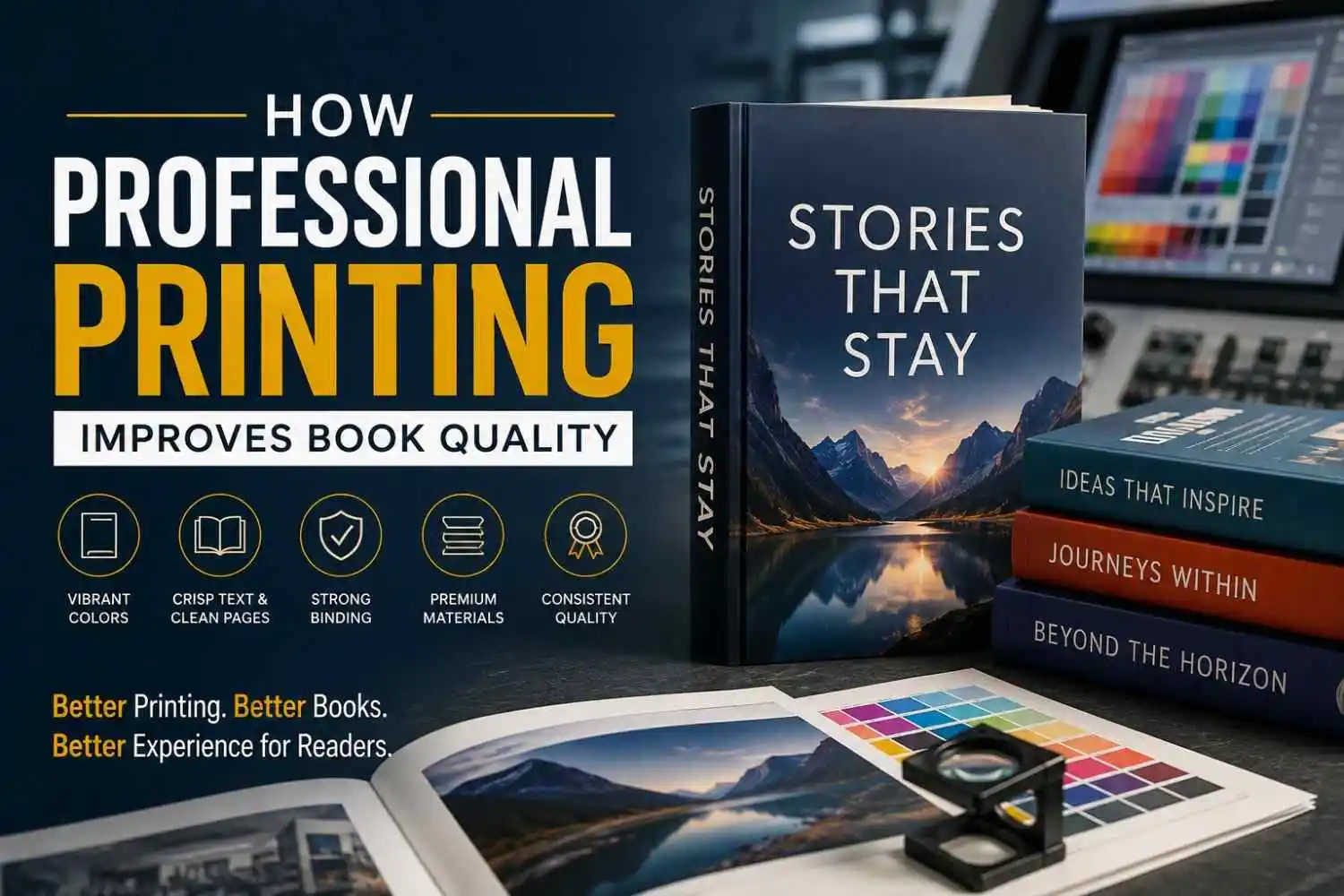
There is a moment every author talks about. The moment you hold your finished book for the first time. I had been through that moment twice before I discovered professional book printing and both times something felt slightly off. The colors looked a little flat. The pages felt thin. The spine had a slight wobble to it. The book worked but it did not feel like the books I pulled off my shelf at home. It took me a while to understand that the writing was never the problem. The printing was. Once I switched to a proper printing setup, everything changed and readers started noticing without me ever saying a word about it.
This post is about what actually improves when you take printing seriously, not in a technical way but in the way a reader feels it when they pick up your book.
The Cover Is the First Thing and It Shows
Before anyone reads a single word of your book they touch the cover. They pick it up, feel the finish, look at how the colors sit. This happens in a bookstore, at a market table, even when a package arrives in the mail and someone pulls the book out.
A cover printed on low quality equipment looks different and people can tell even if they cannot explain why. The colors look slightly off. The finish feels inconsistent. Sometimes there are tiny registration errors where the colors do not line up perfectly and a thin line of white shows up where it should not.
Professional book printing handles this differently because printers calibrate the equipment for accurate colors. The colors you designed are the colors that come out on the cover. Glossy finishes are actually glossy. Matte finishes feel smooth and even across the whole surface. The cover feels like it belongs in a bookstore because it was produced to that standard.
I have had people comment on my covers before they mentioned anything about the story inside. That never happened with my early print runs. The cover is not just packaging. It is part of the experience and printing quality is a big part of what makes a cover look finished.
Inside Pages That Are Actually Comfortable to Read
Most readers never think about the inside pages of a book. When a book is printed well, the interior is invisible. The text just flows and reading feels natural. When the printing is poor, little things start to bother readers without them understanding why.
The ink coverage might be uneven so some words look slightly lighter than others. The text might sit a hair off center on some pages. The spacing can look slightly irregular because the file was not processed cleanly. None of these things ruin a book but they add up and they create a reading experience that feels slightly amateur.
Professional book printing standardizes all of this. The ink density is consistent from the first page to the last. Text sits where it is supposed to sit. Pages are cut evenly so the book feels uniform when you flip through it. These are things that happen automatically at a professional level and they make a real difference to how a reader experiences the book physically.
There is also the question of paper quality. Professional printers give you real choices about paper weight and finish. The pages feel substantial. They do not feel like office printer paper. That weight and texture is part of what makes a book feel like a book.
Binding That Actually Holds Together
I had a copy of one of my early self published books fall apart in someone’s hands. They were maybe a third of the way through and a chunk of pages just came loose. It was mortifying. The content inside was fine but the binding was not strong enough and it failed.
Binding is one of those things you do not notice when it is done well. You only notice it when it goes wrong. Professional book printing includes proper binding methods that are tested to last. Whether you are doing perfect binding for a paperback or case binding for a hardcover, professional equipment applies adhesive or stitching in a way that holds up through real use.
A reader does not just open a book once. They pick it up and put it down dozens of times, bending the spine slightly or leaving it face down on a table. Sometimes it gets passed along to a friend. The binding needs to handle all of this without falling apart. The binding needs to survive all of that and professional printing is built around that expectation.
Color Accuracy That Matches What You Designed
This one matters most for books that rely on visuals. Cookbooks, photography books, children’s books, art books, travel guides. When a recipe photo comes out looking dull and gray instead of warm and appetizing, the whole book suffers. When an illustration for a children’s story looks muddy instead of bright, it loses the magic it was supposed to have.
Color accuracy in professional book printing comes down to calibrated equipment and proper color management. Professional printers use CMYK ink systems that are calibrated regularly so that colors are reproduced consistently. They also use ICC profiles which are basically standardized color maps that ensure your file is interpreted correctly by the printing system.
When I first started taking this seriously I had a children’s book project where the illustrated pages needed to look exactly right. The difference between a proof from a professional printer and a copy from a cheaper service was striking. Same file, same illustrations, completely different results. The professional version looked like the original artwork. The cheaper version looked like a photograph of the original artwork taken under bad lighting.
Consistency Across Every Single Copy
This is something most authors do not think about until they order a larger print run and compare copies side by side. With lower quality printing you can sometimes see variation between copies. One copy has slightly lighter text. Another copy has a cover that printed a bit darker. The pages on one copy feel different from another.
Professional book printing is built around consistency. The whole point of commercial printing equipment is that copy number one and copy number five hundred look identical. The calibration that goes into professional printing is specifically designed to eliminate variation so that every reader gets the same experience regardless of when their copy was printed.
This matters more than people realize. If you are selling books at events and someone recommends your book to a friend, you want the copy their friend receives to look exactly like the one they loved. Consistency is part of building a reputation as an author.
The Spine That Looks Like It Belongs on a Shelf
Walk over to your bookshelf right now and look at the spines. The ones from major publishers are clean, straight, and easy to read. The title and author name are centered and properly sized. The spine looks intentional.
A poorly printed spine is immediately obvious. The text might be slightly off center. The colors might not match the front cover exactly. There can be small artifacts or inconsistencies along the edge where the spine meets the cover.
Professional book printing handles spine production as part of the full cover process. The cover is printed as a single wraparound file and the spine is calibrated based on the exact page count and paper type. The result is a spine that looks like it was always meant to be there.
Hardcover Options That Feel Premium
If you have ever held a well made hardcover book you know the feeling. The case is solid. The fabric or laminate finish feels good in your hands. The pages are sewn or glued properly inside the case. The whole thing has weight and substance that tells you something before you read a word.
Getting to that level requires professional book printing. Entry level or budget printing services often do not offer true hardcover options and the ones that do may cut corners on materials or binding. Real hardcover production involves case binding, quality board for the cover, and finishing options like cloth texture or spot UV coating.
For certain books, a premium hardcover is the right choice. Memoirs, coffee table books, special editions, gift books. These are the kinds of projects where the physical object is part of the value you are offering the reader. Cutting corners on the printing undermines the whole point.
What Readers Actually Notice
Readers do not walk around thinking about printing quality. They are not evaluating ink density or color calibration. But they feel the result of all of those things without knowing it.
When a book feels solid in their hands, readers tend to trust it more before they even begin. Clean, even pages create a smoother reading experience, while a sharp, color-accurate cover makes readers more likely to display or recommend the book.
I have received reviews that mentioned how much the reviewer loved the physical book. Nobody said anything about paper weight or binding. They just said it felt like a real book. That is professional book printing doing its job invisibly, just as good printing should.
Is Professional Book Printing Worth the Extra Cost?
The honest answer is that it depends on what you are trying to do. If you are printing a small run for personal use or testing out an idea, budget printing is fine. But if your book is something you are proud of and you want readers to feel that pride when they hold it, professional printing is not an extra expense. It is part of what you owe the work.
The difference in cost between budget printing and professional printing is often smaller than authors expect. And when you factor in the cost of reprinting because something went wrong, or the cost to your reputation when someone posts a photo of your book with peeling pages, the math shifts quickly.
Your book is the result of months or years of work. The printing is the last step between all of that work and the person who is going to experience it. Getting that step right is not a luxury. It is just finishing the job properly.