Book Writing
 Book Cover Design
 Book Editing
 Book Formatting
 Book Publishing
 Book Video Trailer
 Book Printing
 Audio Books
 Book Illustrations
 Author Website
 Amazon Page Optimization
 Book Marketing
 Fiction Writing
 Non-Fiction
 Autobiography
 Memoir
 Novel Writing
 Children's Book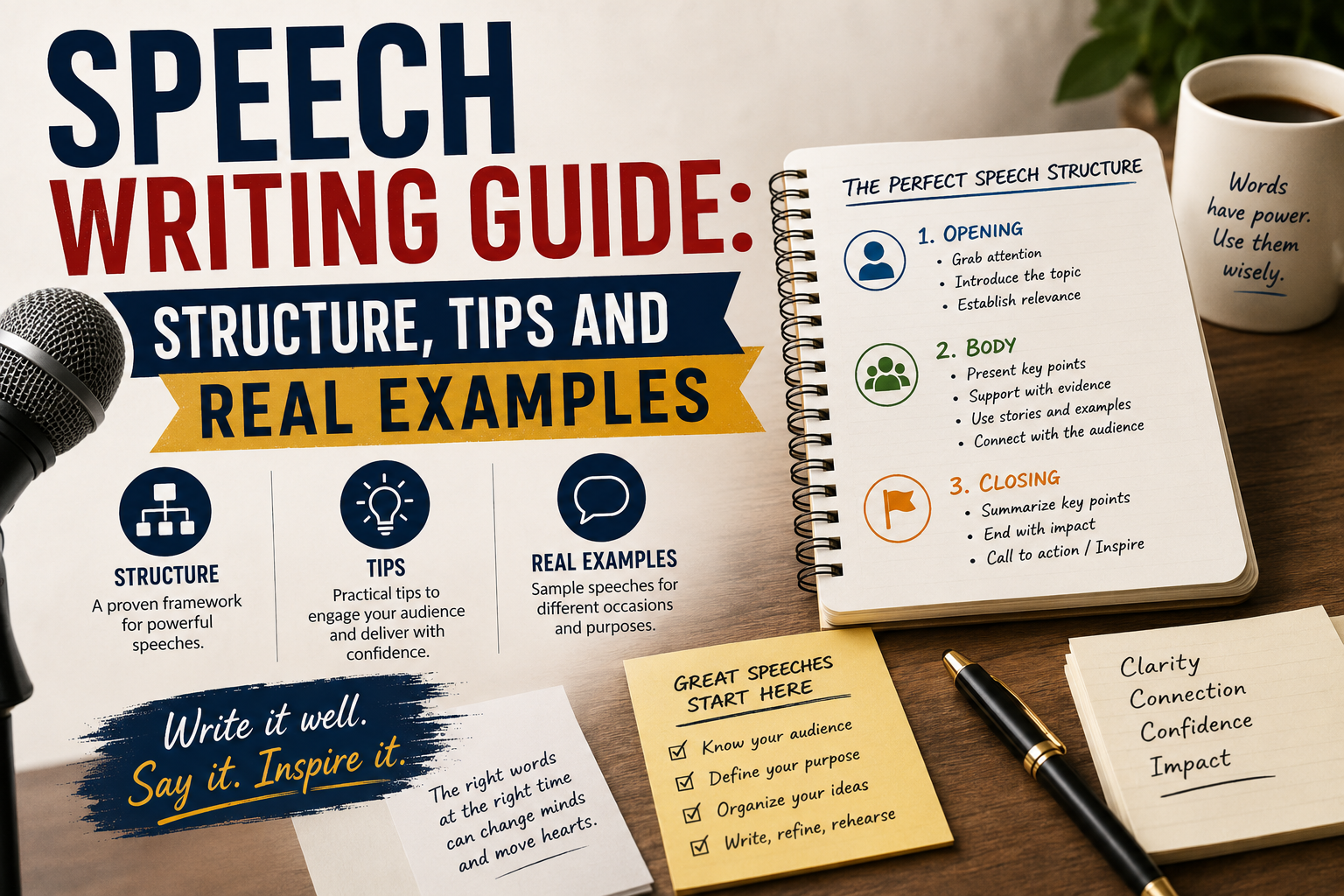
A few years back my uncle gave a retirement toast that I still think about, though not fondly. He had worked beside the guest of honor for thirty years. He stood up with a folded sheet, held it close to his face and read the whole thing in one flat tone. I got a look at the page afterwards and it was genuinely funny. Nobody laughed, because nobody could tell a joke was coming. Half the room became very interested in the cake.
He wrote it the way you write an email, then read it out the way you’d read an email. I’ve done the same thing myself, at two work events and at my sister’s engagement dinner, and every time I came away a bit red in the face and a bit wiser. This guide is what I wish someone had given me before the first one.
What Is Speech Writing?
If you search for what is speech writing, you’ll mostly find definitions that say it’s the writing of speeches. True, and not much use. After a few years of doing it, my own version is that it’s writing people take in by ear, once, at your speed, without any way of asking you to repeat yourself.
That matters more than it sounds. When you read on your phone you skim, skip ahead, and scroll back when a sentence loses you. A listener can’t do any of that. If a line takes two passes to understand, it’s already gone by the time they finish the first, and while they’re still stuck on it you’ve started your next point. Now they’ve missed both. So speech writing leans on short sentences and the words you’d use at a kitchen table. It also leans on pictures people can see immediately, like a wet umbrella propped by a door, where “adverse weather conditions” gives them nothing.
The room counts too. A wedding tent with a crackly microphone calls for a different speech than a boardroom with a projector, even when the subject is the same.
Beginners, and I was one, try to sound clever. It backfires almost every time. A crowd isn’t sitting there hoping to be dazzled. They want to follow you without straining, and if you give them that, they’ll forgive plenty.
The Shape of a Speech
Your audience has no page to flip back through, so the structure you pick is the only map they get. Nearly every talk I’ve admired had a beginning, a middle and an end, and each of those has its own job.
The beginning
You get about thirty seconds, fewer if it’s right after lunch. “Thank you all so much for being here today” burns that half minute on nothing, and I hear it at almost every event I go to.
Start with a small real moment instead. Say your talk is about volunteering. You might open with: “Last winter a stranger shoveled my mother’s driveway at six in the morning and was gone before she could thank him. I still think about that man.” It has a person in it, an hour of the day and a loose thread, and people want to hear where it leads.
The middle
This is where I see the most damage done. There’s so much to say and so little time that we try to say everything. Two or three main points is plenty, and four is the limit. Give each one a story or a specific example, then add a sentence that carries the audience over to the next point so they aren’t left standing at the roadside.
Here’s a test for any draft. Explain the whole speech to a friend in one sentence. If you stumble around for a full minute, the speech is carrying too much, and the fix is usually cutting something you love. I’ve deleted favorite paragraphs more times than I can count and I can’t name a single one I missed.
The end
Weak endings just trail off. Strong ones land. Return to the image you opened with, restate your main idea in fresh words, and give people one thing to carry out the door. Then stop. That nervous “so, yeah, that’s about it” many speakers tack on undoes a lot of good work in about three seconds.
Habits That Actually Help
Read your draft out loud, and do it at the pace you’ll really use. Whatever you trip over at your desk you’ll trip over harder at the podium. When a sentence tangles, cut it in two. When a word feels like something you’d only ever write, swap it for what you’d say to a friend. “Use” beats “utilize” nearly every time.
Find out who’s coming before you type a line. Graduating seniors, a table of executives and a family birthday dinner all want different things from you. I ask myself what they already know, what would bore them stiff, and how I’d like them to feel when I sit down.
Numbers by themselves get forgotten. Tie one to a person and it sticks. “One in three” is fine, but “one in three, and my neighbor Diane was one of them” is the version people repeat in the car on the drive home.
Keep an eye on the clock. Most people talk at around 130 words a minute, so five minutes is close to 650 words. Write long and trim later. Then mark your pauses on the page, because adrenaline makes most of us forget to breathe, and a pause after your best line does more than another clever sentence would.
Finally, rehearse for a real person and ask what stuck with them. Their answer shows you what the speech actually said, which is often not what you meant it to say.
Speeches Worth Studying
Some of the best teaching material is free. Lincoln’s Gettysburg Address runs only a few minutes and shows how much you can say once you cut everything that doesn’t matter. Martin Luther King Jr. built “I Have a Dream” on repetition and vivid pictures, which is why lines from it still get quoted today. Steve Jobs told three personal stories at Stanford and never used a slide. You don’t need much machinery when the stories are true.
Editing shows the gap best. A first draft might say: “Today I would like to discuss the importance of teamwork in the workplace and how it contributes to better outcomes.” It’s grammatical and completely lifeless. Change it to “Every project I’m proud of had one thing in common. I never finished any of them alone,” and suddenly a person is talking.
When It Makes Sense to Get Help
Some talks matter too much to gamble on. A eulogy, an investor pitch, a keynote in front of your whole industry, a tribute to the boss who shaped your career. Capable people freeze in exactly these spots, and this is where speech writing help can be worth paying for. It might be a quick second opinion on a draft you wrote yourself, or a full script built from your own stories.
Many people start looking at speech writing services when a deadline is close or the subject feels delicate. A decent speech writing service will talk with you before writing anything. They’ll want to hear how you speak, which stories you tell over dinner and what you hope the room remembers. What comes back should sound like you on a good day, not like a stranger borrowed your name.
If your situation doesn’t fit a template, a custom speech writing service builds the piece around your audience, your timing and your voice. The better custom speech writing services are comfortable with a two minute toast and a forty minute keynote alike, and they’ll shift the tone depending on whether the day calls for laughs, formality or something gentler.
Most of this happens remotely now. Speech writing services online usually let you share details through a form or a video call, receive drafts by email and request changes without leaving your desk. If you’ve written most of it yourself and only want a check, speech writing help online often comes down to feedback on structure and delivery within a day or two.
Working with a professional
Professional speech writers often come from journalism, rhetoric, communications or theater. They know where filler hides, and they know how to build the one line people repeat in the hallway afterwards. When you hire a speech writer, a big part of what you’re paying for is their judgment about what to leave out. Hand them plenty of personal material, because the best lines come from real memories and rarely from clever phrasing.
Executives, public officials and event hosts often turn to speech ghostwriting services, where the writer drafts the words and the speaker delivers them as their own. It’s an old practice in business and politics. It stays honest as long as the speaker reads every line closely and only says what they truly believe. Good professional speech writing is a shared job. You bring the truth, and the writer helps it travel.
Students and personal occasions
Students face their own kind of pressure, from class presentations to scholarship interviews to graduation addresses. Speech writing for students works best when the helper explains each choice along the way, so the student learns how to organize ideas, credit sources and stay calm. Otherwise they’re back next month needing the same help all over again.
Then there are the personal moments. A personal speech writing service can turn a lifetime of memories into a wedding toast, a memorial tribute or an anniversary speech. Expect a lot of questions about the people involved, since these speeches live on small details, like the way someone laughs or a nickname nobody remembers the origin of. And if the usual format bores you, creative speech writing brings in humor, odd openings, metaphor and storytelling tricks that make a talk feel made for one room only.
Picking a Provider You Can Trust
Quality swings wildly in this field, so a little homework can save you regret. If you’re hunting for the best speech writing service, begin with plain questions. Can you find real writers whose names and backgrounds you can check? Do the samples show range, or does everything sound the same? Are prices and revision terms clear before you pay? Will your private details stay private? Do reviews show up on independent sites, or only on the provider’s own page?
Reading a few comparisons of the best speech writing services will show you who fits your budget and timeline. Be wary of anyone promising flawless work overnight for very little money. Good writing takes thought, and thought takes time.
Why Trust Matters on Stage and Online
Google’s quality guidelines talk about EEAT, which stands for experience, expertise, authoritativeness and trust. It was meant for web content, but it applies to public speaking surprisingly well.
Audiences believe people who have lived what they’re describing. They respect speakers who know their subject and can say where a fact came from. Oddly, they also trust someone who admits what they don’t know, which surprises a lot of nervous speakers. So use your own stories, check your numbers and name your sources out loud. A room believes a speaker for the same reason a search engine rewards a helpful page: the substance holds up when somebody looks closely.
A Simple Way to Begin
Write one sentence about what you want the audience to do, feel or remember. Find out who’s coming and how long you have. Collect two or three stories that back up your point, then draft the opening and closing before the middle, since those two set the frame. Fill in the rest in short sections, read it aloud, mark your pauses and cut whatever drags. Rehearse at least three times, ideally for someone who’ll be honest with you.
Final Thoughts
Good speeches rarely happen by accident. They begin with a clear picture of the audience, follow a shape people can hold onto, and get better through honest editing and practice. Whether you write yours alone or bring in a professional, people should leave having understood something, and still remember it the next morning.
Pick one story, one message and one strong first line, and build from there.