Book Writing
 Book Cover Design
 Book Editing
 Book Formatting
 Book Publishing
 Book Video Trailer
 Book Printing
 Audio Books
 Book Illustrations
 Author Website
 Amazon Page Optimization
 Book Marketing
 Fiction Writing
 Non-Fiction
 Autobiography
 Memoir
 Novel Writing
 Children's Book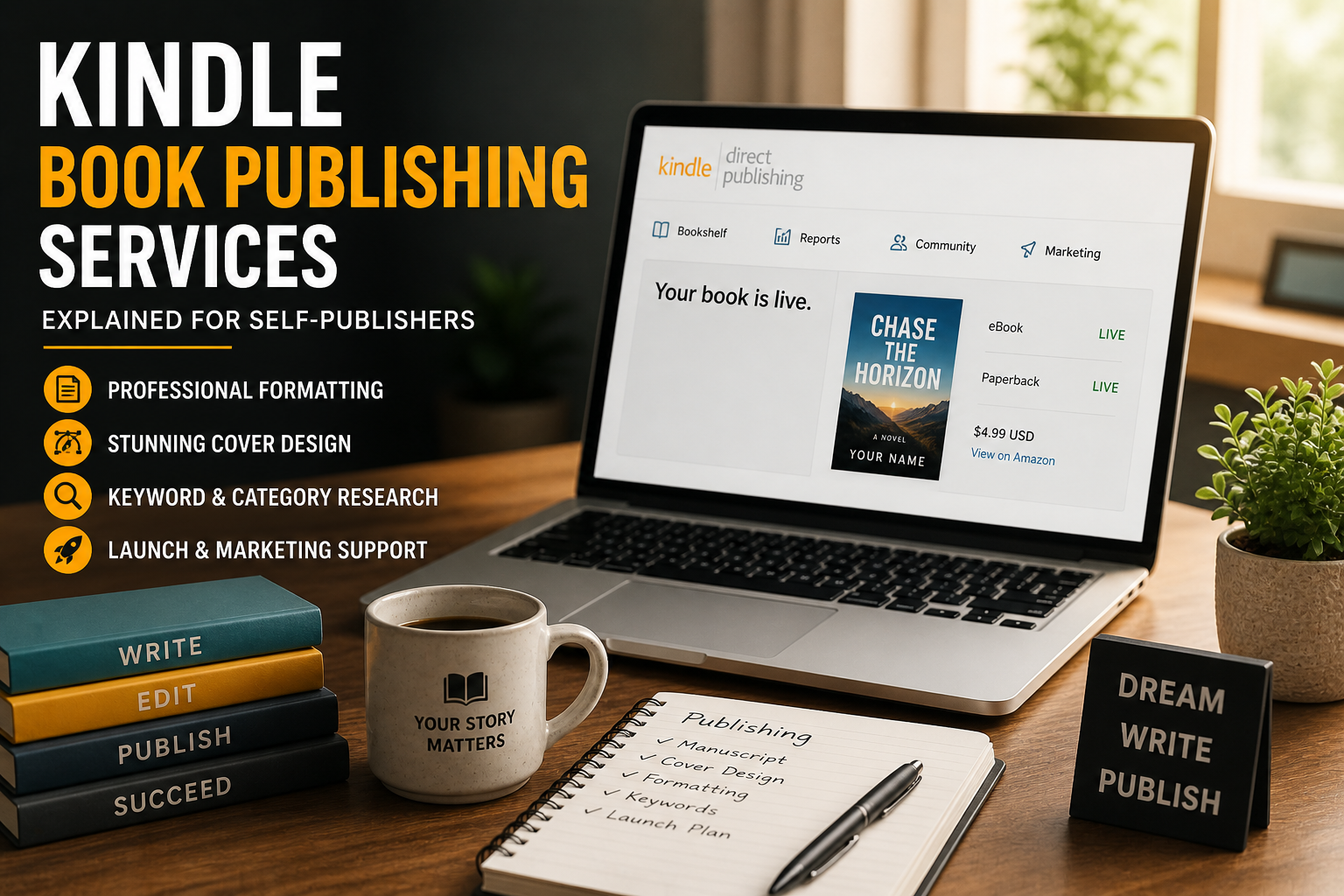
There is a moment every writer knows. You finish your manuscript, you save the file one last time, and then you just sit there staring at the screen. All that work, all those months, and now you have absolutely no idea what to do next. For most writers, this is exactly where kindle book publishing services become the most important thing they never thought to research before sitting down to write. Nobody really prepares you for that part. Writing communities, online courses, YouTube videos, they all focus on the craft of writing itself. The moment you type the last sentence, you are suddenly on your own.
I have seen this happen to so many writers. They pour everything into their book and then realize they have no clue how publishing actually works. Not traditional publishing with agents and rejection letters, but the kind where you do it yourself, on your own terms, through Amazon’s Kindle platform. That world has its own learning curve, its own language, and its own set of decisions that can genuinely make or break whether your book reaches anyone at all.
So let me walk you through it properly. Not in a textbook way. Just the way a friend would if they had already been through it.
First, Understand What You Are Actually Walking Into
Kindle Direct Publishing is Amazon’s free platform for self-publishers. You create an account, upload your manuscript and cover, fill in some information about your book, set a price, and within a couple of days your book is available to readers in over a hundred countries. That accessibility is genuinely remarkable when you think about it. Twenty years ago this was not possible for an independent author.
But here is the thing that catches people off guard. KDP is just the door. What you bring through that door, and how ready it is, determines almost everything that happens afterward. kindle book publishing services exist to help you prepare everything that goes through that door properly. The formatting, the cover, the description, the keywords, the launch strategy, these are not optional extras. They are the actual work of publishing, and treating any of them carelessly tends to show up in your sales numbers pretty quickly.
“The authors who figure this out early save themselves a lot of frustration. The ones who think uploading a Word document and slapping together a cover in Canva is enough usually end up wondering why nobody is buying their book, even when the writing itself is genuinely good.”
Your Manuscript Needs More Preparation Than You Think
Let me tell you something that took a writer friend of mine a painful lesson to learn. He finished his thriller, uploaded it straight from Word, published it, and then bought a copy to read on his own Kindle. The chapter breaks were wrong. Paragraphs were splitting in random places. The table of contents was broken. He had to take the book down, fix everything, and republish. Meanwhile those first few days after launch, which are genuinely the most important window for visibility, were wasted.
This happens because ebooks do not behave like documents. On a Kindle, the text reflows based on the screen size and the font size the reader has chosen. If your underlying file is not structured properly, that reflow process creates a mess. Things that looked perfect in Word look completely different on an actual device.
Getting the formatting right means your chapters start where they should. Your fonts stay consistent. Your table of contents works with a tap. Whether someone reads your book on a Kindle Paperwhite, a tablet, or their phone, the experience feels clean and professional.
Quick Tip
For a straightforward text-heavy book, tools like Vellum or Atticus can help you do this yourself without too much difficulty. For anything with images, tables, or more complex layouts, paying a professional formatter is almost always the smarter call. The cost is small relative to how long that book is going to be out there representing you.
The Cover Situation Is More Serious Than Writers Want to Admit
Writers have a complicated relationship with their covers. After spending months on the words, the idea that a picture is going to determine whether people even read those words feels deeply unfair. But fairness has nothing to do with it.
When a reader is browsing Amazon, they are moving fast. They are scanning thumbnails. Your cover shows up roughly the size of a postage stamp in those search results, and it has maybe one second to make someone curious enough to stop. A cover that looks amateurish, or that does not fit the visual expectations of its genre, sends a quiet message that most readers pick up on without even consciously realizing it. They just keep scrolling.
A cover designer who works regularly in the Kindle space knows what is selling in your genre right now. They know what color palettes readers in that space respond to, what typography signals what kind of story, what visual elements make a thriller look like a thriller and a romance look like a romance. They translate all of that into an image that fits in while still standing out.
If you genuinely cannot afford a custom cover right now, premade covers are a legitimate option. Designers create them in advance and sell them at lower prices, with your title and name swapped in. Quality varies, so look carefully before buying. But even a good premade cover will serve you better than something put together without knowledge of how the market works.
The KDP Select Question
At some point fairly early in your Kindle journey, you are going to have to make a decision about KDP Select. It sounds complicated but the core of it is simple. You agree to sell your ebook exclusively through Amazon for 90 days at a time. In exchange, your book gets included in Kindle Unlimited, the subscription service where readers pay a monthly fee and read whatever they want.
When someone reads your book through Kindle Unlimited, you earn money based on how many pages they read. Not a flat sale, but pages. Amazon sets aside a pool of money each month and splits it among authors based on readership.
The most honest advice here is to try one 90-day period and pay attention to your numbers. No general opinion from the internet is going to tell you as much as your own actual data will.
Your Description Is Not a Summary
This is a mistake almost every first-time Kindle author makes, and it makes sense because it feels logical. Your book description should describe your book, right? So you write a careful summary of what it is about, hit save, and move on.
The problem is that a summary and a sales page are two completely different things with two completely different jobs. A summary informs. A sales page creates a feeling, a sense of urgency, a need to know what happens next. Readers browsing Amazon are not looking for information about your book. They are looking for a reason to care about it.
Look at the descriptions of the top selling books in your genre right now. Notice how they open, usually with something that creates immediate tension or curiosity. Notice what information they deliberately leave out. Notice the rhythm of the language. That is not accidental. Those descriptions are crafted to pull someone in, not just explain what the book contains.
The same level of care applies to your keywords. You get seven slots when you set up your KDP listing, and each one is a direct line to a specific type of reader. Using broad generic terms means competing with thousands of books that have been on the market for years. Finding the specific phrases that real readers in your genre actually search for can get your book in front of people who are already looking for exactly what you wrote.
Print on Demand: Simpler Than It Sounds
Some readers just want a physical book. They want to hold it, fold the corners, leave it on their nightstand. Amazon’s print-on-demand option through KDP means you can give those readers what they want without any of the traditional publishing headaches.
No print runs to fund. No boxes of books stacked in your spare room. No minimum order quantities. A reader orders a copy, Amazon prints it and ships it, and you receive royalties on the sale. Your risk is essentially zero.
The one thing to understand going in is that formatting a print book is a completely separate job from formatting an ebook. The dimensions, margins, and layout all work differently, and your cover needs to be built with a spine width that depends on your final page count. If you are already working with a formatter for your ebook, ask them about handling both together. It is usually more cost effective that way and means one less person you have to coordinate with.
Finding Your Book on Amazon Is Not Automatic
Amazon is one of the biggest search engines in existence, but only for things people are actively looking for. If your book does not appear when the right readers are searching, those readers will never know it exists. This is where category selection becomes more important than most new authors realize.
You pick two categories when you set up your listing, but KDP support can sometimes add you to additional ones if you contact them and make the request. Getting into a smaller, less crowded category can mean your book sits near the top of its niche rather than getting buried on page forty of a massive genre.
A bestseller tag at the category level is not just vanity. It shows up next to your cover in search results and signals to browsing readers that other people have already decided this book is worth their time. kindle book publishing services that include launch strategy often focus heavily on this piece, because the window right after publication tends to carry the most algorithmic weight.
What Happens After You Publish
Most authors expect the launch and then expect things to coast. That is not really how it works. The initial momentum fades, and without ongoing effort the book quietly settles into obscurity alongside millions of other titles that launched and then went silent.
The authors who build something real on Kindle tend to do a few things consistently. They run price promotions periodically to bring in new readers. They learn Amazon Ads well enough to run campaigns that bring in more money than they cost. They build an email list of readers who actually want to know when the next book comes out, because that list is the only audience they truly own. And they keep publishing, because every new book brings attention back to everything they have already written.
40+
Reviews builds serious reader trust on your listing
70%
Royalty rate when priced between $2.99 and $9.99
100+
Countries your book reaches through Amazon KDP
Reviews matter more than most new authors expect. Before your launch, putting together a group of advance readers who will receive the book early and leave genuine reviews on publication day is one of the most practical and high-return things you can do.
Choosing Who to Work With
If you decide to bring in outside help through any of the kindle book publishing services available, take your time making that decision. Talented professionals exist in every part of this space, but so do people who take your money and deliver disappointing results.
Look at real books they have worked on. Find those books on Amazon and look at how they actually appear. Read what other authors have said about working with them, not just the testimonials on their own website. Ask specific questions before committing. A professional who is worth hiring will answer those questions clearly and honestly.
Watch Out For
Walk away from anyone who promises you a specific number of sales or guarantees bestseller status. That is not something any honest professional can promise. Markets are unpredictable. What a good service can do is make sure your book is as ready as it possibly can be when it meets those readers.