Book Writing
 Book Cover Design
 Book Editing
 Book Formatting
 Book Publishing
 Book Video Trailer
 Book Printing
 Audio Books
 Book Illustrations
 Author Website
 Amazon Page Optimization
 Book Marketing
 Fiction Writing
 Non-Fiction
 Autobiography
 Memoir
 Novel Writing
 Children's Book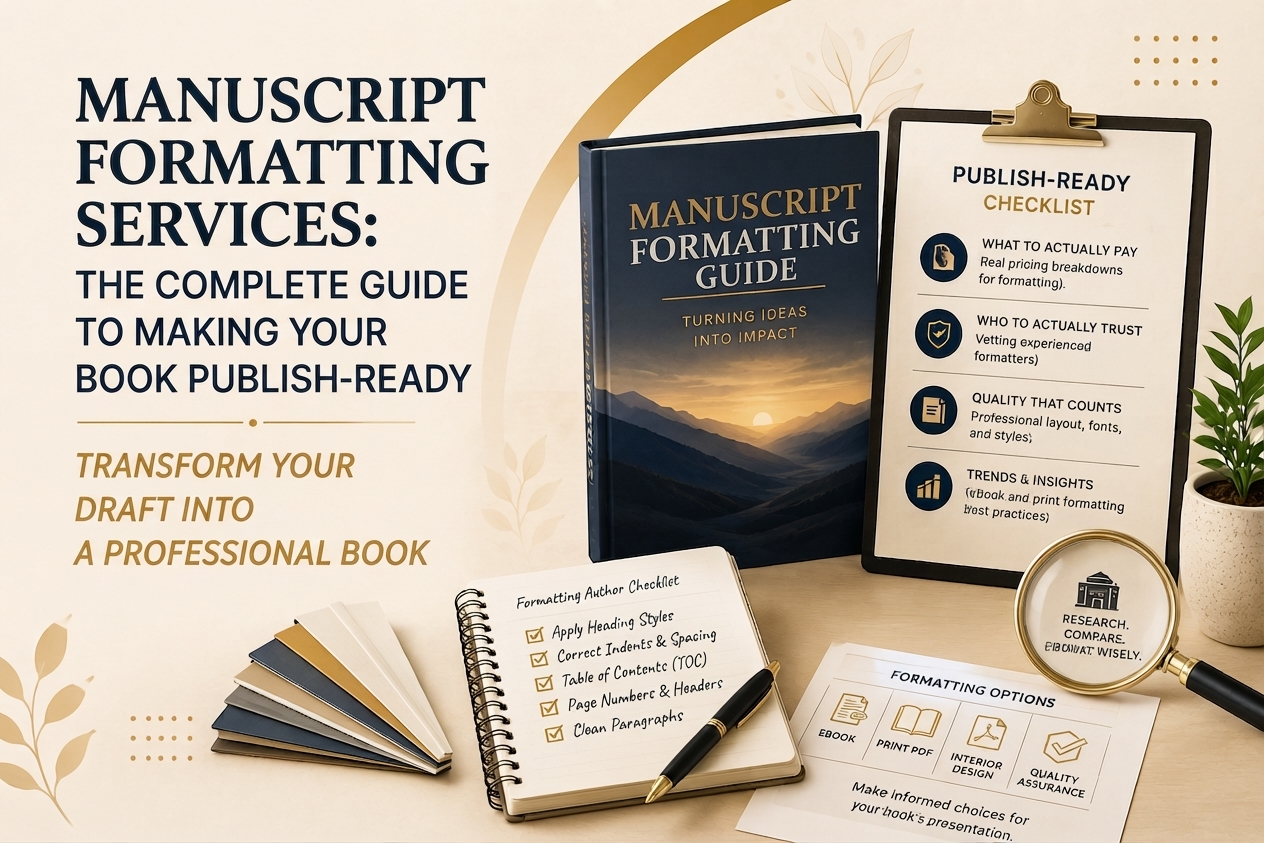
You finally did it. The last chapter is written, the ending feels right, and for the first time in months you can actually breathe. That feeling of finishing a manuscript is something else entirely. But give it a day or two, and a different kind of anxiety creeps in. Now what? How does this thing go from a Word document on your laptop to an actual book that people can hold or download? I have been through this process, and I can tell you the part that caught me completely off guard was formatting. Not the writing, not even finding a publisher. The formatting. And that is exactly why manuscript formatting services exist, because this part is a lot more involved than anyone warns you about.
Nobody really talks about it in writing groups or craft books. You hear about query letters, finding agents, building your author platform. Formatting gets maybe a paragraph in a self-publishing guide and then everyone moves on. But ask anyone who has submitted to a traditional publisher or tried to upload their first eBook to Amazon, and they will tell you the same thing. Getting the formatting wrong can genuinely derail everything else you worked so hard to get right.
Let Me Explain What Formatting Actually Is
Because I think there is real confusion here, even among writers who have been at this for years.
Formatting is not editing. Your editor fixes sentences. Your formatter fixes how those sentences sit on the page. We are talking about font choices, the spacing between lines, how far paragraphs are indented, where chapters begin, how headers look, where page numbers appear, how wide the margins are. All of that is formatting.
And the tricky part is that the rules change depending on what you are doing with the manuscript. A submission going to a literary agent has specific expectations, usually Times New Roman at 12 point with double spacing and clean one inch margins. A print book being sent to a printer needs to account for trim size, for the gutter where pages meet the binding, for fonts that are properly embedded so they do not get swapped out. An eBook is a completely different animal because nothing is fixed. Readers control their own font size, their own background color, sometimes their own font choice altogether. Your file has to be built in a way that bends without breaking.
Three different scenarios, three different sets of requirements. Easy to get wrong if you are figuring it out as you go.
Why This Actually Matters More Than People Think
Here is a story that might sound familiar.
A writer I know spent close to two years on her debut novel. Really solid work. She queried about thirty agents and heard almost nothing back. When she finally got feedback, one agent mentioned almost as an aside that the manuscript formatting had been inconsistent throughout. Font sizes jumping around, chapters not starting on fresh pages, that kind of thing. The agent had not gotten far enough to form an opinion about the actual writing.
That is a genuinely gutting thing to hear after two years of work. And it is also completely preventable.
Agents move fast. They have to. When something looks off right away, they move on without feeling bad about it because there are fifty other queries waiting. Your manuscript formatting is essentially your first handshake with every single person who opens that file. Make it sloppy and you have already lost ground before they have read a word.
Self-publishing is not any more forgiving. Readers on Amazon are not shy about leaving reviews. A review that says the eBook formatting was broken or the print version had text crawling into the binding does not disappear. It sits there for years, visible to everyone considering whether to buy your book. Proper manuscript formatting services exist specifically to make sure none of that happens to you.
Print Formatting and eBook Formatting Are Honestly Two Separate Jobs
This is the part that really surprised me when I first got into this.
When you format a print book, you are working with something fixed. Every page has a specific size. The text sits in a defined space. The formatter sets up the trim size, gets the margins right so nothing disappears into the spine, embeds all the fonts, deals with things like widow lines sitting orphaned at the top of pages, and then exports a PDF that the printer uses directly. What that file looks like is exactly what gets printed.
Ebooks do not work that way at all. An eBook layout is reflowable. It shifts and adapts based on whatever device the reader is using and whatever settings they have chosen. The same file might display beautifully on a Kindle Paperwhite and then look completely different on someone’s phone. A good eBook file handles all of that gracefully because it is built on clean structure rather than manual positioning. Proper heading styles, paragraph tags, a table of contents that actually links to each chapter, and a final EPUB file that clears the validation checks run by Amazon and Apple Books and everyone else before they will even list your book.
These two things require different software, different skills, and different thinking. The best manuscript formatting services are comfortable with both and know exactly which approach a given project needs.
Honest Talk About the Mistakes Writers Make on Their Own
I am not saying this to be discouraging because plenty of writers do learn to format their own work. But these are the things that go wrong most often, and they are worth knowing about.
The spacebar indent is probably the most widespread one. Writers hit the spacebar a few times at the start of each paragraph because it looks right on screen. Then the file gets converted and all those spaces behave unpredictably. Fixing it across a full length manuscript is the kind of task that makes people question their life choices.
Double hitting Enter between paragraphs instead of setting actual paragraph spacing through styles is another one. Looks fine while you are writing. Becomes a structural problem the moment that file needs to go somewhere else.
Manually bolding or sizing chapter titles rather than applying proper Heading styles means your eBook ends up without a functioning table of contents. Readers tap the contents, nothing happens, one star review incoming.
And then there is the issue of widows and orphans, which sounds like a Victorian novel but is actually a typography term. A widow is one lonely line sitting at the very top of a page. An orphan is one lonely line at the very bottom. Neither one belongs there. Experienced formatters fix these without being asked because it is just part of doing the job properly.
What to Actually Look for When You Are Hiring Someone
There are a lot of people offering formatting services. The range in quality is enormous.
The first thing worth checking is whether they work across both print and digital. Those are different skill sets and not everyone has both. For print, Adobe InDesign produces the cleanest output by a significant margin. For eBooks, tools like Vellum or Atticus do excellent work. If someone’s entire workflow lives inside Microsoft Word, that is useful information.
Ask whether they have worked on books in your genre before. A fantasy novel with illustrated maps and decorative chapter openers needs different handling than a memoir. A business book with sidebars and callout boxes is not the same job as a poetry collection. Genre experience matters in formatting just as it does in editing.
Ask to see a sample. Offer a chapter and see what they do with it. Any formatter who is confident in their work will not have a problem with this. If they push back or act like it is an unreasonable request, keep looking.
Make sure revisions are included in whatever price they quote you. You will almost certainly want changes once you see the first version of the file. That is normal and expected. A service that nickel and dimes you for every small correction after the fact is not set up to treat clients well.
Fitting Formatting Into Your Actual Publishing Timeline
If you are submitting to traditional publishers, your submission manuscript needs to look professional and correctly formatted before it ever reaches an agent’s inbox. The publisher handles final book formatting if they acquire the work, but your job is to make a strong first impression with what you send.
For self-publishing, formatting is the step that comes after everything else is completely done on the editorial side. All developmental work, line editing, copyediting, proofreading, that whole process needs to be finished before your manuscript goes to a formatter. Making edits after formatting has been completed means parts of the formatting work may need to be redone, which nobody wants.
Build in at least two to three weeks between your final proofread manuscript and your publication date. Formatting takes time to do well. Reviewing the formatted files takes time. Corrections happen. Then there is the upload process and waiting for platform approval. Two to three weeks is not being overly cautious, it is being realistic.
What You Actually Get Out of Doing This Right
A properly formatted book clears technical validation without issues. It looks the way it should in print. It reads well on every device. It holds up under the kind of scrutiny that comes when a reviewer, a librarian, or a bookstore buyer picks it up and flips through it.
But the real value is something less tangible. When formatting is done well, readers never think about it once. They open the book and they read. Nothing interrupts them. Nothing pulls them out of the experience. The formatting disappears completely, which is exactly what it is supposed to do.
That is what genuinely good manuscript formatting services deliver. Files that meet every technical requirement, yes. But more than that, a reading experience that gets completely out of the way and lets your writing land the way you always intended it to.
You spent a long time writing something worth reading. The least it deserves is a presentation that does it justice.
First time author or seasoned indie publisher, the writers who treat manuscript formatting as essential rather than optional are the ones whose books tend to get taken seriously. It is one of those investments that quietly pays for itself every single time.