Book Writing
 Book Cover Design
 Book Editing
 Book Formatting
 Book Publishing
 Book Video Trailer
 Book Printing
 Audio Books
 Book Illustrations
 Author Website
 Amazon Page Optimization
 Book Marketing
 Fiction Writing
 Non-Fiction
 Autobiography
 Memoir
 Novel Writing
 Children's Book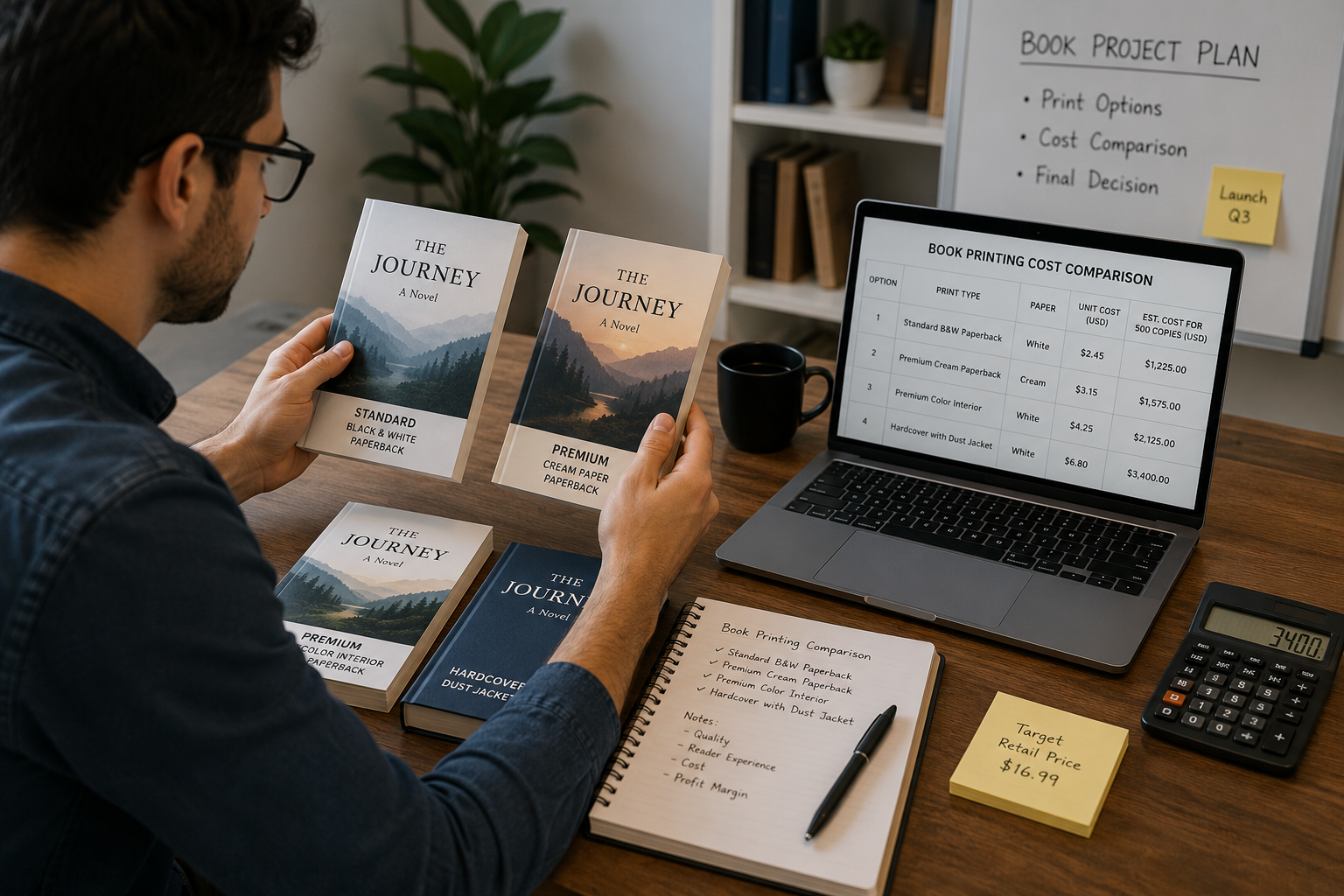
Nobody warns you about this when you first decide to publish a book. You figure out the writing part, maybe hire an editor, design a cover, and then the printing quote comes in and you just stare at it. I remember thinking there had to be a cheaper way. Turns out there was, and it had nothing to do with finding some shady discount printer. Book printing costs are almost entirely driven by your page count and trim size, and once I understood that, I cut my bill by nearly half without changing a single word of my content.
My first book was formatted the way I thought books were supposed to look. Big comfortable font, generous margins, lots of breathing room on the page. It felt professional to me. What I did not know was that those choices were the reason my 60,000 word manuscript was coming out to 320 pages. When I tightened the formatting a little, dropped from 12pt to 11pt font, and adjusted the margins to something still perfectly readable, the same book became 248 pages. The words did not change. The story did not change. But the price per copy dropped noticeably and on a run of a few hundred copies, that adds up fast.
A lot of first time authors make this exact same mistake and never realize it. They spend months writing, they put real effort into the editing process, and then they hand the manuscript off to a designer or just format it themselves without thinking about what each formatting choice actually costs them at the printer. I have talked to people who were quoted prices that seemed outrageous for what was essentially a short book, and when I asked them how many pages it came out to, the answer almost always explained everything. Fonts, margins, line spacing, chapter heading styles, all of it adds pages, and pages add money.
The Hidden Cost of Extra Pages
The fix is not complicated. Before you finalize your interior layout, open up your formatted file and look at the page count. Then try dropping your font size by just one point. Try tightening your margins by a quarter inch on each side. Try reducing your line spacing slightly. None of these changes will make your book look cheap or hard to read. Readers genuinely do not notice these things. But each small adjustment can shave pages off your total and bring your per unit cost down in a way that actually matters when you are printing hundreds of copies.
How Trim Size Affects Book Printing Costs
The trim size thing took me even longer to figure out. I was defaulting to 6×9 because honestly that is just what books look like in my head. It is the size I grew up reading, the size I associate with serious published work. But a lot of content, especially non-fiction, self-help, or business books, works just as well in 5.5×8.5. Printers charge based on how much paper goes into a book, so smaller pages cost less to produce. I tested this on one of my titles and the per unit cost went from around four dollars down to under three. Five hundred copies at that difference is real money back in your pocket, money that can go toward marketing or your next project instead of sitting in a box of books in your garage.
Best Trim Sizes for Fiction Books
If you are writing fiction, the trim size conversation gets even more interesting. Many novelists print at 5×8 or even smaller, and readers expect that. It is a completely normal size for paperback fiction and it costs noticeably less to produce than the larger formats. I have seen authors stubbornly stick to 6×9 for a novel because they felt it looked more substantial, not realizing they were paying a premium for a choice their readers did not care about at all.
Why Proof Copies Are Worth Every Penny
Something else I got burned by early on was skipping the proof copy. I approved a cover file straight from my screen and what came back from the printer looked nothing like what I was seeing at my desk. The colors were flat, almost muddy. A bright teal that looked vivid on my monitor came out looking like a dull grayish green on the actual printed cover. I had to eat the cost of that entire batch and reprint everything. It was painful and completely avoidable. Now I always order a physical proof before committing to any full print run. It costs almost nothing and it has saved me from repeating that mistake more than once.
Reducing Costs on Books With Images
This is especially important if your book has any interior images, charts, or graphics. What looks sharp on a screen can come out blurry or pixelated in print if the resolution is not high enough. And color images inside a book can be surprisingly expensive. If you have a book with interior photos or illustrations and you are printing in full color throughout, your costs are going to be significantly higher than a black and white interior. One thing worth considering is whether all those color images are truly necessary inside the book, or whether the book could work just as well in black and white while you use a color cover to attract attention. That single decision alone can dramatically reduce book printing costs per copy.
Comparing Printers Can Save You Thousands
A lot of people do not realize how much the choice of printer affects book printing costs at different volume levels. The big self-publishing platforms are convenient and the quality is usually decent. I am not knocking them for small runs or for people who want the simplicity of everything in one place. But once you are printing more than two or three hundred copies at a time, they are not always the best deal. I started getting quotes from commercial printers outside of those platforms and found price differences of 30 percent or more for the exact same specs, same paper, same binding, same cover finish, everything. It takes a few extra emails and maybe a phone call or two, but it is absolutely worth doing when you are ordering at any real volume.
How to Get Better Printing Quotes
Do not be intimidated by the process of getting quotes from commercial printers. Most of them have online quote forms now. You just enter your trim size, page count, paper type, binding style, cover finish, and quantity, and they send you a number. Get at least three quotes before you commit to anything. You might be surprised at how different the numbers are from one printer to the next, sometimes for reasons that have nothing to do with quality and everything to do with their current workload or their equipment setup.
Choosing the Right Paper Type
Paper type is another variable most authors never think about. Standard white paper, cream paper, and uncoated paper all have different price points. Cream or off-white paper is a popular choice for fiction because it is easier on the eyes during long reading sessions, but it can cost slightly more than standard white. Coated paper is used for books with lots of images and it costs more than uncoated. Knowing what your book actually needs versus what you are defaulting to out of habit can make a small but real difference in your final cost.
Smart Ways to Lower Printing Costs Further
The last thing that helped me bring down book printing costs was combining orders. If you are reprinting an existing title around the same time you are launching a new one, ask the printer about running them together. I did this once with two of my books and got a volume rate that saved me over 20 percent compared to what two separate orders would have cost. Printers are often flexible about this if you just ask directly. They would rather fill a larger order at a slightly lower margin than turn away business. The worst they can say is no, and most of the time they will work with you.
Plan Reprints Before You Run Out of Stock
Planning your reprint timing strategically also helps. A lot of authors reprint reactively, meaning they wait until they are almost out of stock and then rush an order. Rush orders cost more, and ordering smaller quantities more frequently is almost always more expensive per unit than ordering a larger batch less often. If you can look ahead and plan your inventory a few months out, you give yourself the ability to order at a calmer pace, compare prices properly, and take advantage of better per unit rates at higher quantities.
Save Money Without Sacrificing Quality
One thing I want to be honest about is that none of this is about cutting corners or ending up with a product you are not proud of. Every single change I described, the font size, the trim, the printer choice, none of it affects the reading experience in any way that matters to your audience. What your readers care about is whether the book is well written, whether the cover looks good in a thumbnail online, and whether the content delivers on what it promised. They are not measuring your margins with a ruler.
The money you save by being thoughtful about your production choices is money you can reinvest into actually getting the book in front of people. Marketing, ads, review copies, author copies to hand out at events, all of that costs money too. Every dollar you rescue from unnecessary book printing costs is a dollar that works harder for your book somewhere else.
Final Thoughts
I wish someone had laid all of this out for me before my first print run. I learned most of it the expensive way, through bad quotes I accepted without shopping around, through a cover reprint that stung my wallet, through formatting choices I made because they looked nice without thinking about what they cost. You do not have to learn it that way. These are simple, practical adjustments and any one of them can make a real difference on your next order.