Book Writing
 Book Cover Design
 Book Editing
 Book Formatting
 Book Publishing
 Book Video Trailer
 Book Printing
 Audio Books
 Book Illustrations
 Author Website
 Amazon Page Optimization
 Book Marketing
 Fiction Writing
 Non-Fiction
 Autobiography
 Memoir
 Novel Writing
 Children's Book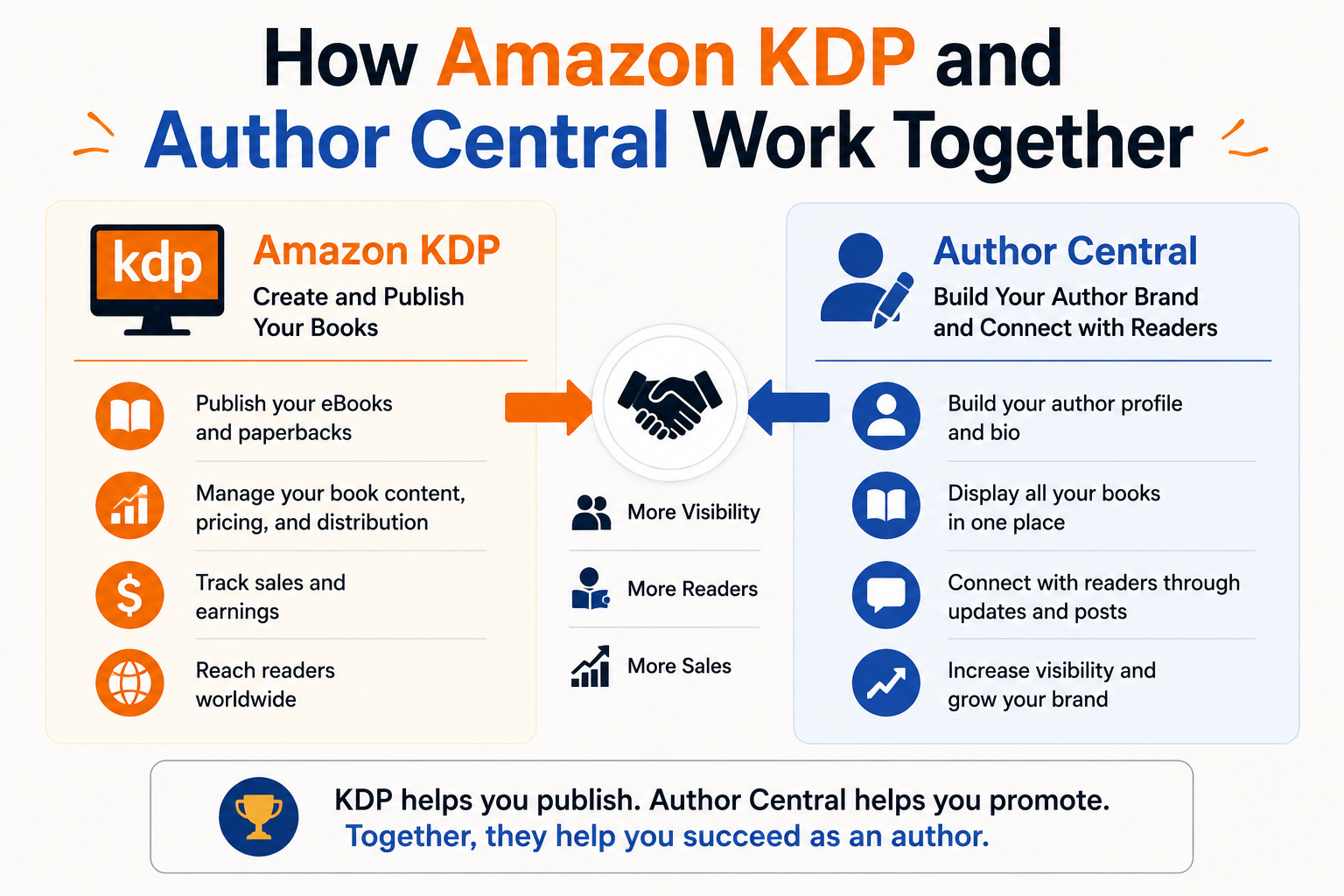
Amazon gives you two separate tools to work with: KDP and Author Central. Most authors use one but ignore the other. Some use both but never connect them properly. The ones who understand how these two platforms feed into each other? Those are the authors whose books keep showing up in search results month after month, even without a big marketing budget behind them.
What Amazon KDP Actually Is (and What Most People Get Wrong About It)
Amazon Kindle Direct Publishing is the platform where you publish your book. You upload your file, set your price, pick your categories, write your description, and hit publish. Simple enough on the surface. But here is where authors usually stumble: they treat KDP like a form to fill out rather than a tool to work with.
Every single thing you type into your KDP listing, your title, your subtitle, your seven keyword fields, your book description, your category selections, all of it feeds directly into how Amazon decides where to show your book. This is what people mean when they talk about amazon book page optimization. It is not some complicated technical process. It is just understanding that your listing is a product page, and product pages that are built thoughtfully get found while ones that were rushed through in twenty minutes get buried on page forty of the search results.
Think about it this way. Two authors write books on the same topic. One of them spends an afternoon on their KDP listing, researches real reader search terms, writes a description that actually speaks to what their audience wants, and picks categories where they have a fighting chance of ranking. The other author copies a paragraph from the back cover, picks two broad categories, and moves on. Same book quality. Completely different visibility. That gap is entirely created by the listing.
What Author Central Is and Why Skipping It Is a Real Mistake
Amazon Author Central is free, it takes maybe an hour to set up properly, and a surprising number of authors have never touched it. Which honestly makes no sense once you understand what it does.
When you set up Author Central and claim your books, something changes on every product listing you own. Your name, which was previously just plain text, becomes a clickable link. Anyone who reads your book, likes it, and wants to find out what else you have written can click your name and land on a proper author page instead of going nowhere. That is a huge difference, especially if you have more than one title out.
Your Author Central profile can include a full biography, your photo, links, videos, upcoming events, even a blog feed. It becomes the place that gives readers a reason to stick around after they finish one book. And honestly, building that kind of reader relationship on Amazon is something most authors overlook completely while they are busy chasing launch week numbers.
But there is another side to Author Central that matters even more from a listing standpoint. It gives you the ability to add editorial reviews directly to your book pages. You cannot do this through KDP. If a book blogger reviewed your novel, or a trade publication covered your nonfiction title, or a well-known name in your genre gave you a quote, you can put that on your listing through Author Central. That kind of social proof changes how new readers perceive your book before they have read a single page.
How the Two Platforms Actually Work Together
This is the part that clicks everything into place. Once you have claimed your books on Author Central, the two platforms start working as a system rather than as separate tools.
Your name becomes a link on every listing. Readers move between your books naturally. Your editorial reviews appear on your product pages. Your bio shows up below your book description. Your sales ranking data becomes visible in Author Central so you can actually track what is happening with your listings over time and make adjustments based on real numbers rather than guesses.
There is also a quieter benefit that is worth mentioning. Amazon pays attention to whether authors are actively maintaining their presence on the platform. A complete, well-maintained Author Central profile signals that you are a serious publisher, not someone who uploaded one book and disappeared. That tends to have a positive effect on how your listings perform in search. It is part of what makes amazon book page optimization a long-term strategy rather than a one-time task.
Here is a quick look at what Author Central specifically adds to your KDP listings:
- Editorial Reviews. Reviews and endorsements that appear on your product page, something KDP has no option for on its own.
- Author Bio on Every Listing. Your biography appears automatically below the book description on each title you own.
- Sales and Ranking History. Actual data on how your books are performing over time, which helps you make real decisions.
- A Unified Catalog. All your titles in one place, making it natural for readers to move from one book to the next.
- A Personal Note Section. The ability to write something directly to readers right on the product page itself.
Amazon Book Page Optimization: Where the Real Work Happens
Most authors who look at their book’s sales numbers and feel frustrated have not spent serious time on their listing. This is the honest truth. A great book with a weak listing will consistently underperform a decent book with a strong one. The listing is what gets people to click. The book is what gets them to come back.
So here is what actually matters on the KDP side.
Amazon reads your subtitle and uses it as a ranking signal. If your subtitle is vague or purely creative, you are leaving discoverability on the table. A subtitle that includes your main keyword naturally and communicates exactly what the book delivers will outperform a clever one almost every time. Be clear. Be specific. Save the poetry for the book itself.
This is the most common mistake and it costs authors real money. A description that summarizes the plot or the topic is not doing its job. Your description needs to open strong enough to stop a scrolling reader, speak directly to what they are looking for, and close with a reason to buy right now. KDP allows HTML formatting in the description field. Use it. Break up the text, bold key lines, and make it easy to read on both desktop and mobile.
Every field you leave blank is a missed chance to show up in a search. Think like your reader, not like a writer. What would someone actually type into Amazon’s search bar when they want a book like yours? Long, specific phrases work far better than single words. If you want to research this properly, tools like Publisher Rocket can show you exactly what real readers are searching for in your genre.
You get two category choices inside KDP, but you can contact Amazon support and request to be placed in additional categories. Some authors end up in ten. The strategy here is to find categories where your book genuinely belongs but where the competition is manageable enough that you can realistically rank near the top. A bestseller badge in a well-chosen niche category brings in steady, consistent traffic. That badge does real selling work for you.
Amazon Kindle Page Optimization: What Is Different for Ebooks
Print and Kindle optimization share a lot of the same principles, but there are a few things specific to ebooks that are worth giving real attention to.
The Look Inside feature is one of them. Amazon automatically shows the first ten percent of your Kindle book to any reader who wants a preview. That opening section needs to function as a sales tool, not just an introduction. Readers who open the preview are already interested. They are deciding whether to commit. If the first few pages do not pull them in, they will close it and move on. The writing quality matters, obviously, but so does how the content is formatted and whether it immediately delivers on the promise your cover and description made.
Beyond that, here are the elements that shape amazon kindle page optimization most directly:
- Cover Design at Small Sizes. Kindle covers appear as tiny thumbnails in search results. A cover that looks beautiful at full size but loses its impact at eighty pixels wide is a problem. The title text needs to be readable at thumbnail scale. If it is not, you are losing clicks before readers even land on your page.
- Pricing Strategy. Books priced between $2.99 and $9.99 earn the 70% royalty rate. More importantly, buyers have price anchors, and testing where your readers feel the value sits can meaningfully affect your conversion rate. Promotional pricing through Countdown Deals is also worth experimenting with.
- KDP Select Enrollment. Enrolling makes your book available to Kindle Unlimited subscribers, which for many genres represents a very large potential readership. You also get access to free promotion days and Countdown Deals. For authors who are building an audience, the additional exposure often outweighs the exclusivity requirement.
- Your Opening Pages. This circles back to Look Inside. Give your opening the same attention you give your cover and description. It is part of the same sales funnel.
- A+ Content. If you qualify through Brand Registry, A+ Content lets you add enhanced visuals, additional text sections, and comparison tables below the standard description. It makes your listing look noticeably more complete and professional, and it gives you more space to make the case for your book.
When It Makes Sense to Work With Amazon Page Optimization Services
There is a gap between understanding what needs to be done and actually doing it well. Amazon’s algorithm is not static. What ranks well today is shaped by factors that shift over time, and keeping up with that while also writing books is genuinely difficult. That is why a lot of serious authors, especially those with multiple titles or backlist books that have stopped performing, start looking at professional amazon page optimization services.
Good optimization services do not just rewrite your description. They research your actual market, find out what readers in your genre are searching for right now, audit your existing listings for what is working and what is not, rebuild your keyword strategy from the ground up, and help you position your book in categories where it can actually rank. They also handle Author Central setup and improvements if that has been sitting on your to-do list for a while.
The return on that kind of work can be significant. A backlist title with an outdated description and the wrong categories can sit invisible for years. The same book with a properly optimized listing starts showing up in searches it never appeared in before. The book has not changed at all. Only the way Amazon sees and presents it has changed.
A Simple Way to Think About the Strategy
Stop treating KDP and Author Central as two separate chores. Think of them as one system with two entry points. Here is a straightforward way to approach it:
- When you publish through KDP, treat the listing as seriously as you treat the manuscript. Research your keywords. Write your description to sell, not to summarize. Pick categories with intention.
- Set up Author Central immediately after publishing and fill it in completely. Do not leave the bio blank, do not skip the photo, and if you have any editorial reviews, add them right away.
- Use Author Central to push those editorial reviews onto your book product pages. They show up in a prominent position and they carry real weight with undecided readers.
- Check your Author Central sales and ranking data regularly and use it. If a book is dropping, look at the listing. Something usually needs refreshing.
- Every three to six months, revisit your KDP keywords and descriptions. Reader search behavior changes. The categories that were working a year ago may not be the best fit now. Keep up with it.
- As your catalog grows, your Author Central profile becomes more valuable. Each new book you publish strengthens the whole system because readers can move through your work naturally.
Mistakes That Quietly Cost Authors Sales
These are not beginner mistakes. Authors who have been publishing for years make them too.
- Describing the book instead of selling it. Your description needs to make someone feel something and want to act on it. A plot summary does not do that. A pitch does.
- Never touching Author Central. If your name on every listing is just plain, unlinked text, you are breaking the journey for readers who would have happily bought another book from you. One hour of setup prevents this permanently.
- Using keywords that are too broad or too irrelevant. Readers who land on your listing because of a mismatched keyword and then immediately leave are sending Amazon a signal that your book is not what people are looking for. That hurts your ranking. Precision matters more than volume.
- Ignoring editorial reviews. A quote from a credible source, even a well-known blogger in your genre, adds a layer of trust that a hundred reader reviews often cannot. If you have endorsements and they are not on your listing, you are underselling your book.
- Treating your listing as a finished product. It is not. It is a living document that should reflect what is currently working in your market. Authors who revisit their listings regularly keep their books competitive. Those who do not, quietly watch their rankings drift down.
Final Thoughts
KDP and Author Central were not built to be used in isolation. They work as a pair. One handles the technical infrastructure of getting your book listed and discoverable. The other builds the human layer that gives readers a reason to trust you and explore your catalog. Together they create something neither one offers alone.
The authors who understand amazon book page optimization as an ongoing practice rather than a one-time setup tend to build catalogs that generate income for years. The authors who rush through their listings and never look back tend to wonder why their books stop selling after launch week.
Whether you manage this yourself or bring in amazon page optimization services to support you, the underlying principle is the same. Your Amazon listing is a storefront. Treat it like one. Keep it clean, keep it current, and make sure everything on it is working toward the same goal: getting the right reader to click buy.
Start with whichever title matters most to you right now. Read your own listing the way a stranger would. Ask yourself honestly whether it is doing its job. Then make the changes you know it needs. The results usually speak for themselves.