Book Writing
 Book Cover Design
 Book Editing
 Book Formatting
 Book Publishing
 Book Video Trailer
 Book Printing
 Audio Books
 Book Illustrations
 Author Website
 Amazon Page Optimization
 Book Marketing
 Fiction Writing
 Non-Fiction
 Autobiography
 Memoir
 Novel Writing
 Children's Book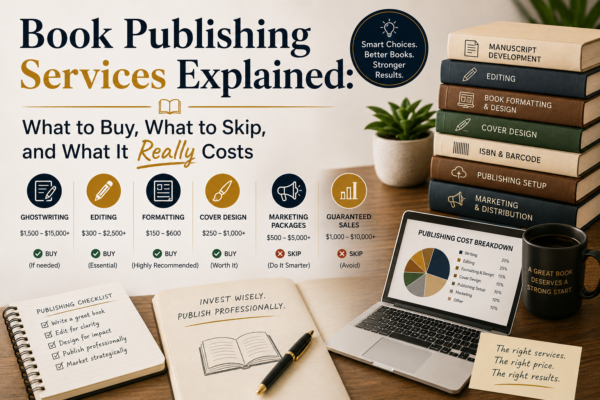
Publishing a book in 2026 is genuinely exciting but also genuinely confusing. The options have multiplied, the pricing varies wildly, and the difference between a book that looks professional and one that looks like it was formatted in a hurry can mean everything when a reader is deciding whether to buy.
I’ve talked with hundreds of authors navigating this process, and the number one thing that trips people up isn’t the writing it’s figuring out what kind of help they actually need, and what they can realistically afford to spend on it. This guide is my attempt to cut through the noise.
Whether you’re a first-time author trying to figure out where to even start, or someone who’s published before and wants to do it better this time, the goal here is simple: help you make a decision you won’t regret six months after your book goes live.
What Book Publishing Services Actually Do
“Book publishing services” is an umbrella term that covers everything from a single editor working freelance to a full-service agency that handles your book from rough draft to launch campaign.
What most authors actually need is somewhere in the middle. You’ve written the book. Now you need people who know what they’re doing to help you turn it into something that competes visually, structurally, and commercially with books from major publishers.
Here’s what typically falls under that umbrella:
Not every author needs all of these. A business author who already has a strong social following might skip the marketing package. A novelist self-publishing for the first time might need everything. The key is knowing what you need before you start comparing prices.
The most common mistake I see: Authors pay for a full-service package when they only needed formatting and cover design or they skimp and only pay for formatting, then wonder why their book isn’t selling. Match your spending to your actual gaps.
The Main Types of Publishing Services
The publishing services landscape has shifted dramatically over the past few years. The lines between “self-publishing” and “professional publishing” have blurred in ways that actually work in your favor if you know how to navigate them.
| Service Type | What You Get | Best For |
|---|---|---|
| Kindle / Amazon-Focused | eBook formatting, Amazon SEO, digital distribution, keyword strategy | Authors prioritizing Amazon’s marketplace and digital-first readers |
| Full-Service Publishing | Everything from manuscript assessment through launch — editing, design, print, distribution, marketing | Authors who want to hand the project off and stay focused on writing |
| Hybrid Publishing | Author-funded model with professional quality; you keep your rights and a larger royalty share | Experienced authors with some publishing knowledge who want flexibility |
| Print-on-Demand | Physical books printed as orders come in no upfront inventory, no warehouse costs | Anyone wanting physical copies without committing to a large print run |
| Marketing-Only | Launch planning, ad campaigns, ARC distribution, review strategy, social content | Authors with a finished, already-formatted book who need visibility |
Amazon-Focused Services: Why They’ve Changed Everything
A few years ago, publishing on Amazon meant doing it yourself uploading files, guessing at keywords, hoping for the best. Today, there are entire service companies built around optimizing the Amazon publishing experience, and for many authors, this is genuinely the right starting point.
The appeal is obvious. Amazon accounts for the overwhelming majority of ebook sales in the US, and a significant chunk of print book sales too. A service that knows how Amazon’s algorithm works, what converts on a product page, and how to position a book in a category can mean the difference between 50 sales and 5,000.
Amazon-focused publishing services can often have your book live and selling within a few weeks of receiving your manuscript. Traditional publishers still average 12–18 months from acquisition to shelf.
The Real Story on Publishing Costs
Publishing costs are all over the map, and that range exists for real reasons not just because companies are charging whatever they think they can get.
What Actually Drives the Price
Book length and complexity. A 40,000-word romance novel is a fundamentally different project than a 100,000-word business book with 60 charts, 200 footnotes, and a bibliography. Editors, designers, and formatters price accordingly and they should.
Scope of services. A basic package might cover formatting and uploading. A premium package from a full-service company might include three editing passes, a custom cover with three concept rounds, an author website, a press release, and a six-week launch campaign. These are not comparable products.
Timeline. If you need your book finished in six weeks for a conference keynote, expect to pay a rush premium typically 25–50% above standard rates. Good companies have other projects running; expediting yours requires reshuffling their team.
Many authors budget for publishing but forget that the work doesn’t stop at publication day. A realistic marketing budget for the first three months post-launch should be an additional 20–40% of what you spent on production. A brilliant book that nobody can find is still an invisible book.
Online Services vs. Traditional Publishers: Choosing Your Path
This is the question I get asked more than any other, so let me give you a direct answer rather than a balanced-but-useless “it depends.”
For most authors reading this guide especially self-publishing authors, first-time authors, and nonfiction authors building a platform professional online publishing services will serve you better than traditional publishing. Here’s why that’s not actually a controversial statement.
Traditional publishing still makes sense if you’re writing a book where physical bookstore placement genuinely matters to your strategy, or if you’re in a market where the publishing house’s relationships are worth more than your creative control and royalty share. Academic publishing, certain literary fiction, and major celebrity memoirs all still follow this path for good reason.
For everyone else, the calculus has changed. Professional online publishing services have gotten genuinely excellent, and the ability to move quickly, keep your rights, and earn 60–70% royalties on each sale is hard to argue with.
How to Choose: A Practical Framework
Once you’ve decided on the general direction, here’s how to evaluate the companies you’re considering.
Before You Talk to Anyone, Know This
- Your book’s genre, target reader, and approximate word count
- Whether you want print, ebook, or both and in what order
- Your distribution goals: just Amazon, or wider physical retail too?
- Your realistic timeline and whether you have a hard deadline
- Your total budget, including post-launch marketing
Walking into a conversation with these answers means you’ll get more accurate quotes, avoid being upsold on services you don’t need, and waste a lot less time.
Questions That Separate Good Services from Bad Ones
When you’re talking to potential publishing partners, the quality of their answers tells you more than their portfolio. Here are the questions worth asking:
Get detailed quotes from at least three companies before committing. Don’t compare headline prices compare what’s included line by line. A $4,000 package that includes developmental editing, cover design, and distribution setup is a completely different thing than a $4,000 package that’s just formatting and layout.
Common Mistakes That Cost Authors Money
Choosing based on price alone. The cheapest option rarely produces a book that competes. The most expensive option isn’t automatically better. Look at the work they’ve done, talk to their authors, and make a decision based on fit and quality not sticker price.
Skipping developmental editing to save money. A book that’s structurally weak or poorly argued won’t be saved by a beautiful cover and flawless formatting. If your manuscript hasn’t had a real developmental edit, that’s almost always the first place to spend money.
Not planning for post-launch. Publication day is not the finish line. It’s the starting gun. Authors who treat it as the end of their work often end up with a well-produced book that quietly disappears. Build a launch plan even a modest one before you sign anything.
Signing contracts without reading the rights clauses. Rights language in publishing contracts can be genuinely opaque, and a clause that limits what you can do with your book in five years is easy to miss when you’re excited about publication. If you’re unsure, pay a publishing attorney for an hour of their time. It costs less than regret.
Ready to Publish Your Book?
Our team works with authors at every stage from manuscript assessment to launch strategy. Get a free consultation to find out what your book actually needs.