Book Writing
 Book Cover Design
 Book Editing
 Book Formatting
 Book Publishing
 Book Video Trailer
 Book Printing
 Audio Books
 Book Illustrations
 Author Website
 Amazon Page Optimization
 Book Marketing
 Fiction Writing
 Non-Fiction
 Autobiography
 Memoir
 Novel Writing
 Children's Book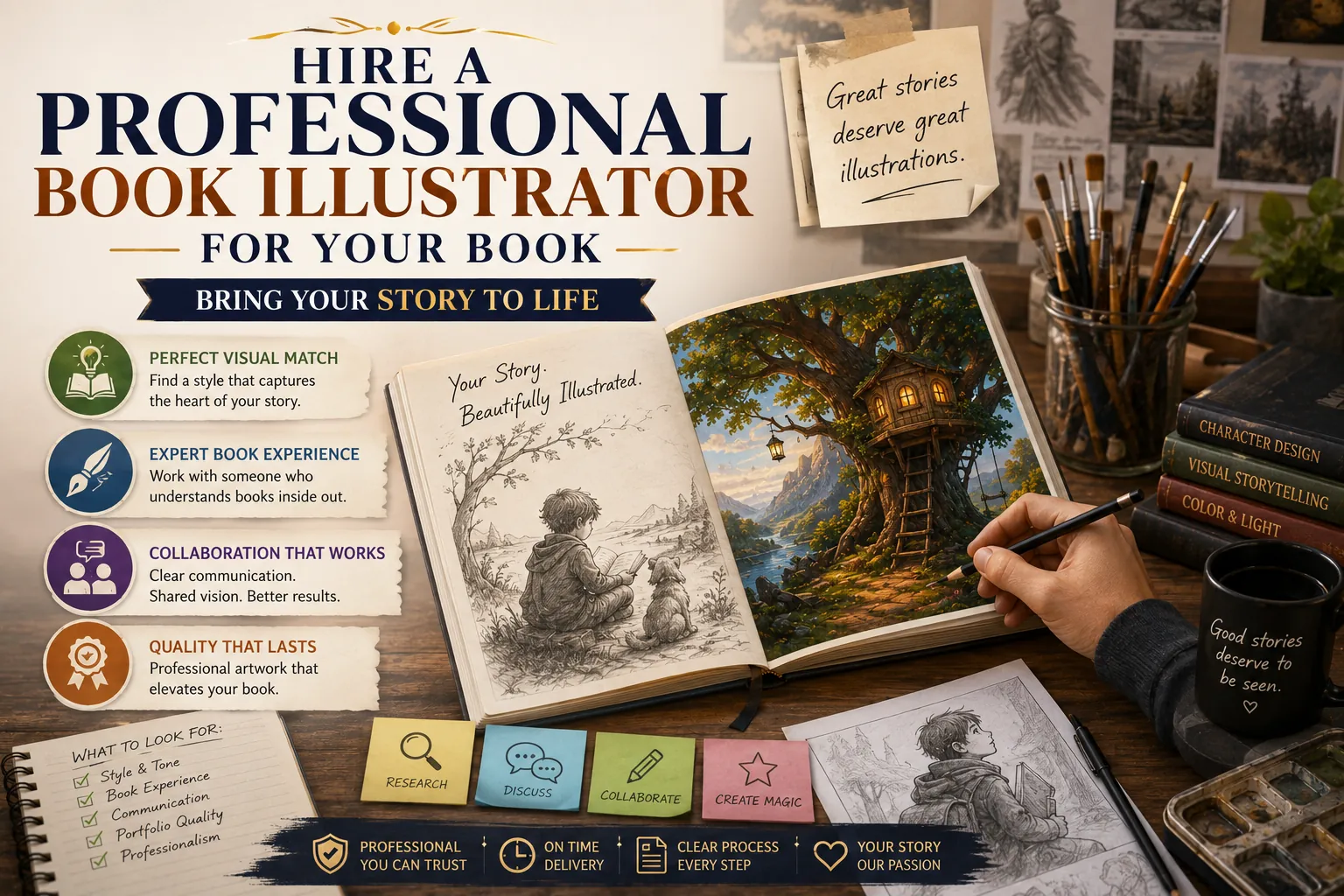
There is a specific kind of frustration that only writers understand. You finish something. You actually finish it, which most people never do, and then you sit there looking at it wondering why it still does not feel complete. That was me about two years ago. Manuscript done, cover thrown together in Canva, and a gut feeling I kept pushing away that told me this was not ready. I ignored that feeling for longer than I should have. Hiring a professional book illustrator felt like an expense I could skip, a luxury for people with publisher budgets, not for someone doing this independently. That thinking cost me more time and money than just doing it right the first time ever would have.
I Thought Good Writing Was Enough
Here is something I genuinely believed for a long time. If the writing is strong, the visuals are secondary. I thought this because I had read books with mediocre covers that I loved anyway, and I figured my readers would do the same thing.
What I did not account for is that those books usually had something I did not have, which was a publisher’s name on the spine and a distribution network putting them in front of readers who were already primed to pick them up. When you are independent, nobody is primed for anything. A stranger on the internet is going to make a decision about your book in about two seconds based almost entirely on how it looks. Two seconds. That is not enough time for your writing to save you.
A cousin of mine told me something that stuck. She said she had never once read the back cover of a book before deciding whether to pick it up from a shelf. She looks at the front, decides yes or no, and only then turns it over. I asked a few more people and got roughly the same answer. That was uncomfortable information but it was useful.
The First Time I Tried to Find Someone
I went to a freelance platform and posted what I needed. Within a day I had maybe thirty responses. I had no idea how to evaluate them so I did what most people do when they are overwhelmed and have a budget they are nervous about. I sorted by price and picked someone in the middle of the range who seemed enthusiastic.
The first sketches came back and my stomach dropped a little. They were not terrible. They were just completely wrong for my book.
The style felt sharp, angular, and slightly cold. My book, however, was meant to feel warm and a bit playful.
I shared feedback and went through several revisions. Each round improved the work slightly. In the end, the illustrations looked polished. Still, something felt off emotionally, and I could not fully explain why.
I published it anyway because I had already paid and I did not want to start over. That version of the book still exists somewhere and I cringe every time I am reminded of it.
What Starting Over Actually Taught Me
The second time I approached this completely differently. I stopped thinking about budget first and started thinking about fit. I spent probably two weeks doing nothing but looking at illustrated books, saving images that felt right, trying to understand what I was actually drawn to visually before I talked to a single person.
That sounds like a lot of time to spend before even beginning the search but it was the most useful thing I did. Because when I finally started reaching out to illustrators, I had something concrete to share. Instead of relying on vague emotional descriptions and hoping the illustrator would understand, I came prepared with clear visual direction. I gathered specific references that showed exactly what I had in mind. This allowed me to communicate details like color palettes, line weight, and even the subtle emotions in the characters’ expressions.
The person I eventually hired told me later that my brief was one of the clearest she had received from an independent author. That made the whole collaboration smoother than anything I had done before.
What You Should Actually Be Looking For
The Style Has to Match Your Story’s Feeling
When people say find someone whose style you like, they are giving you incomplete advice. You need to find someone whose style matches the specific emotional register of your particular book. Those are different things.
I liked a lot of portfolios I came across. Clean, impressive work. But liking someone’s art and knowing it belongs in your book are two completely separate feelings. The one you want is when you look at someone’s portfolio and without any effort at all you start seeing your characters in those images. That is the feeling you are waiting for. Do not settle for anything less than that because you will feel it every time you open the finished book if the fit is wrong.
Book Experience Is Not Optional
There is a difference between someone who is a great artist and someone who is a professional book illustrator in the full sense of what that means. Knowing how to draw beautifully is one skill. Knowing how a double page spread works, how to lead a reader’s eye from one page to the next, how to balance an image with text so neither one drowns the other, how to design a cover that works at three inches on a phone screen and also at full size on a shelf, those are separate skills that come specifically from working on books.
I made the mistake of hiring someone with a gorgeous portfolio who had never actually worked on a book before. The individual images were lovely. The way they sat on the page was awkward and the cover did not work at thumbnail size at all, which is where most people would first see it online. Book experience matters and it is worth asking about directly before you commit to anything.
Pay Attention to How They Talk to You Before You Hire Them
This is something I did not know to look for the first time and now I think it might be the most important thing. How someone communicates before a project starts tells you almost everything about how the project itself will go.
When I reached out to the illustrator I ended up working with, she did not just say sounds great when can we start. She asked me about my timeline, my printing setup, what file formats my printer required, who my audience was, whether I had thought about how the illustrations would be used in any digital versions. These were questions I had not fully answered myself yet. That is a good sign. Someone who asks smart questions before taking your money is someone who has done this enough times to know what goes wrong when those questions are not answered early.
The Cost Thing and Why It Messed With My Head
I am going to be straightforward about this because I wasted a lot of mental energy on it. Good illustration is expensive and it is supposed to be. The rates that experienced professional book illustrators charge reflect years of developing a skill, the time it actually takes to produce finished artwork, and the licensing rights you are getting to use that artwork commercially. When you understand what you are actually paying for, the number makes more sense.
Picture book illustration costs can vary widely, but professional rates typically start in the low thousands and increase depending on factors like page count and the illustrator’s experience. Projects that involve spot illustrations or simple chapter headings are generally more affordable. On the other hand, highly technical nonfiction illustrations can fluctuate significantly in price due to their complexity.
What I finally said to myself was this. I had spent months writing this book. If the thing that represented it to the world looked like I had not taken it seriously, then all of that time writing it was being undermined before anyone even read a word. That reframe helped me stop treating the illustration budget like a place to cut corners.
Where I Actually Found Someone Who Worked Out
Reedsy was where I had my best experience. The platform does a reasonable job of vetting people before they can list themselves, which means the baseline quality is more consistent than open freelance platforms where literally anyone can post a profile.
Something that worked even better, honestly, was going back to books I already had on my shelf that I loved visually and looking at who illustrated them. Publishers credit illustrators in the book, usually on the copyright page. I found two people that way whose work I genuinely admired, reached out to both of them directly, and one of them was available for independent projects and within my budget.
Author communities are also worth trying. I was in a few online groups for independent authors and when I asked for referrals I got actual names with actual experiences attached to them. Not just here are some platforms to try but this specific person did my book and here is what working with them was like. That kind of specific information is hard to find anywhere else.
How the Actual Project Went
We started with a brief I had put together over a few days. It covered the story, the tone, the audience, visual references I had collected, a few things I specifically wanted to avoid, and some notes about my printing and distribution setup. She came back with questions, we had a call, and by the time she started sketching we were genuinely on the same page.
The thumbnail stage was where I learned to give feedback properly. My instinct was to react to what I did not like, but what actually helped was trying to articulate what I had imagined instead. Not this does not work but I was picturing him looking out the window rather than at the camera, something that feels more internal. That kind of directional feedback made every round faster.
By the time the color work came in I was mostly just excited. There were small adjustments but nothing structural because the groundwork had been laid properly at the beginning.
What Was Actually Different When the Book Came Out
The difference was not subtle. The previous version of my book existed. This version of my book had a presence. People mentioned the cover before they mentioned anything else. Two readers specifically said they bought it because of how it looked. A teacher who used it in her classroom told me the kids responded to the illustrations in a way that made the story land differently than it would have as text alone.
I am not saying good illustrations will fix a bad book. They will not. But good illustrations will make a good book visible in a way it cannot be on its own, especially when you are publishing independently and you do not have a marketing team or a publishing house name doing any of that work for you.
If You Are Still on the Fence About This
Stop waiting for the budget to feel comfortable because it probably never fully will. Stop telling yourself readers will look past the visuals if the writing is good enough because most of them will not get far enough into the writing to find out.
Spend real time on the search. Look at more portfolios than you think you need to. Find someone who has actually done books, not just someone who makes beautiful art. Have conversations before you hire anyone and pay attention to how those conversations go. Get a contract with everything written down including revision rounds, timeline, file formats, and usage rights.
When you do find the right professional book illustrator for your project, you will feel it. Not because they are the most famous or the most expensive but because their visual world and your written world will feel like they were made for each other.
That is the collaboration worth waiting for.