Book Writing
 Book Cover Design
 Book Editing
 Book Formatting
 Book Publishing
 Book Video Trailer
 Book Printing
 Audio Books
 Book Illustrations
 Author Website
 Amazon Page Optimization
 Book Marketing
 Fiction Writing
 Non-Fiction
 Autobiography
 Memoir
 Novel Writing
 Children's Book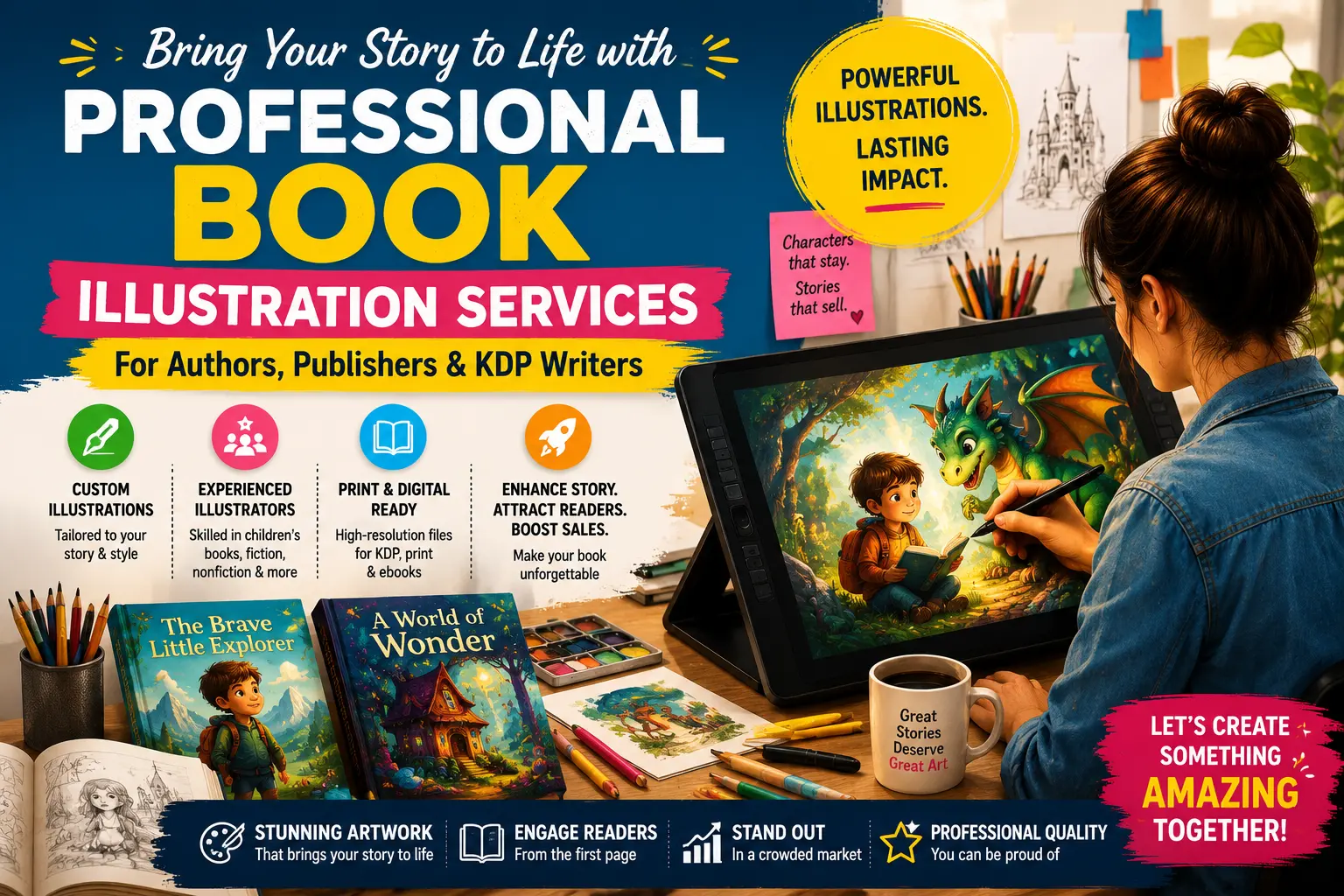
My cousin published a children’s book two years ago. She had spent fourteen months writing it, revising it, reading it aloud to her kids until every sentence felt right. When it finally went live on Amazon, she sent me the link and I clicked it immediately. The cover stopped me. Not in a good way. It looked like something assembled from a free icon website, flat colors, stiff shapes, no life in it at all.
The book sold eleven copies in the first month, mostly to family. Six months later she found an illustrator through a friend’s recommendation, had the cover redone, and relaunched. Same book, same words, same price. First month after the relaunch she sold over two hundred copies. That experience taught me more about book illustration services than anything I had read before. It is not a cosmetic decision. It is a commercial one, and for many books it is the decision that determines whether the book finds its readers or disappears quietly.
Whether you are writing for children, putting together an illustrated poetry collection, or formatting something for KDP, the visual layer of your book is working on readers before they read a single word. It is worth treating it that way from the beginning.
Why Most Authors Think About This Too Late
The mistake that costs more to fix later
The pattern I keep seeing is that authors think about illustrations somewhere near the end of the process. Manuscript finished, formatting mostly sorted, and then the question comes up almost as an afterthought. Should I add some illustrations? By that point, certain decisions have already been made that constrain what illustration can do for the book.
Illustration is not something you apply to a finished book like a coat of paint. It is part of how the book communicates. The books that stay with readers, the ones people remember from childhood with genuine affection, are remembered almost entirely through their images. The color of a room in a particular scene. The expression on a character’s face at the moment everything changes. The way a certain landscape made you feel unsafe or safe. Those were choices made by an illustrator who was thinking about the story deeply, not someone who came in at the end and drew pictures to match scenes that had already been locked down.
What this means practically for KDP writers
If you are selling on Amazon, the thumbnail of your cover is your first and sometimes only chance to get a reader to stop scrolling. That image communicates something about your book in about two seconds. Generic illustration communicates something too — it tells the reader that the book was not taken seriously by the person who made it, and that impression is very hard to recover from further down the page.
What Professional Book Illustration Services Actually Cover
Character design is its own discipline
When people hear illustration they think of someone drawing pictures. What professional book illustration services actually involve is considerably more layered than that. Character design alone is a serious undertaking. It is not just deciding what your protagonist looks like. It is developing a visual identity that carries emotional truth across thirty, forty, fifty pages. The way a character holds their shoulders when they are nervous. What their eyes do when they are pretending to be fine. An illustrator who does this well makes characters that readers feel they know personally. An illustrator who does it poorly gives you a main character who seems like a slightly different person every few pages, and readers feel that inconsistency even when they cannot name it.
Scene work, covers, and the details most people overlook
Scene illustration requires something closer to a filmmaker’s instincts than most people expect. Composition, the direction of light, how a reader’s eye moves across a double page spread without them realizing it is being guided these are decisions that happen in every single illustration. A cover is a different challenge again. It has to work as a tiny thumbnail on a phone screen and as a full printed object you hold in your hands. It is a piece of marketing that also has to be art, and that is a harder combination than it sounds. Many illustrators who produce beautiful interior pages struggle with covers specifically because of that dual requirement.
Finding the Right Illustrator Is a Matching Process
Style fit matters more than portfolio quality alone
I have watched authors hire illustrators based purely on how impressive a portfolio looked without asking whether that style actually fit their manuscript. The results are usually books that feel visually at odds with themselves. If your story is quiet, tender, and emotionally careful, and you hire someone whose natural aesthetic runs toward bold graphic lines and high contrast imagery, you get a book where the words and the pictures seem to be describing different emotional experiences. Readers feel that mismatch without being able to explain it. They just find the book slightly uncomfortable to spend time with.
When you look through a portfolio, do not stop at the showpiece images. When reviewing a portfolio, try to find a complete book project if one is available. Pay attention to whether the character on page three still feels like the same person on page twenty-six. Facial expressions deserve extra scrutiny because most emotional storytelling in illustration is communicated through faces. Beautiful backgrounds paired with flat, expressionless faces will undermine any story that depends on character connection, and most good stories do.
Questions worth asking before you hire anyone
Ask about their specific experience with book illustration services in a full book production context. There is a real difference between an artist who creates individual pieces and one who has completed a full illustrated book. The book process is collaborative, iterative, and involves taking feedback without treating every revision as an attack on the work. That is a different skill from making art, and not everyone has both.
The Technical Requirements Nobody Mentions Until It Is Too Late
Print specifications for KDP and POD platforms
Publishing through KDP or any print-on-demand platform means your illustrations have to meet specific technical requirements. Files need to be 300 DPI minimum for print. Color profiles matter because what looks accurate on your screen can look noticeably different once it goes through a commercial printer. Bleed areas exist because paper is trimmed after printing and anything important sitting too close to the edge gets cut. Safe zones determine where text and key visual elements need to sit to survive that trimming process.
Why hiring someone unfamiliar with print production costs you later
A professional working in book illustration services for the self-publishing market knows all of this without being told. They deliver files labeled clearly, at the correct resolution, with proper bleed already built in. When this goes wrong it is almost always because the author hired someone with genuine artistic talent who had simply never prepared files for commercial print before. The illustrations can be genuinely lovely and still create problems that cost time and money to sort out at the upload stage.
Honest Answers on Cost and Timeline
What the numbers actually look like
A complete picture book project, cover plus full interior spreads, will take a professional illustrator somewhere between two and four months under normal working conditions. Sometimes longer if the project is complex or their schedule is full. Work that gets rushed looks rushed. That is almost a universal rule in illustration.
On cost, professional illustrators working at an experienced level typically charge somewhere between one thousand and five thousand dollars for a full picture book. Illustrators with a strong reputation and a waiting list charge significantly more. There are newer illustrators who charge less and produce strong work, but you need to see completed book projects in their portfolio before committing, not just individual pieces.
What to avoid and why
Platforms offering complete illustrated children’s books for a few hundred dollars are not delivering professional book illustration services. They are delivering volume. What comes back tends to be visually generic in ways that make your book harder to distinguish from the hundreds of similar-looking titles already on Amazon. That is the opposite of what illustration is supposed to do for you.
How to Write a Brief That Actually Helps Your Illustrator
What to include and why it matters
Handing your manuscript to an illustrator and saying take it from here can work if you have found someone with strong instincts and no hesitation about asking clarifying questions. More often it produces rounds of revision and a final result that is close to what you imagined but not quite right. Close but not quite right in a book illustration context is an expensive outcome.
A useful brief describes the emotional experience you want a reader to have while turning pages .A strong brief highlights the visual details that matter most to the story. Reference images can help establish direction, though they should serve as inspiration rather than material to copy. It should also clarify what elements are fixed and which parts of the project are open to creative interpretation. And it establishes from the beginning how many revision rounds are included, what the milestone dates are, and what file formats you need at the end.
What Happens After the Files Are Delivered
Layout, formatting, and getting it right for upload
Getting illustration files from your illustrator is not the end of the work. Those files need to be integrated into a layout. If you are working with a book designer the illustrations get placed alongside the text and the whole document gets prepared for print or digital distribution. If you are going directly to KDP, your cover file needs to match their cover calculator precisely and your interior PDF needs to meet their specific formatting requirements. An illustrator or designer who has done this before understands what that means. One who has not may deliver beautiful files that still require additional work before they are upload-ready.
The Real Reason This Investment Is Worth Making
A book with original illustration that was developed thoughtfully does not just sell better at launch. It builds recognition over time. If you are writing a series, a consistent visual style across multiple books creates the kind of familiarity that readers come back to. Parents who loved the feeling of your first book will look for the second one specifically because it feels like familiar territory.
The authors I have seen build lasting readership took book illustration services seriously early, not because they had budgets that made it easy, but because they understood that the visual experience of a book is part of the book itself. It is not a layer you add afterward. It is woven into what the book is and how readers experience it. The writers who treated it as an afterthought are often the ones who cannot understand why a book they genuinely worked hard on is not finding its audience. Sometimes you do not have to look further than the cover to find the answer.
📚 Keep Reading — Related Guides
🔗 How Book Illustration Services Improve Reader Engagement
🔗 Custom Book Illustrations Designed for Bestselling Books
🔗 Children’s Book Illustration Services: Cost & Packages Explained
🔗 Hire a Professional Book Illustrator for Your Book