Book Writing
 Book Cover Design
 Book Editing
 Book Formatting
 Book Publishing
 Book Video Trailer
 Book Printing
 Audio Books
 Book Illustrations
 Author Website
 Amazon Page Optimization
 Book Marketing
 Fiction Writing
 Non-Fiction
 Autobiography
 Memoir
 Novel Writing
 Children's Book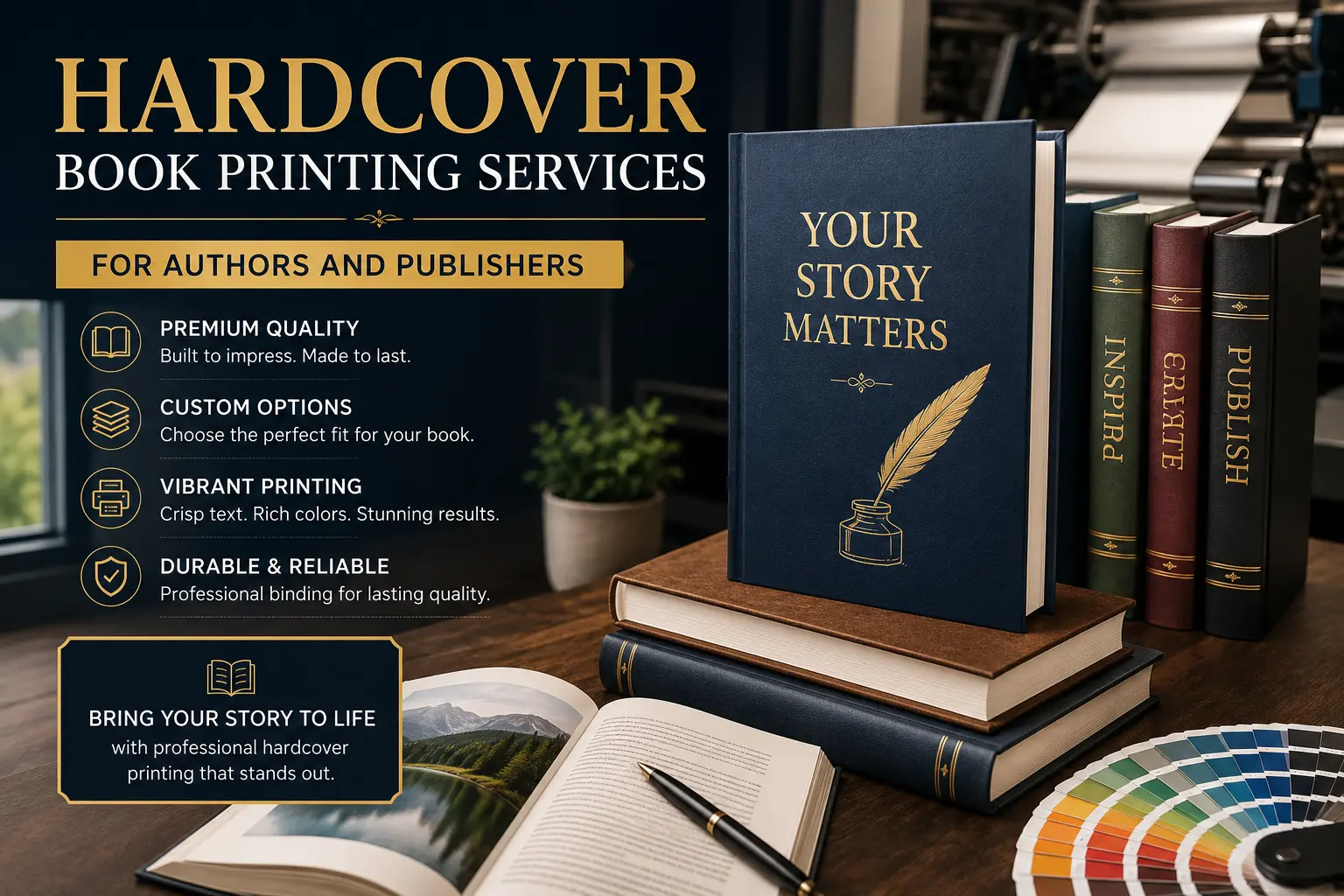
There’s something about holding a hardcover book that a paperback just can’t match. The weight of it. The way the cover feels sturdy instead of flimsy. That sense that this thing was actually built to last. If you’re an author or publisher trying to figure out where to get your book made, hardcover book printing services matter more than most people realize. That usually only becomes clear after going through the process once and making a few costly mistakes along the way.
I’ve talked to a lot of independent authors over the years who assumed printing was the easy part. Write the book, format it, send it off, done. Then the proof copy shows up in the mail and something feels off. The spine looks cheap. The pages are a weird yellowish tone when they wanted crisp white. That cover art that looked stunning on a laptop screen shows up muddy and flat in print. This is exactly why it helps to understand what actually goes into quality printing before committing to any print run, big or small.
What Actually Goes Into a Good Hardcover
A hardcover book isn’t just a paperback with a stiffer cover slapped on top. There’s a whole construction process happening that most readers never think about, but authors really should.
The case, the rigid outer shell, comes together separately from the text block, which is your actual printed pages bound as one unit. Endpapers then join these two pieces, and honestly, the quality of that joint decides whether your book survives getting tossed in a bag over and over or falls apart after a couple reads. Cheap binding shows up fast. Pages start loosening, the spine cracks, readers notice within the first few chapters and they will mention it in a review.
Paper stock matters just as much, maybe more than people expect. A lot of authors don’t realize there’s a real gap between the paper used in a mass market paperback and what goes into a proper hardcover edition. Heavier stock feels better in the hand, holds ink more richly if you’ve got illustrations or photographs, and just lasts longer on a shelf without turning that dull yellow color over time.
Quick tip:
Ask your printer whether they offer a printed case cover or a dust jacket, and request samples of both. The choice affects cost, durability, and how your book photographs for marketing, so it is worth seeing in person before you decide.
Then there’s the cover itself. You’ve got options between a printed case cover, where the image goes directly onto the board, or a dust jacket that wraps around a cloth or paper covered case. Each choice affects cost and how the finished product actually looks and feels once it’s in someone’s hands. A dust jacket gives more flexibility with design and tends to photograph better for marketing purposes, but it adds a manufacturing step and a little more cost per unit too.
Good hardcover book printing services will walk you through these choices instead of just handing over a default template and calling it a day. That conversation upfront, even if it takes an extra phone call or two, saves a lot of regret down the line.
Common Mistakes Authors Make With Their First Print Run
I want to be straight with you here because I’ve watched the same handful of mistakes trip up first time authors again and again, almost like clockwork.
The biggest one, by far, is skipping the physical proof. Digital proofs on a screen look nothing like what actually comes off a press. Colors shift, text that looked perfectly centered on screen can print slightly off, and obviously paper texture can’t be judged from a PDF no matter how good your monitor is. Always request a physical proof copy before signing off on a full print run, even if it costs a bit extra and adds a few days to your timeline. Trust me, it’s worth the wait every single time.
Another mistake, and I see this constantly, is misjudging quantity needs. Some authors underestimate. Others swing way too far in the opposite direction. New authors often print too few copies because they’re nervous about upfront cost. Then they scramble later when the book actually starts selling. They end up stuck waiting weeks for a reprint, right during their best selling window. Others go the opposite way entirely, printing thousands of copies based purely on optimism. They end up with boxes of unsold books sitting in a garage for years afterward.
Cover file resolution trips people up constantly too, more than you’d expect. A cover that looks razor sharp at 72 DPI on a screen will look genuinely blurry once printed at the resolution a press actually needs. This is a conversation worth having early, well before final files get submitted for production, not the week before your launch date.
Choosing Between Different Hardcover Printing Approaches
Not every book needs the same printing approach. Honestly, this is where a lot of authors get confused. There’s more than one path to a finished hardcover, and nobody really explains the differences clearly upfront.
Offset printing makes sense for larger runs, generally anything above five hundred copies or so. The per unit cost drops significantly at that scale, and the print quality tends to be excellent, especially for books with detailed illustrations or photography work. The tradeoff is a bigger upfront commitment and a longer setup process before the presses even start running.
Digital printing works well for smaller runs, or when you just need flexibility and aren’t ready to commit big. Say you’re self publishing and want fifty copies for a launch event, or you genuinely don’t know yet how many you’ll sell. Digital printing lets you order smaller batches without the setup costs offset requires, though the per unit price runs a bit higher as a tradeoff.
Print on demand has genuinely changed things for a lot of independent authors. You upload your files once, and copies get printed only when orders actually come in. No warehouse full of unsold books, no upfront investment just sitting in boxes collecting dust. The quality has improved quite a bit in recent years. It’s still worth saying it doesn’t always match what dedicated hardcover book printing services can produce through a proper offset run. This is especially true for anything involving specialty finishes or premium paper.
A Real Example Worth Considering
A publisher I know handled a debut novel a couple years back. They initially planned on print on demand exclusively, mostly to avoid financial risk on an author with no track record yet. Made sense on paper, honestly. But then early reviews started coming in strong. A few bookstores expressed interest in stocking physical copies too. That’s when they realized print on demand alone couldn’t keep pace with retail demand. It also couldn’t match the margins bookstores typically expect from a proper wholesale order.
So they switched to a hybrid approach instead. They went with a modest offset run for retail distribution and bookstore orders. Print on demand stayed available too, for online sales and any last minute reorders that popped up. That flexibility saved them from overcommitting financially upfront. It also meant they didn’t miss out on retail opportunities that showed up unexpectedly once the book started gaining some real traction.
This kind of situation comes up more often than you’d think. Building in some flexibility from the start, instead of locking into one single approach right away, tends to work out better for most authors and small publishers navigating their first few titles.
What to Ask Before Committing to a Printer
Picking the right printing partner involves more than just comparing price quotes side by side, though I get why that’s usually where people start looking.
Ask about turnaround time realistically, and get it in writing if you possibly can. A lot of printers quote optimistic timelines that don’t account for revisions, delays, or just high seasonal demand around certain months of the year. If you’ve already got a launch date locked in, build in real buffer time, more than you think you need.
Ask what paper and binding options come standard versus what counts as an upgrade with extra cost attached. Some printers bundle decent quality right into their base price. Others nickel and dime you for every single upgrade, from paper weight to the lamination finish on the cover.
Always ask to see physical samples of previous work rather than relying on website photos. Feel the paper, flex the spine, and check how detailed images reproduce on the page. This tells you more about quality than any sales pitch ever will.
And ask about minimum order quantities, because they vary a lot between printers. Some hardcover book printing services will happily run as few as twenty five copies. Others require several hundred before they’ll even take on the project at all. Knowing this upfront saves you from wasting time discussing options that were never actually feasible for what you needed.
Working With Publishers Versus Going Independent
If you’re working with a traditional publisher, they make a lot of these printing decisions for you, which honestly comes with both upsides and downsides worth thinking through carefully.
The upside is you’re not managing vendor relationships or comparing quotes yourself, and publishers usually have existing arrangements with printers they already trust from experience. The downside is you’ve got noticeably less control over paper choice, binding style, or overall finish quality. If aesthetics genuinely matter to you as an author, this is worth bringing up directly with your publisher early on, before final decisions get locked in and it’s too late to change anything.
Independent authors have full control, sure, but that control comes with real responsibility attached too. You’re the one vetting hardcover book printing services, comparing samples side by side, and making the calls on paper stock and binding style yourself. It’s more work upfront, no question about that. But a lot of independent authors I’ve talked to actually prefer having that level of control over their finished product, even if it means more decisions to make and more homework required along the way.
Conclusion
Getting a hardcover book made right involves more moving pieces than most people expect. Binding quality, paper stock, print run size, turnaround time, it all adds up. But once you understand what separates a well made book from a mediocre one, things change. The process gets a lot less intimidating. It gets more manageable too. Whether you’re a first time author or a small publisher handling your fifth title this year, take the time to properly vet hardcover book printing services before committing. That effort pays off in a finished product that looks good and holds up over time. It genuinely represents the work you put into writing it. That physical copy sitting on a reader’s shelf is often the very first real impression of your book they’ll ever get. It’s worth taking the time to get right.
If you’d like, share the rest of that blog and I can go through it to shorten other long sentences before you run Yoast again.