Book Writing
 Book Cover Design
 Book Editing
 Book Formatting
 Book Publishing
 Book Video Trailer
 Book Printing
 Audio Books
 Book Illustrations
 Author Website
 Amazon Page Optimization
 Book Marketing
 Fiction Writing
 Non-Fiction
 Autobiography
 Memoir
 Novel Writing
 Children's Book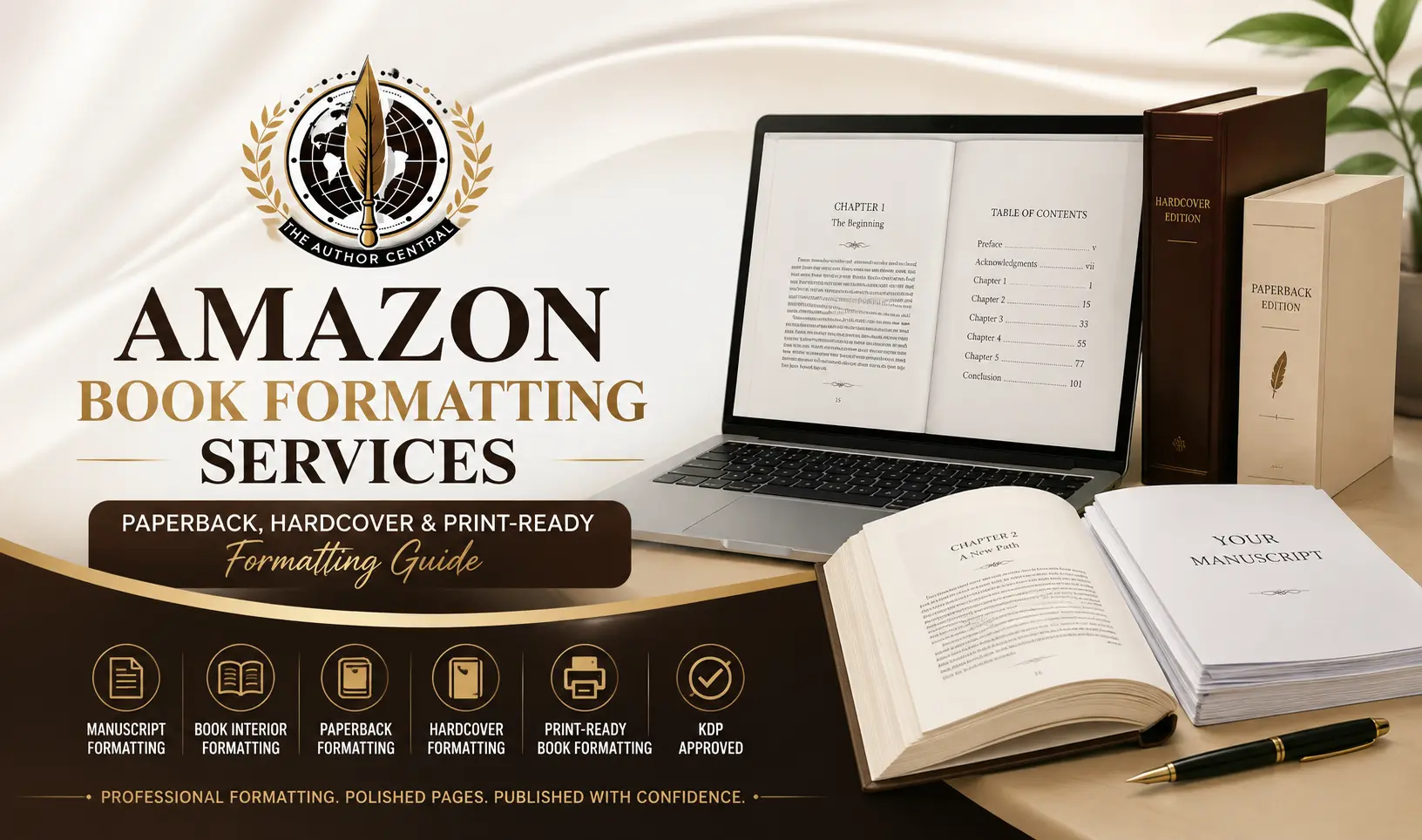
You finished the book. That’s genuinely huge, most people never make it past chapter three. But here’s what nobody warns you about at the finish line: amazon book formatting services aren’t some optional extra you tack on if there’s budget left over. They’re the actual difference between a book that reads like it came from a real publishing house and one that screams “made this in Word at 1am.”
I’ve talked to a lot of first-time authors over the years. Same pattern, almost every time. Months spent polishing prose, then formatting gets crammed into a single weekend. And it shows. Readers can’t always name what’s wrong. But they feel it. A margin that’s slightly off. Spacing that shifts. A font that quietly changes somewhere around chapter four. Small things. They still yank people right out of the story.
So let’s actually get into it. Paperback, hardcover, both, here’s what matters.
What Are Amazon Book Formatting Services, Really?
Strip away the sales pitch and it comes down to this. Someone takes your raw manuscript and turns it into a file Amazon KDP will accept, one that also looks good once it’s sitting in someone’s actual hands.
Correct trim size. Proper margins. Bleed settings for anything touching the page edge. Gutter space that accounts for binding. Font consistency, first page to last. None of it sounds exciting. But it’s precise work, and precision is exactly what most DIY attempts are missing.
Here’s the part that catches people off guard: writing a book and formatting one are completely different skills. You can be a brilliant novelist and still have zero clue how spine width math works, or why your chapter headings insist on landing at the bottom of a page instead of the top. That’s not a flaw in you. It’s just a different discipline, full stop.
Why DIY Formatting Usually Falls Apart
Loads of authors try formatting their own books first. Makes sense, honestly. Open the doc, nudge some margins, export as PDF, call it a day.
Except that’s rarely how it plays out. A paragraph that looks perfectly fine on your laptop can shift the second it converts to print. Page breaks land in odd spots. Headers repeat where they shouldn’t. And most of the time you don’t catch any of this until the physical proof lands in your mailbox, and now you’re paying for a reprint.
Formatting software has quirks. Weird ones. They rarely surface until something’s already broken. Which is basically why so many self-published writers eventually stop fighting it and turn to professional print-ready book formatting instead. Not laziness. Just recognizing what’s worth handing off.
Why Print-Ready Formatting Actually Matters
It’s not a box you tick before hitting submit. It shapes two things, really: whether Amazon even accepts your file, and how a reader feels the second they open the book.
Technically, Amazon’s system doesn’t bend much. Thin margins, missing bleed, an off page count, any of it can send your file back for revisions. Annoying on a normal day. Genuinely stressful if you’ve already told your audience a launch date.
There’s a quieter cost too, though. A well-formatted interior signals quality before a reader’s even read your first line. It says, this was made with care. Sloppy spacing does the opposite. It makes people question the writing itself, even when the writing is genuinely strong. Unfair? Kind of. But it’s real, and it’s exactly why amazon book formatting services exist at all.
Mistakes That Keep Showing Up
Same handful of errors, over and over, in self-published books:
- Font sizes that drift between chapters, sometimes subtle, sometimes obvious
- Widows and orphans, those lonely single lines stuck at the top or bottom of a page
- Margins that don’t actually match the chosen trim size
- Page numbers missing or placed strangely
- Images too low-res to print clean, so they blur or pixelate
None of these sink a book on their own. Stack them together, though, and the whole thing feels unfinished. Catching all of it takes attention most authors just don’t have time for, not while they’re also trying to launch the book.
Paperback Formatting: What You Actually Need to Know
Paperback formatting demands precision, mostly because Amazon KDP has firm rules on trim size, margins, and bleed. Miss the mark and the file bounces right back.
Start with trim size. Amazon supports several standard sizes, each with different margin requirements. A 6×9 novel isn’t set up the same way as a 5×8. Your gutter margin, that inner space near the spine, has to grow as page count grows too. Thicker books need more room to bind without eating into your text.
Fonts matter more than people expect, honestly. Serif fonts, Garamond, Georgia, tend to read more naturally on paper than sans-serif fonts do, which were really designed for screens in the first place. Most formatters land on 11 or 12 point body text, with steady line spacing all the way through.
Getting Front and Back Matter Right
Front matter, your title page, copyright page, table of contents, plays by its own rules. Page numbering typically starts after this section, not right at the very beginning.
Back matter deserves the same attention. Your author bio, your acknowledgments, should match the font and style of everything else. Sounds minor. Isn’t. This consistency is what makes a book feel finished and intentional, rather than stitched together at the last minute.
Get paperback formatting right the first time and you skip the endless cycle of ordering proof copy after proof copy, which adds up fast.
Hardcover Formatting: A Different Beast Entirely
Hardcover formatting overlaps with paperback in plenty of ways, but it stacks on complexity that catches people off guard. Amazon’s hardcover option through KDP needs its own setup for the dust jacket, spine width, and interior bleed.
Spine width isn’t something you eyeball. It depends entirely on page count and paper type, and getting it wrong throws off your whole cover design. This is where things get genuinely technical, and it’s exactly why professional formatters lean on Amazon’s spine width formula instead of guessing.
Interior formatting for hardcovers mostly mirrors paperback rules, though designers often widen the margins a touch. Sturdier binding means text can vanish into the gutter more easily when the book’s lying open flat, so that extra room actually matters.
Why Hardcover Projects Often Need a Professional Touch
Hardcover printing costs more, and mistakes here cost more to fix too. That’s the honest reason so many authors bring in professional amazon book formatting services specifically for this format. One miscalculation, and you’re reprinting an entire batch. That eats into a budget fast, way faster than a paperback error typically would.
Releasing both paperback and hardcover editions? Try to keep the interior formatting matched across both. Readers who own both copies notice when fonts or spacing don’t line up. It chips away at the feeling that these are the same carefully made book in two formats.
Slow down here. Hardcover formatting rewards patience, and rushing it almost always leads to expensive do-overs later.
Manuscript Formatting Comes Before Any of This
Before a file ever reaches the print-ready stage, it needs solid manuscript formatting first. Think of it as groundwork, the stuff that makes everything downstream easier.
This means consistent paragraph indentation, no stray extra spaces, standardized chapter headings, a genuinely clean file structure. A surprising number of formatting headaches trace back to small leftover habits from early drafts, double spaces after periods, inconsistent tabs, things like that.
Clean up your manuscript before handing it off, whether to a professional or a self-formatting tool, and you save real time later. A messy file takes longer to convert properly. It also raises the odds something small slips through unnoticed.
Book Interior Formatting: The Details That Add Up
Book interior formatting is where it all actually comes together. Typography, spacing, structure, visual balance, working in concert to make a book pleasant to read from page one straight through to the last page.
Give chapter openings some visual distinction, a drop cap, a bit of extra spacing, some small stylistic touch. Readers register these cues even when they couldn’t explain why they like them.
Keep your header and footer styles consistent all the way through. Running your book title or chapter name along the top of each page? That formatting needs to stay uniform. No exceptions, none.
And don’t skip the widow and orphan check. Most tools catch these automatically now, sure. But a manual pass before final submission is still worth the ten extra minutes it takes.
Choosing the Right Amazon Book Formatting Services
Not every formatting service operates on the same level, not even close. Before committing to one, ask specifically about their experience with Amazon KDP. General formatting know-how doesn’t always translate to platform-specific requirements.
Look for a provider offering a proof review before final submission. That single extra step catches errors before they turn into expensive printing problems. Turnaround time matters too, particularly if you’re building toward a launch date you genuinely can’t afford to push back.
Price is a factor. It shouldn’t be the deciding one, though. Paying a little more for meticulous, experienced formatting tends to save money down the road, fewer reprints, fewer rejected files, fewer wasted proof copies sitting in a box somewhere.
Conclusion
Formatting isn’t the exciting part of publishing. Nobody dreams about gutter spacing and margin math. But it’s one of the most important steps you’ll take, and rushing it always shows in the final product, one way or another. Whether you’re deep in paperback formatting, hardcover formatting, or juggling both at once, the technical details carry just as much weight as the writing itself.
Clean manuscript formatting, careful book interior formatting, a real grasp of print-ready book formatting, they all work together to build something readers can trust from the very first page. And if the technical side still feels like a lot, because honestly, it often is, investing in reliable amazon book formatting services can save you time, money, and a fair amount of frustration. Your readers deserve a book that looks as good as it reads. The right formatting partner gets you there without the trial and error.