
Ask ten authors what self-publishing cost them and you’ll get ten different answers, anywhere from nothing to well past $15,000. If you want a book that holds its own next to something from a traditional house, plan on $2,000 to $6,000. That’s the realistic middle. What surprises most people is that the money almost never goes in one dramatic mistake. It trickles out: a package that bundles more than you asked for, a marketing add-on that sounded urgent, a contract nobody walked you through.
One caveat before we go on: these are ballpark figures for a book of roughly 50,000 to 70,000 words, not quotes. Prices shift, so confirm before you pay anyone.
Quick takeaways
- You can publish on KDP for free. Whether anyone buys a book with no edit and a template cover is a different question.
- Packages are where most overspending happens, mainly because of the marketing and “bestseller” extras tucked inside them.
- Edit first. Cover second. Marketing last. Most people flip that order.
- Check whose name sits on your ISBN as publisher of record. If it isn’t yours and you didn’t agree to that on purpose, you’re renting your own book.
- Before you sign anything, run each cost through Pay, Delay, or Skip (explained below).
A quick disclosure: The Author Central sells writing, editing, design, and publishing services. We still want you to spend wisely, even if that means you don’t hire anyone, and parts of this guide will tell you exactly when that’s the right call.
So, What Does It Actually Cost?
It comes down to three choices: how much professional help you buy, how many formats you publish, and whether you’re paying someone to do work you could handle yourself.
Think of it as three rough levels.
At the bottom is true DIY, about $0 to $300. You edit the book yourself, grab a template cover, and use the platform’s free ISBN. That’s fine for a hobby project or for testing an idea, but it’s a tough route if you want sales.
The middle is where most first-timers belong, around $2,000 to $6,000. That buys a professional edit, a custom cover, a properly formatted interior, and an ISBN in your own name. It works for most nonfiction, fiction, and memoir.
Then there’s the full-service route, $5,000 to $15,000 or more, where one company handles writing or editing, design, publishing, and marketing. It suits people who’d rather hand everything off, as long as the price and terms are fair.
These are our own planning estimates, pulled together from published freelance editing rates, ISBN prices, and platform fees.
Where the money goes, line by line
Editing is the biggest line in most budgets. A developmental edit, which looks at structure and story, usually runs $2,000 to $6,000 or more, charged per word or per project. A copyedit on a 60,000-word book tends to land around $1,200 to $2,500, which works out to roughly 2 to 4 cents a word.
For a benchmark, the Editorial Freelancers Association surveys working editors every year. Its 2026 chart has fiction copyediting at about 2 to 2.7 cents a word, though the EFA itself says those figures are guidance, not recommended prices. You can see the full chart on the EFA rates page.
The rest of the budget looks like this:
| Expense | Typical range | Notes |
|---|---|---|
| Proofread | $600-$1,800 | Final pass after layout |
| Cover design | $0-$1,500 | Template to custom professional |
| Interior formatting | $0-$500 | Software or freelancer |
| ISBN (US) | $0-$295 | $125 single, $295 for 10; see below |
| Print-on-demand setup | $0 | KDP and IngramSpark both charge no title setup fee |
| Marketing (launch) | $0-$2,000+ | Wildly variable; see the Delay list |
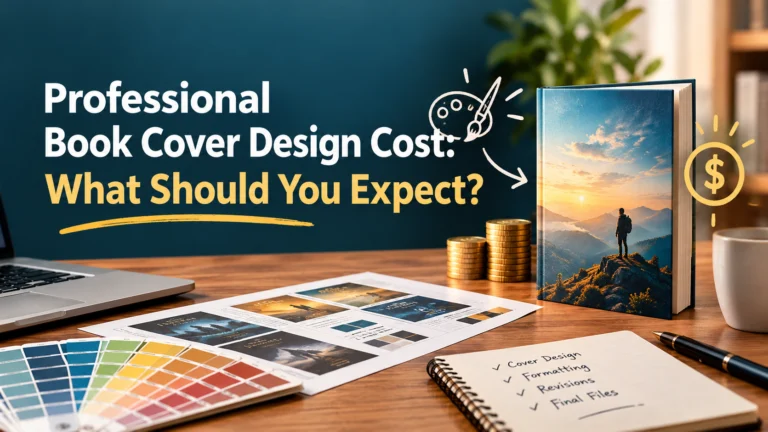
Cover pricing deserves its own conversation, and we cover it in our book cover design cost guide.
Five Ways First-Time Authors Burn Money
Strip away the jargon and wasted publishing money almost always looks like one of these.
1. Buying the package before reading what’s in it
Packages are easy. That’s the problem. A $6,000 bundle might hold a $400 cover, a $200 formatting job, and $3,000 of “marketing” that turns out to be a press release and a social media graphic.
Ask for an itemized breakdown. If a company won’t price the pieces separately, you can’t tell whether the bundle is a deal or a markup.
2. Marketing a book that isn’t ready
Ads and launch campaigns make whatever you’ve got louder. If the manuscript hasn’t had a professional edit, you’re paying to show more people a weaker book.
3. A gorgeous cover on an unedited book
The cover gets the click. The writing gets the review. We’ve all seen the pattern: $1,000 on the cover, nothing on editing, then three early reviews that mention typos.
4. Not knowing who owns the ISBN
In the US, Bowker is the official ISBN agency. When a company says it’s “giving” you an ISBN, that number is registered under the company’s name, not yours. That can make leaving later a headache. Ask who the publisher of record is, and what happens to your files if you walk away. Source: Bowker MyIdentifiers.
5. Printing a pile of books “just in case”
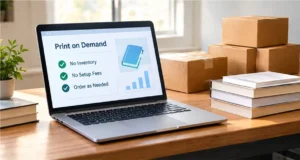
Print-on-demand exists so you don’t need boxes in your garage. Unless you have confirmed buyers, like a speaking event, order a small batch of author copies and let the platform print the rest as orders come in.
The Pay / Delay / Skip Framework
This is the simplest budgeting tool we know. Before you approve any expense, drop it into one of three buckets.
Pay
Pay means the things that decide whether a reader finishes your book and tells a friend about it.
- Editing. Get at least a copyedit and a proofread. If you’re not sure the structure or story works, add a developmental edit on top.
- A cover that fits your genre. Readers size up quality in a couple of seconds.
- A clean interior. Chapter openings, spacing, and type matter a lot in print.
- Your own ISBN, if you plan to publish beyond one platform.
Delay
Useful later. Wasteful before the book is finished and you have real data.
- Paid advertising, until you know your product page actually converts.
- Audiobook production, until the ebook or print edition shows demand.
- Hardcover, unless you have a specific reason like gifting or libraries.
- Video trailers, until you have an audience to show them to.
- A full author website, once you have more than one title or a service to promote.
Skip
Rarely worth it for a first book.
- “Bestseller” badge packages. A temporary category ranking isn’t sustained sales.
- Paid customer reviews. Amazon’s review guidelines don’t allow reviews posted in exchange for compensation, and Amazon says it removes reviews when it finds evidence of payment. It can also put your author account at risk.
- Copyright “services” that add their own fee on top of the government’s. You can file directly with the US Copyright Office. Right now its fee schedule lists $45 for a single author registering one work they solely own, and $65 for the Standard Application. The Office has proposed raising these, so check before you file.
- Big print runs with no confirmed demand.
- Package items you already have, like a cover you designed or an edit you’ve finished.
Sources: US Copyright Office: Fees · Amazon: Customer Review Guidelines · Authors Guild: Comments on proposed Copyright Office fee increases
If an expense doesn’t improve the reading experience or protect your ownership, it goes in Delay or Skip. That’s the whole test.
Spend in This Order
Most budget problems are really ordering problems. This sequence protects your money:
- Finish and revise the manuscript yourself. It’s free, and editors charge less when there’s less to fix.
- Hire a professional editor. For most books it’s the best return on any dollar you spend.
- Commission the cover once editing is done and your title and subtitle are final.
- Format the interior from the final edited text, not before.
- Proofread the formatted pages. Layout can sneak in new errors.
- Set up your ISBN and platform accounts.
- Publish, then watch what happens for 30 to 60 days.
- Only then put money into marketing, based on what’s actually working.
Follow this and you’ll avoid paying twice, which is how a lot of budgets quietly double (think reformatting after late edits).
Self-Publishing vs. Hybrid vs. Vanity vs. Traditional
Sales calls blur these terms on purpose. Here’s the plain version.
| Factor | DIY self-publishing | Hybrid publisher | Vanity press | Traditional publisher |
|---|---|---|---|---|
| Upfront cost to author | Low to moderate | Moderate to high | High | None (advance paid to you) |
| Who owns rights | You | Varies by contract | Often unclear or shared | Usually the publisher, for a term |
| Royalties | Highest share | Mid to high, varies | Often low or eaten by fees | Lowest share |
| Quality gatekeeping | None; you decide | Selective (the legitimate ones) | Typically none | Highly selective |
| Biggest risk | You carry the whole workload | Paying too much for services | Paying a lot and losing control | Rejection and long waits |
Here’s the cleanest way to tell hybrid from vanity. A genuine hybrid publisher chooses what it publishes, is open about what things cost, and owns the quality and distribution of the finished book. A vanity press says yes to nearly everyone, and its income comes from author fees, not from selling books.
The Independent Book Publishers Association (IBPA) has published criteria for what a reputable hybrid should do, including vetting submissions and publishing under its own imprint and ISBNs. Use it as a checklist: IBPA Hybrid Publisher Criteria.
One thing that confuses people: a real publisher, hybrid included, uses its own ISBNs because it is your publisher. A service company that sells you editing and design shouldn’t be listed as publisher of record on your book. Figure out which one you’re dealing with before you sign.
The Red-Flag Checklist
If two or more of these sound familiar, pause and ask more questions.
- They reached out to you first, by cold call, DM, or email, and there’s a discount that expires soon.
- The price isn’t itemized, or they won’t separate the services.
- They guarantee “bestseller” status, sales numbers, or reviews.
- They’re listed as publisher of record, but the contract doesn’t say they’re acting as your publisher or what that means for your rights.
- You can’t download your final files, or they charge to release them.
- They take exclusive rights for a long stretch with fuzzy reversion terms.
- Royalties are calculated on “net” with no clear definition.
- “Marketing” is vague, with no deliverables or reporting.
- There’s no clear refund or cancellation clause.
- You can’t talk to past authors or see published work.
Five questions to ask any company, us included:
- Can I see an itemized price list?
- Who’s the publisher of record, and whose ISBN is being used?
- Do I keep all my rights, and can I take my files and leave?
- What exactly does “marketing” include, and how will you report on it?
- What happens if I’m unhappy after the first draft or edit?
Worth reading next: Authors Guild: Avoiding Publishing Scams and Authors Guild: Author Contracts, Everything You Need to Know Before Signing.
Do You Really Need to Buy an ISBN?
Almost every first-timer gets stuck here, so let’s keep it simple.
- Print books need an ISBN. KDP gives you a free one for paperbacks and hardcovers, but it only works on KDP, and your imprint shows up as “Independently published.”
- Ebooks on KDP don’t need an ISBN at all.
- Bowker sells ISBNs at $125 for a single or $295 for a set of ten. Each format needs its own number (paperback, hardcover, ebook), and one you buy yourself can be used on other platforms too.
- A 10-pack usually makes sense if you’re planning several formats or more than one book. ISBNs don’t expire.
- IngramSpark doesn’t hand out free ISBNs, so you’ll need your own if you want wider distribution.
Sources: Amazon KDP Help: ISBN and imprint · Amazon KDP Help: Get an ISBN · Bowker MyIdentifiers
Quick rule: want bookstore and library distribution, or want your own imprint name on the book? Buy your own. Just testing an Amazon-only ebook? Skip it.
KDP vs. IngramSpark: What You Take Home Per Sale
What you spend is only half the story. The other half is what comes back with each sale.
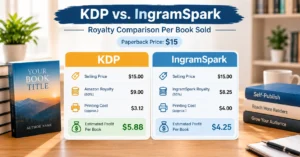
On KDP, ebooks pay 70% when you price between $2.99 and $12.99 on Amazon.com. Amazon stretched that band in July 2026, and it used to top out at $9.99. Price outside it and you get 35%. For print, KDP pays 60% of the list price minus printing cost once you’re at $9.99 or above on Amazon.com, and 50% below that.
IngramSpark works differently. You choose the wholesale discount bookstores get, and a 1.875% market access fee comes off books enabled for distribution (it went up in February 2026). What you get in return is far better reach into bookstores and libraries.
Quick math: a $15 paperback that costs $4.85 to print puts $4.15 in your pocket on KDP at the 60% rate. Use the official calculators before you set a price, because these numbers keep moving.
Plenty of authors simply use both: KDP for Amazon, IngramSpark for everything else.
Careful with old articles. Plenty of guides still mention a $49 IngramSpark setup fee and $25 revision fees. IngramSpark says title setup is free and that revision fees were dropped starting February 1, 2026.
Sources: KDP Help: eBook royalties · KDP Help: Pricing and print royalty rates · KDP Help: 70% price band update · IngramSpark: Changes in print cost, market access fee, and more
What Should You Spend, Based on Your Goal?
What the book is for should decide how much you spend.
A business book meant to build credibility, say for a coach or consultant, deserves a developmental edit plus a copyedit, a strong cover, a solid author page, and a print edition. Hold off on the audiobook and trailer. Expect somewhere between $3,500 and $7,000.
A family memoir needs far less: a copyedit, a clean layout, and a small print run for relatives. Skip the ads and wide distribution. Think $1,500 to $4,000.
For a fiction series, put the money into the edit, a cover that fits the genre, consistent branding across books, and a 10-pack of ISBNs. Leave hardcover and a big launch for later. Book one usually lands around $2,500 to $5,500.
These are illustrative planning estimates, not quotes.
A memoir written for 40 relatives doesn’t need an ad campaign. A consultant’s book that exists to win clients, on the other hand, can justify a stronger edit and a polished author presence, because its whole job is to build trust.
When You Don’t Need to Hire Anyone
Honestly? Sometimes you don’t. You can probably manage on your own if:
- You’re an experienced writer with solid self-editing habits and a few trusted beta readers.
- The book is a personal project with no commercial goal.
- You don’t mind learning formatting software and cover templates.
Even then, pay for a proofread. It’s cheap insurance, and the typos you can’t see are always the ones readers spot first.
When Paid Help Is Worth It
Hiring someone makes sense when it saves you real time, lifts the quality, or lowers the risk of an expensive mistake. It’s worth a look if:
- The book supports your business or professional reputation.
- You’ve got a finished draft but can’t tell what’s weak.
- You’d rather spend your energy writing and launching than wrestling file specs.
- You want one team coordinating editing, design, and publishing. Take a look at our book publishing and book editing services.
When you do hire, buy by service, compare itemized quotes, and keep every file. You can see how we structure our packages, and please run the red-flag checklist on our offer too.

An Example: Rebuilding a $7,900 Package
This is a hypothetical scenario to show the framework at work. The numbers are planning estimates, not a real client’s results.
Picture a first-time business author with a 60,000-word manuscript. A company offers her a $7,900 all-in package: editing, a cover, formatting, an ISBN, a “bestseller launch campaign,” a book trailer, and 500 printed copies.
She asks for an itemized breakdown and sorts every line into Pay, Delay, or Skip:
| Item | Bucket | Estimated cost |
|---|---|---|
| Copyedit (about 3 cents/word) | Pay | $1,800 |
| Proofread | Pay | $900 |
| Custom cover | Pay | $700 |
| Interior formatting | Pay | $300 |
| Own ISBN (Bowker 10-pack) | Pay | $295 |
| Small batch of author copies | Pay | $250 |
| Book trailer | Delay | $0 for now |
| Paid ads | Delay | $0 for now |
| “Bestseller launch campaign” | Skip | $0 |
| 500 printed copies | Skip | $0 |
| Rebuilt total | about $4,245 |
She keeps everything that improves the reading experience and her ownership, and saves roughly $3,650. Some of that can go toward a developmental edit or a launch budget later, once she sees how the book does.
The Bottom Line
The costliest publishing mistakes usually aren’t about price. They come from buying the right thing at the wrong time, or giving up control without realizing it.
Keep this in your back pocket:
- Pay for editing, your cover, your interior, and (when it makes sense) your own ISBN.
- Delay ads, audiobooks, trailers, and extras until the book has earned them.
- Skip bestseller badges, paid customer reviews, and bundled add-ons you don’t need.
- Know who owns your ISBN, files, and rights at every step.
Holding a publishing offer right now and not sure what’s inside it? Send it our way. You can request a free, no-obligation review through our contact page, and we’ll tell you what we’d pay for, what we’d delay, and what we’d skip, even if the answer is that you don’t need us.