Book Writing
 Book Cover Design
 Book Editing
 Book Formatting
 Book Publishing
 Book Video Trailer
 Book Printing
 Audio Books
 Book Illustrations
 Author Website
 Amazon Page Optimization
 Book Marketing
 Fiction Writing
 Non-Fiction
 Autobiography
 Memoir
 Novel Writing
 Children's Book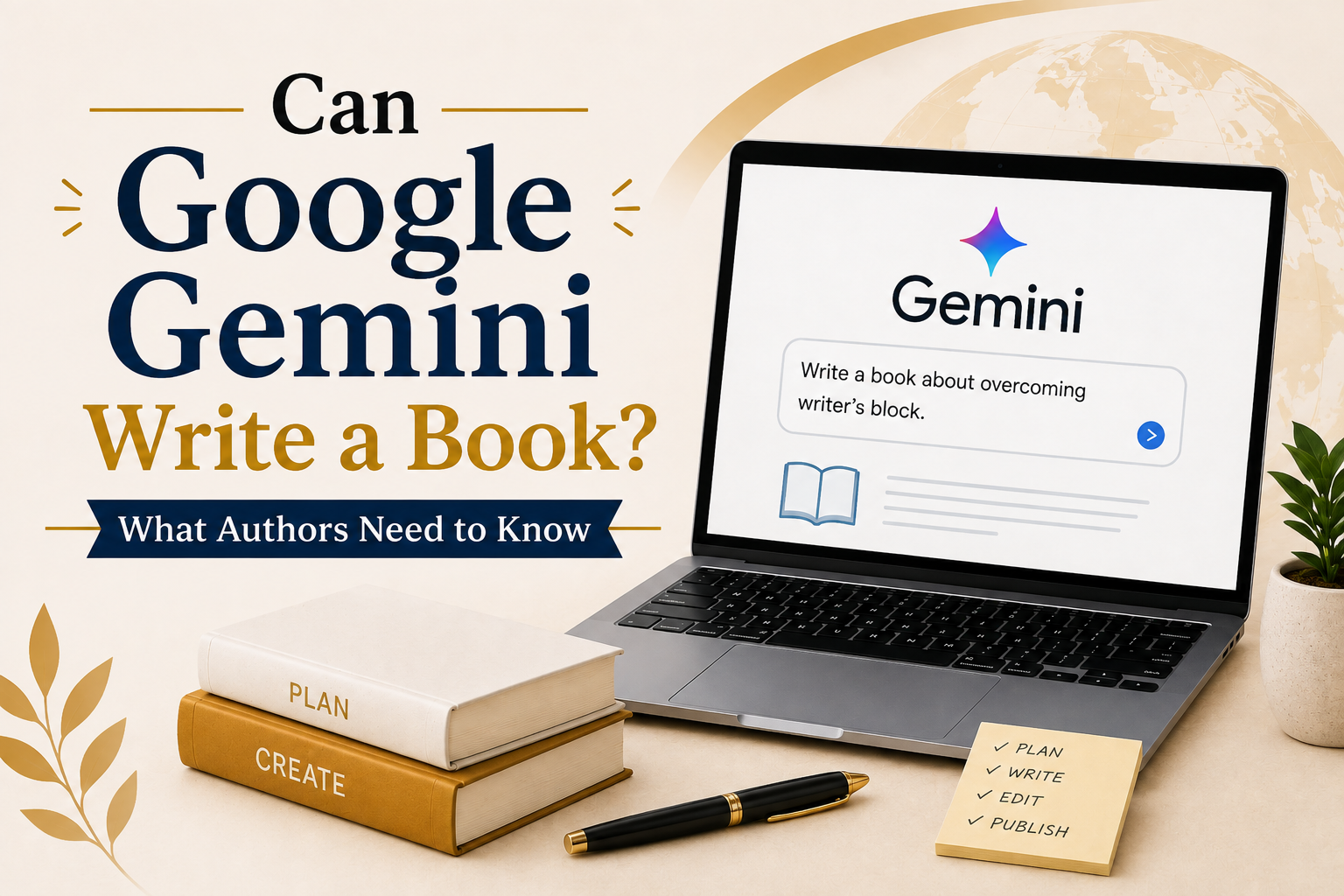
A client asked me last month whether she even needed a writer anymore. She’d been playing with Google Gemini for a week and had forty pages of “something.” Was it a book? Not really. Was it useless? Also not really. That gap between those two answers is basically what this whole article is about.
Short version: Gemini can help you write a book. It cannot write the book for you. Not one worth putting your name on, anyway. It’s a language model, so it’s genuinely fast at certain jobs, brainstorming, outlining, knocking out a rough draft of a scene or a section. What it doesn’t have is your taste. It doesn’t know when a chapter drags or when a claim needs a second source before you print it.
Below, I’ll go through where Gemini pulls its weight, where it quietly falls apart, how it compares to ChatGPT, and when it just makes more sense to hand the project to a person instead.
So, Can Gemini Actually Write an Entire Book?
Sure, in the sense that it’ll produce sixty thousand words if you ask for them. Chapters, a beginning, an ending. Whether any of it holds together is a different story.
It handles the individual pieces reasonably well:
- Creating book ideas and concept angles based on a genre or topic
- Developing a working book concept and premise
- Creating chapter by chapter outlines
- Generating first draft content for individual chapters
- Helping develop characters, their backstories, and motivations
- Building out fictional settings and world details
- Assisting with plot structure and pacing
- Drafting nonfiction sections based on research notes
- Expanding short bullet points into fuller paragraphs
- Rewriting or improving existing material for clarity
Where it starts to wobble is continuity, and this is the part people underestimate. A book isn’t eighty short pieces glued together, it’s one long connected thing. Your character’s eye color can’t change between page 12 and page 212. A number you cited in chapter two shouldn’t quietly contradict itself by chapter nine. Gemini doesn’t track that the way a person does, especially once you’re working across a dozen separate sessions spread over weeks.
That’s really the difference between “AI wrote some words” and “this is a finished manuscript.” One is raw material. The other’s been through structural edits, line edits, proofreading, and a hundred small calls only the author can make. Gemini gets you to a draft quicker. It doesn’t get you the rest of the way.
Where It Actually Earns Its Keep
Used with a bit of skill, Gemini works more like a tireless assistant than a ghostwriter. A few spots where it’s genuinely worth using:
Brainstorming, first and foremost. Stuck on a concept? Throw something half-formed at it and you’ll get back a dozen angles, most forgettable, one or two you can actually use. Beats an hour of staring at nothing.
Outlining tends to go well too, since it’s a structural task and structure is where these models are strongest. Give it your premise, ask for a chapter breakdown, and you’ll have something to argue with instead of a blank page.
Fiction writers can use it as a decent sounding board, character quirks, a conflict you hadn’t thought of, whether a plot point actually holds up. It won’t give your protagonist a soul. It can help you spot a hole before your beta readers do.
For research, it’s handy for summarizing dense material or wrangling scattered notes into some kind of shape. And for rewriting a stiff paragraph, testing a different tone, or generating a couple of alternate takes on a scene that isn’t landing, it saves real time.
None of that makes it an author. It makes it a fast set of hands. Worth remembering.
And Where It Falls Apart
Now the less flattering half, because pretending otherwise doesn’t help anyone publishing a real book.
Voice is the biggest issue. Left to its own devices, Gemini settles into a kind of smoothed-out average tone, because that’s roughly what it is, an average of a huge amount of writing. Unless you actively push it toward something specific, that’s what you’ll get.
Emotional weight is another gap. It can describe grief. It hasn’t felt it. Memoir, literary fiction, anything leaning on real feeling, usually needs a heavy human pass afterward.
Then there’s originality, which gets slippery. The model learned from existing text, so its instincts pull toward familiar phrasing and predictable shape rather than anything genuinely new. Not plagiarism exactly. Just not particularly fresh either.
Accuracy is a real problem too, and not a small one. It’ll state something with total confidence and be wrong. Anything factual in a nonfiction manuscript needs an independent check, every time, no shortcuts.
A handful of smaller things worth flagging: long unedited stretches tend to fall into repetitive rhythms. Context slips on bigger projects, especially split across many sessions. And the copyright picture around AI writing is still moving, so a little caution there isn’t overkill.
If there’s one thing to take from this section, it’s that typing “write my whole book” and expecting something publishable back just isn’t how this works. What comes out is a starting point.
How Authors Can Use Gemini
The most effective approach is treating Gemini as a collaborator in a structured workflow, not as a replacement for the writing process itself. Here’s a practical sequence many authors follow, rather than one giant prompt and a prayer:
- Develop the core book idea and central premise
- Define the target audience and what they need from the book
- Create the overall book structure and format
- Build a detailed chapter by chapter outline
- Develop characters or key nonfiction concepts in depth
- Write detailed prompts for each chapter, including tone and key points
- Generate initial drafts using Gemini as a starting point
- Rewrite and refine the AI-generated content in your own words
- Fact-check every claim, statistic, and reference
- Apply your unique voice, stories, and personal insight throughout
- Perform a full developmental edit for structure and pacing
- Proofread the complete manuscript carefully
- Prepare the final manuscript for publishing
The shape of it matters more than the count. It’s human plus AI, not AI in place of human. Gemini speeds up the mechanical stretch in the middle. Everything on either side of that is still yours.
Gemini or ChatGPT, Which One Actually
I get asked this a lot and the honest answer is neither wins outright.
Gemini tends to do well on research-heavy work, and if you’re already living inside Google’s ecosystem for notes and docs, it slots in easily. ChatGPT has a bigger, older library of writing-specific prompts floating around, and plenty of fiction writers find its creative output a touch looser and more flexible.
For outlining, it’s close to a wash if your prompts are detailed either way. For long creative passages, both need real style samples or they’ll default to sounding like themselves instead of you. For editing, it usually comes down to how precisely you describe what “better” means, tighter pacing, a different tone, cleaner sentences, rather than which tool you picked.
I’d stop thinking of it as a competition. Think fit instead, your workflow, your genre, which interface annoys you less. A lot of authors end up using both without ever really deciding between them.
How to Keep Your Own Author Voice
One of the most common concerns authors have about using generative AI is ending up with a book that doesn’t sound like them. This is a legitimate concern, and it’s also very manageable with the right approach.
- Give Gemini writing samples from your own past work so it has something to reference
- Clearly define your tone and personality in your prompts, whether that’s conversational, formal, witty, or direct
- Create a simple personal style guide covering vocabulary, sentence length preferences, and things to avoid
- Draw on your own ideas, stories, and lived experience rather than relying purely on AI suggestions
- Rewrite AI-generated passages in your own words instead of copying them directly
- Add original examples and personal insights the AI could never generate on its own
- Never accept the first draft Gemini produces as final
- Keep terminology and phrasing consistent throughout the manuscript
- Always perform a final human edit pass before considering a chapter finished
The goal is AI backing up your voice, not replacing it. Readers pick up on the difference even when they can’t quite say why.
Publishing AI-Assisted Books on Amazon KDP
Generally yes, you can. There’s nuance worth knowing before you hit publish, though.
KDP allows AI-assisted and AI-generated content, but authors stay responsible for accuracy and originality. Amazon’s introduced disclosure rules for certain categories of AI content, and those rules have already shifted more than once. Given that, check Amazon’s current official guidelines directly rather than trusting a blog post from six months ago, including this one. This isn’t legal advice, and for specific copyright or disclosure questions, Amazon’s own page is the source that matters.
There’s a separate quality issue too. Books that read as obviously AI-written, repetitive, thin, tonally inconsistent, tend to underperform with actual readers regardless of what the platform technically permits. That’s a big reason authors who use Gemini for early drafts still bring in professional book writing services before publishing. Amazon book writing services exist for exactly this handoff, taking an AI-assisted draft and turning it into something a person clearly cared about, because at that point, someone did.
A Few Prompts Worth Stealing
Vague prompts get vague results, so here are more specific ones you can bend to your own project.
Book idea generation:
Generate five original book concepts in [genre] for [target reader]. Each should tackle [specific theme or problem] and include a one-sentence hook.
Book outline:
Build a chapter-by-chapter outline for a [genre/topic] book, around [X] chapters, for [target audience]. Cover these core ideas: [list them].
Character development:
Develop a full profile for [character name]: personality, core motivation, internal and external conflict, key relationships, strengths, weaknesses, and how they might change over the story.
Plot development:
Outline a plot for a [genre] story built around [core conflict]. Include rising tension, at least one real twist, pacing notes per act, and an ending that earns itself.
Nonfiction chapter draft:
Using this outline [paste it], write a first draft in a [tone] voice for [audience]. Prioritize clarity over filler.
Editing pass:
Review this for clarity, structure, and flow. Keep the meaning and my own voice intact: [paste passage].
Voice matching:
Here are three samples of my writing: [paste samples]. Study the tone and rhythm, then rewrite this to match: [paste passage].
Expansion:
Expand this into a fuller chapter. Add real depth, not repetition or claims you can’t back up: [paste section].
Treat every one of these as something to push back on, not an answer to copy and paste.
When Should You Hire a Professional Book Writer?
There’s a point where AI alone stops being enough, and it’s better to notice it early than three drafts deep.
Consider working with professional book writers if any of the following apply to your project:
- You have a strong idea but genuinely don’t have the time to write a full manuscript
- Your book needs professional structural development beyond what outlining alone can fix
- You’re writing a commercial book that needs to compete in a crowded category
- The project requires extensive developmental and line editing
- You’re working on a complex nonfiction book that needs deep subject matter accuracy
- Your fiction project needs experienced help with plot, pacing, or character development
- You want a genuinely publication-ready manuscript, not just a draft
- You need help preparing your book specifically for Amazon KDP
- You struggle to maintain consistency across a long manuscript
- You want a skilled human writer to transform your ideas into polished, professional content
That’s where custom book writing services and custom fiction book writing services come in. Whether you’re searching for book writing services near me or comparing professional book writing services with an actual track record, what you get from professional book writers is the part AI can’t fake, editorial judgment, subject expertise, and a person accountable for what lands on your desk at the end.
None of this rules out AI, to be clear. Plenty of authors use Gemini to blow through brainstorming and rough drafting, then hand things to professional book writers for the structure and polish that turns a draft into an actual book people will pay for.
Where That Leaves You
Can Gemini write a book? It can generate a lot of raw material, and used with some intention, it’s a genuinely useful tool at nearly every stage of the process. It won’t replace the judgment, the voice, or the editorial instinct that turns a pile of drafted pages into something worth someone’s time. That part’s still on you.
Used well, paired with your own input and, when the project calls for it, professional book writing services, Gemini can be a real part of how a book actually gets made these days.