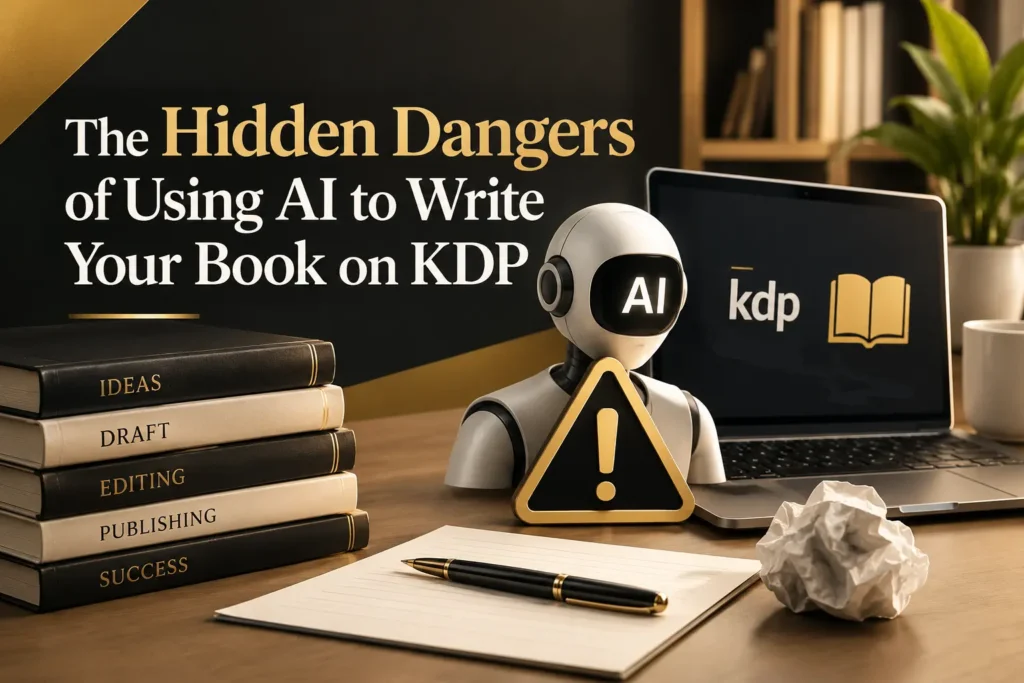
Yes, you can use AI when you publish on Amazon, but letting it write the whole book is where people get burned. The dangers of AI-generated books on KDP rarely show up as a sudden ban. They show up as a disclosure box ticked wrong, a string of lukewarm reviews, or a manuscript you can’t fully claim as your own.
You’ve probably seen the videos. Someone promises a finished book by dinner and passive income by spring. I get why that pulls people in, especially when you’ve got a day job and a stack of half-formed ideas.
The trouble is that the bill comes later, and it’s bigger than the time you saved. So let’s look at where the real risks sit and how to use AI without wrecking your name as an author.

Why AI-Generated Books on KDP Tempt So Many Authors
A decent tool can spit out a full draft in under an hour. If you’ve got ten book ideas, that feels like ten books by the end of the month. Social media makes it look painless.
Here’s the problem, though. Open any crowded KDP category and you’ll see the same thing over and over: identical chapter order, the same upbeat tone, advice so vague it could apply to anyone. Readers pick up on it fast. After a few disappointing purchases, they stop trusting the whole shelf, including your book.
That’s the part the get-rich videos skip. When speed is available to everyone, speed stops being an edge.
What the KDP AI Content Policy Says Right Now
Amazon splits AI use into two camps. When a tool creates the text, images, or translations, that’s AI-generated, and Amazon wants you to say so whenever you publish or republish a title. When you write the material yourself and only use a tool to clean it up, that’s AI-assisted, and you don’t need to disclose it.
That’s the current shape of the KDP AI content policy, but Amazon can reword it any time. Check the live version before each launch. Don’t lean on a blog post from last year, and that includes this one.
There’s also a weekly cap on how many new titles one account can create. It exists to slow down bulk publishing, which is exactly the habit AI encourages.
AI-Generated vs. AI-Assisted: Where You Draw Your Own Line
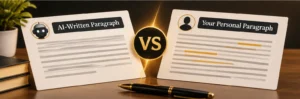
Try this. Ask yourself who made the creative calls. Who came up with the ideas? Who decided the structure? Who wrote the actual sentences? If you pasted in a prompt and kept whatever came out, that was the tool. If you wrote the chapter and ran it through a grammar checker, that was you.
The gray zone is the bullet-point workflow. You jot a few lines, the tool turns them into full pages, and you tidy up. I’d call that AI-generated, since the sentences aren’t really yours, and I’d disclose it.
Danger One: Misreading the Amazon KDP AI Disclosure Rules
Most people don’t skip disclosure on purpose. They rush the upload screen, skim the question, and assume a little AI doesn’t count.
Here’s the thing, though. The Amazon KDP AI disclosure rules ask a simple question, and whatever you answer gets attached to your account.
So why make a fuss about it? Because a wrong answer can look like lying. Platforms tend to come down harder on dishonesty than on honest AI use.
Scenario one: Take Sam, who runs a small nonfiction side hustle. One afternoon he generates a 40-page productivity guide, changes a few paragraphs, and clicks “no” at the upload screen because, hey, he edited it. Three months later a reader reports the book as low quality. Now Sam has a flagged title and a disclosure answer that doesn’t hold up.
The fix is dull, but it works. Decide your answer while you’re drafting, not at the upload screen, and jot down how the book was made.
Danger Two: AI Book Copyright Issues Nobody Warns You About
In the United States, copyright rests on human authorship. The Copyright Office has said that material produced purely by a machine generally isn’t protected.
That’s one of the AI book copyright issues new publishers rarely hear about. If you publish raw AI output, a competitor could copy it, and you’d have little to stand on.
Mixed work plays out differently. If you write a good chunk yourself, and you make real choices about what goes in and how it’s arranged, that human contribution can earn protection. Put simply, more of you on the page means a stronger claim.
Copyright rules also change from country to country, and they’re still shifting. Before you build a business on any of this, talk to a qualified attorney.
One more thing: AI tools sometimes echo wording from existing books, so run a plagiarism check on anything you didn’t write yourself.
Danger Three: Readers Notice Faster Than You Think
Readers can feel generic writing even when they can’t explain why. Every sentence has the same rhythm. The claims stay fuzzy. And the small, odd stories that make nonfiction memorable? Gone. Would you finish a book that felt written for nobody in particular?
It hurts twice. A reader leaves a cold review, and weak engagement can also mean fewer people ever see your book.
How Readers Spot AI-Generated Books on KDP Within Minutes
Nobody needs detection software. They just notice things like:
- Chapters that all open the same way
- Advice with no examples, numbers, or personal detail
- References they can’t verify anywhere
- Covers and titles that look like a dozen others
- Stray formatting left over from copy-pasted output
Once reviews start mentioning these, rankings, ad results, and future launches all suffer. Recovery is slow.
Danger Four: Made-Up Facts and Sources That Don’t Exist
AI tools state wrong facts with a straight face. They’ll also invent quotes and pin believable names on claims nobody ever made. The writing flows so nicely that you don’t spot the problem until a reader does.
Say you’re writing about money, health, or legal topics. One wrong fact there can mean a refund request, a one-star review, and worse, a reader who acts on bad information.
Here’s the rule I’d follow. Check every claim, name, and date against a primary source. Can’t find it in five minutes? Cut the line. [Personal Example: Add a real moment when an AI tool gave you a wrong fact or a fake source]
Danger Five: Risking Your Entire Account
Amazon can remove any title that breaks its content guidelines. Keep running into problems, and your whole account could be at risk. Your royalties, series, and future books all live under one login, so a single bad batch can cost more than the book that caused it.
That’s why bulk publishing is the riskiest play. Ten rushed, near-identical AI-generated books on KDP raise the odds of quality flags, duplicate-content complaints, and reader reports all landing at once.
Scenario two: Now picture Priya. She’s writing a beginner’s bookkeeping guide for freelancers, and every chapter comes from her own client work. She uses AI only to spot gaps in her outline and smooth a few clunky sentences. She keeps her drafts, answers the disclosure question honestly, and her reviewers end up praising her examples.
Where AI Helps Without Causing Fallout
A handful of uses are pretty safe:
- Brainstorming angles and reader questions
- Finding gaps in an outline you built yourself
- Grammar and clarity edits on your own text
- Listing counterarguments you should address
- Testing subtitle ideas
Notice the pattern? Each of those helps you think. None of them does the thinking for you, so the ideas, examples, and final sentences stay yours.
AI-made covers and interior images fall under disclosure too. If a tool made it, say so.
Is It Safe to Publish AI-Written Books on Amazon?
It can be, as long as AI supports your work and doesn’t stand in for it. The risks of AI writing for self-publishing climb with every creative decision you hand over. Before you publish, check your manuscript against what I call the Human Layer Framework:
- Idea layer: The main angle, argument, or story is yours.
- Evidence layer: You checked every fact, quote, and source yourself.
- Voice layer: You reworked the draft until it sounds like one real person, not a committee.
- Proof layer: You saved notes, drafts, and revision history that show you wrote it.
If one of those layers is missing, stop and fix it first. Failed AI books usually skip the idea and voice layers, which is why they read like everyone else’s.
Here’s a quick gut check. Remove the AI, and if the book can’t exist anymore, it’s AI-generated and your disclosure should say so.
Keep an Authorship Log From Day One
This is the habit most guides skip. Start a simple log for every book, and spend two minutes on it after each writing session.
Each time, jot down the date, what you wrote on your own, and any moment you used a tool and why. Keep dated drafts, outlines, and research notes together in one folder. If Amazon ever questions a title, or you need to show your creative contribution, you’ll have evidence instead of fuzzy memory.
It also keeps your disclosure answers honest. Six months from now, you won’t have to guess what the tool actually did.
Your Next Step: Audit One Chapter Today
Open your manuscript and mark each chapter as written by you, assisted by AI, or generated by AI. Then run the four layers on each one, and rewrite or cut whatever fails.
After that, reread Amazon’s current guidelines and answer the disclosure question honestly. If you want a catalog that lasts, treat AI-generated books on KDP as a shortcut that costs more later, and treat AI as a helper that speeds up your own work.
Start small. Pick one chapter, rewrite it in your own voice with your own examples, then set it beside the AI draft. You’ll see the difference right away.