I finished my second book and figured I already had this publishing thing down. Upload to Amazon, hit publish, move on. Then a friend who runs a small writing workshop mentioned she’d started putting her titles on Barnes and Noble Press too, and that sent me down a rabbit hole comparing Barnes and Noble Press vs Amazon KDP at almost midnight, wondering if I’d been missing out on readers this whole time.
It’s not as simple as “just use both,” even though that’s often where people end up landing anyway. Each platform has its own quirks, its own audience, its own small annoyances that you only really notice once you’ve published something through them. I’ve got titles live on both now, and I’ve made enough little mistakes along the way that it seemed worth writing this down for someone else.
So let’s actually get into what separates these two, past the surface stuff everyone already knows.
The Basics of Each Platform
Amazon KDP barely needs an introduction anymore. It’s the default for most self-published authors, mostly because Amazon controls such a huge chunk of online book sales. Upload your file, set a price, and within a day or two your book is live. No fees. No weeks-long wait for approval. Basically no barrier beyond having a finished manuscript and a decent cover.
Barnes and Noble Press works similarly on paper. Also free, also handles ebooks and print, also gives you a dashboard for pricing and sales tracking. But the interface feels a bit dated compared to KDP’s, and the whole system has this slightly clunky, not-updated-often feeling to it. That’s not a dealbreaker on its own, though it’s worth mentioning, because KDP’s smoothness really is one of its quieter advantages.
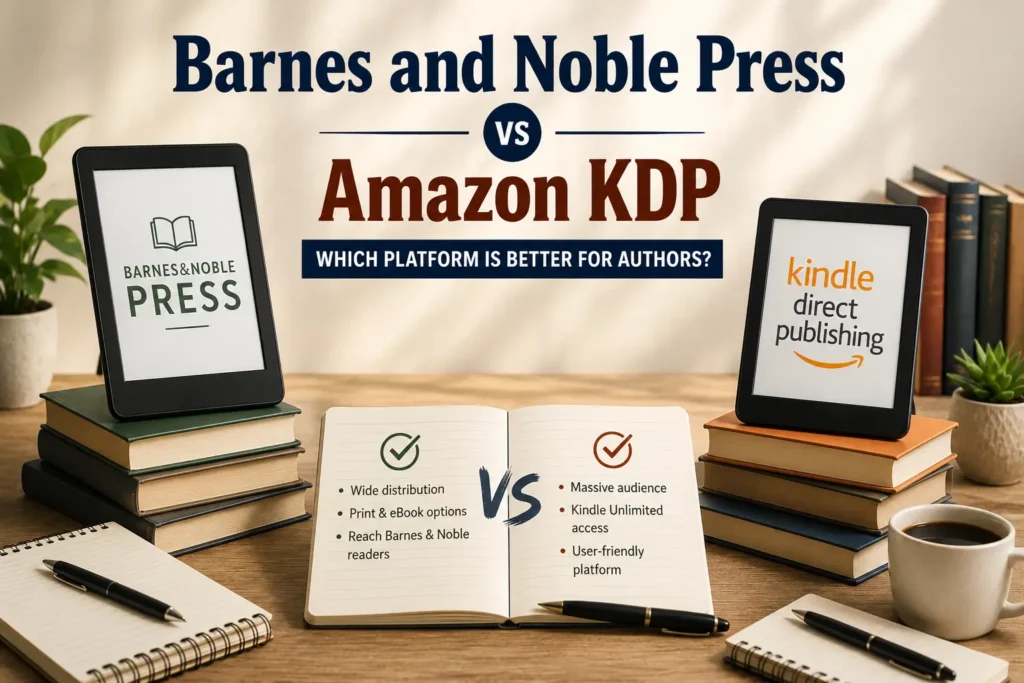
Where things actually diverge is audience. KDP puts you in front of Amazon’s massive customer base, including Kindle Unlimited readers, which matters a lot for people who read fast and don’t want to buy books one at a time. Barnes and Noble Press puts your book on their site, and if you’re doing print, there’s a theoretical shot at getting into physical stores through certain local programs. That part is far less automatic than most people assume going in.
Why This Comparison Even Matters
Here’s what actually pushed me to look into Barnes and Noble Press vs Amazon KDP properly instead of just defaulting to Amazon like everyone else seems to. Putting all your eggs in one retailer means your income depends entirely on that company’s algorithm, that company’s policies, and honestly that company’s mood toward self-published authors in any given month. I’ve heard enough stories about sudden account flags or category shifts on KDP to understand why some authors want a second option, even a small one.
Royalties and Pricing Differences
This is usually where people start paying real attention, and fair enough. Money talks.
KDP pays 70 percent royalties on ebooks priced between $2.99 and $9.99. Go outside that range and it drops to 35 percent. Print royalties work differently, calculated from list price minus printing costs and a set percentage, landing somewhere around 40 to 60 percent depending on your book’s specs.
Barnes and Noble Press also offers 70 percent on ebooks, but the thresholds for hitting that rate work a little differently, and there’s more nuance around file size and specific price points than KDP’s more straightforward tiers. Print royalties are broadly similar between the two, though the exact number shifts based on trim size, page count, and whether you’re printing in color or black and white.
Worth noting: Once you run actual numbers for a specific book, the royalty gap between platforms usually ends up pretty small. It’s rarely the deciding factor people expect going in. What actually matters more is which platform sells copies for your genre and your audience, and that part varies wildly from one author to the next.
A Practical Example From My Own Books
I put my second novel on both platforms at the same time, mostly out of curiosity. Six months later, KDP had sold roughly ten times what Barnes and Noble Press had. That’s not universal, plenty of authors report the opposite, especially in genres with a strong Barnes and Noble in-store following, think literary fiction or heavily illustrated nonfiction titles. But for my thriller, Amazon’s audience just dwarfed everything else.
That result taught me something worth remembering. The Barnes and Noble Press vs Amazon KDP question doesn’t have one clean answer. It depends on genre, existing audience, and honestly how much separate marketing effort you’re willing to put behind each platform.
Distribution and Print Options
Print is where things get genuinely interesting, and where a lot of authors get tripped up about what each platform actually delivers versus what they assume it delivers.
KDP’s print arm, which absorbed the old CreateSpace system a while back, turns out solid paperbacks and hardcovers at reasonable cost. But like I mentioned earlier, those books mostly live inside Amazon’s own retail world. Bookstores rarely stock them, since there’s no easy returns process, and most retailers want that safety net before taking a chance on an unknown title.
Barnes and Noble Press has a different angle here, and honestly it’s one of the more appealing things about the platform. Since it’s tied directly to Barnes and Noble, there’s at least a real pathway for your print book to end up on actual shelves, particularly through local store programs some branches run for regional authors. I want to be upfront though, none of this is automatic. You usually need to reach out to individual community relations managers yourself, and results vary a ton depending on your location and how compelling your pitch turns out to be.
What Nobody Tells You About Getting Into Physical Stores
I emailed my local Barnes and Noble after publishing through their platform, half expecting silence or a form rejection. Instead, the community relations manager wrote back within a week and set up a small consignment deal for a handful of copies. It wasn’t huge, maybe a dozen sold over three months, but it was a real, physical presence I never would have gotten through KDP alone. Your results will depend heavily on your specific store and your book’s subject, but it’s worth trying if a shelf presence matters to you at all.
Ease of Use and Platform Reliability
I’ll just say it plainly. KDP’s dashboard and overall publishing flow feel more refined. Sales data updates fast, the interface is intuitive even for first-timers, and support, while far from perfect, usually responds within a reasonable window when something breaks.
Barnes and Noble Press feels a step behind on polish. Sales reporting lags sometimes, the interface hasn’t been refreshed in a while, and I’ve hit occasional formatting quirks where a file uploads fine on KDP but needs tweaking before it looks right on Barnes and Noble Press. None of that is a dealbreaker exactly, but if a smooth, modern publishing experience matters to you, KDP has the edge right now.
That said, KDP isn’t flawless either. Sudden algorithm shifts affecting visibility, or occasional account flags authors report with little warning, happen there too. No platform runs perfectly, and anyone claiming otherwise probably hasn’t published enough books to hit the inevitable snag yet.
Making the Right Choice for Your Book
So who wins the Barnes and Noble Press vs Amazon KDP debate? Honestly, for most authors, publishing on both makes the most sense. There’s no rule forcing exclusivity, unless you’ve enrolled in KDP Select for Kindle Unlimited access, which does require your ebook stay exclusive to Amazon.
If volume is your priority and you’re fine with Amazon shaping most of your strategy, lead with KDP and treat it as your main platform. If physical bookstore presence and reaching Barnes and Noble’s specific readers matters for your genre, don’t skip their platform just because it gets less attention online. It genuinely opens doors Amazon’s ecosystem simply doesn’t.
Keep in mind: Don’t expect either platform to turn your book into a bestseller by itself. Both need ongoing marketing, a decent cover, and a fair amount of patience. What each one gives you is infrastructure to sell books once readers actually find them. Finding those readers is still mostly on you.
Setting Realistic Expectations
Don’t expect either platform to turn your book into a bestseller by itself. Both need ongoing marketing, a decent cover, and a fair amount of patience. What each one gives you is infrastructure to sell books once readers actually find them. Finding those readers is still mostly on you.
Final Thoughts
At the end of the day, Barnes and Noble Press vs Amazon KDP isn’t really about crowning a winner and walking away from the other. It’s about understanding what each one brings and using both strategically based on your genre, your goals, and how much time you’re willing to spend on each. KDP will probably stay your main sales driver simply because of Amazon’s size, but don’t write off what Barnes and Noble Press can add, especially if a physical store presence and spreading your income across more than one company matters to you long term. Publish on both if you can, keep an eye on your numbers, and let what actually happens with your specific book guide where you put your energy next.