Book Writing
 Book Cover Design
 Book Editing
 Book Formatting
 Book Publishing
 Book Video Trailer
 Book Printing
 Audio Books
 Book Illustrations
 Author Website
 Amazon Page Optimization
 Book Marketing
 Fiction Writing
 Non-Fiction
 Autobiography
 Memoir
 Novel Writing
 Children's Book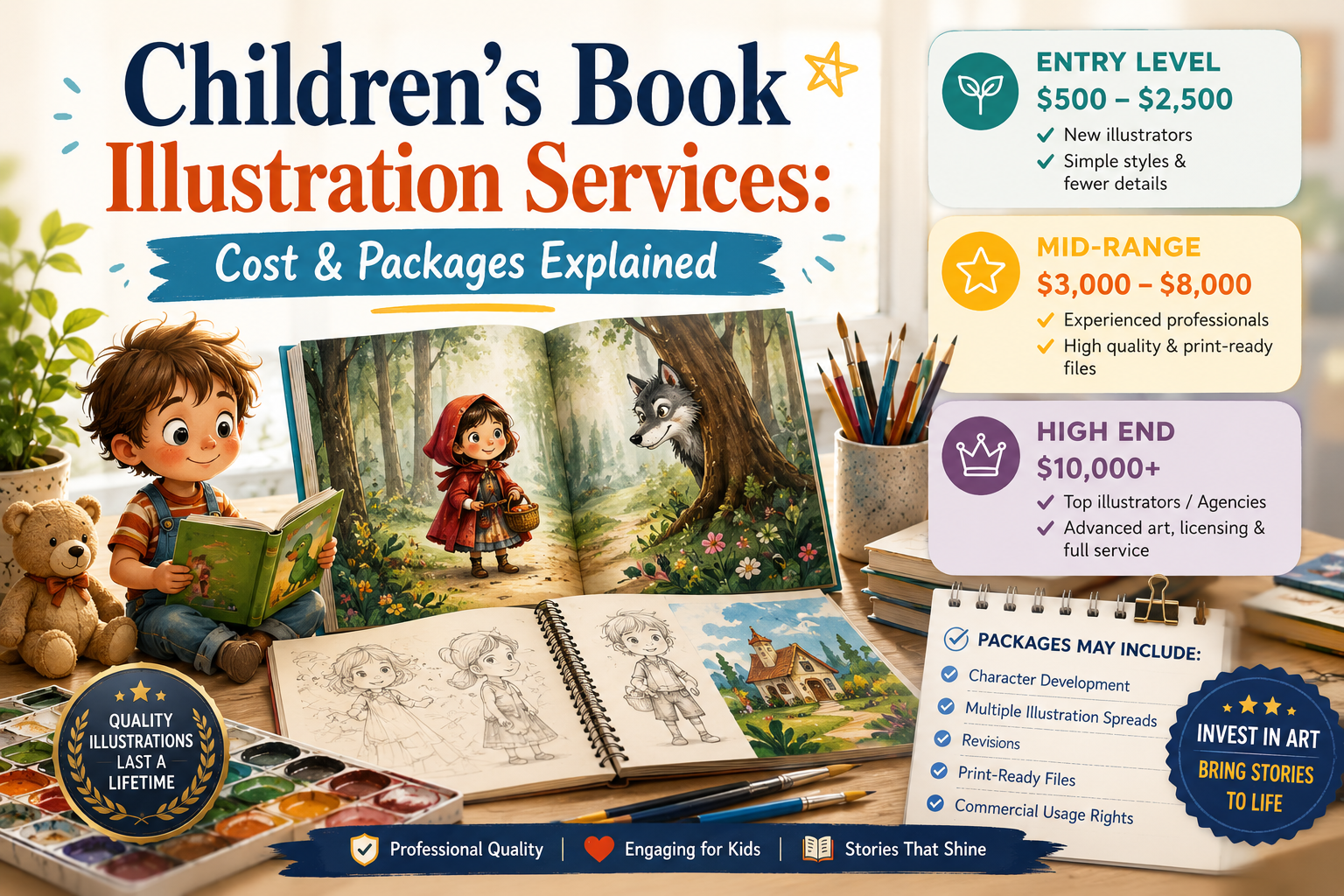
Okay so when I first tried to figure out the cost of getting a children’s book illustrated, I was genuinely lost. One person was quoting me $400 for the whole thing, someone else wanted $9,000, and both of them had portfolios that looked pretty good to me. I had no idea what I was actually supposed to be comparing. It took me way longer than it should have to understand how children’s book illustration services actually work, and I really wish someone had just sat me down and explained it clearly from the start.
So that is what I am going to do here. No fluff, no padding, just the actual stuff you need to know before you spend any money.
First Thing You Need to Understand, the Art Is Doing Half the Work
Most authors I have talked to treat the illustrations like an add-on. Like the story is the real thing and the pictures are just decoration on top. That mindset will get you into trouble pretty fast.
Think about how a young child actually sits with a picture book. They are not carefully reading every word. Instead, they focus on the pictures, using them to understand who the characters are, whether a page feels safe or scary, and if that animal seems friendly or not all from the visuals alone. The illustrations are not supporting your story. In a lot of ways they are telling it.
This is why you cannot just hire anyone who draws nicely. A proper children’s book illustrator understands how kids process images. They know that a slightly slumped posture on a character signals sadness without a single word of text. They know which color combinations feel warm and inviting versus which ones create unease. And critically, they know how to keep a character looking exactly the same across 16 different spreads so that a four year old recognizes them every single time.
That is a real skill set. It takes years to develop. And the pricing in this industry reflects that.
The Style You Pick Will Shape Your Quote More Than Almost Anything Else
Before a serious illustrator even starts talking money with you, they want to know what style you are after. And this is not a minor detail because style directly affects how many hours the work takes.
Soft watercolor with hand-painted textures and layered backgrounds takes a lot longer to produce than clean flat digital illustration. Highly detailed spreads with complex environments and lots of characters take more time than simple two-figure compositions with plain backgrounds. So when you see two illustrators quoting very different prices for what seems like the same job, style and complexity are almost always the reason behind the gap.
Your Book Format Changes the Entire Scope
A standard 32-page picture book typically needs around 14 to 16 full spreads plus a cover illustration. A board book for toddlers might only need 10 to 14 images but they need to be bold and simple in a specific way that actually works for that age group. An early chapter book might only need a few spot illustrations scattered through the text. These are completely different scopes of work, and any illustrator worth hiring is going to ask about your format before they give you any numbers.
What Do Children’s Book Illustration Services Actually Cost
Alright, the real reason most people are reading this.
I am going to give you actual numbers but I want to be upfront that the range in this industry is genuinely wide. What you pay depends on the illustrator’s experience level, the complexity of your project, their location, and how you find them. That said, here is how it generally breaks down.
Entry Level Illustrators
If you go with someone who is newer to the industry, maybe recently graduated or still actively building their freelance client base, you are looking at roughly $500 to $2,500 for a complete picture book. The lower end of that usually means simpler artwork, less experience with actual print production requirements, and sometimes slower turnaround.
This is not automatically a bad option. There is genuinely strong work being done at this price point. But you have to look carefully at their portfolio, specifically for completed book projects, not just standalone character drawings. And be honest with yourself about how much direction you are willing to provide, because newer illustrators typically need more of it.
Mid-Range Professionals
This is where most self-publishing authors realistically land, and it tends to be the sweet spot for quality versus cost. An illustrator who has completed several actual book projects, has a consistent style, and understands how to deliver proper print-ready files will typically charge somewhere between $3,000 and $8,000 for a full picture book. That range usually covers character development sketches, a set number of spreads, a defined number of revision rounds, and final files.
If you want something that looks professional and can genuinely hold its own on a bookstore shelf or on Amazon, this is the range you should be planning for.
High End and Agency Level Work
Illustrators with credits from major publishers or strong public followings charge from $10,000 upward. Full service agency packages that bundle art direction, file management, and licensing consultation can push well past $20,000. For most independent authors this tier is more than you need, but if you are building something you plan to license or pitch to a traditional publisher, the calculus changes.
Breaking Down What the Packages Actually Include
This is where a lot of people get caught out. They see a price, they say yes, and then somewhere mid-project they realize the quote did not cover what they assumed it did. When you are comparing children’s book illustration services, always go through the package details line by line before you agree to anything.
Basic Packages
At the entry level you are getting a set number of full-color spreads, usually one round of revisions per piece, and delivery of final files in standard formats. Character development sheets may or may not be included and this varies quite a bit between illustrators so always ask directly.
This works fine if you walk in with an extremely clear vision and detailed references for everything. If you like to develop ideas collaboratively or you tend to refine things a lot as you go, you will hit the limits of a basic package pretty quickly.
Standard Packages
Most authors end up here. A standard package typically includes character concept sheets showing your characters from multiple angles and expressions, a full set of spreads for a complete picture book, two to three revision rounds per illustration, and files prepared for both print and digital formats. Whether the cover is included varies, so confirm that upfront rather than assuming.
Premium and Full Service Packages
Premium packages are designed for authors who essentially want to hand off most of the visual production side of things. Beyond illustrations these can include cover design, text layout, print file preparation for platforms like IngramSpark or KDP, and sometimes a character style guide if you are planning a series. Pricing here can stretch anywhere from $8,000 to $20,000 depending on exactly what is bundled in. For someone who does not want to deal with the technical side of print production, this can genuinely be worth it.
The Costs Nobody Puts in the Headline
Pay close attention to this part because it is where first-time authors almost always get surprised.
Revision fees are the big one. Every package comes with a cap on how many revision rounds are included. Once you go over that cap you pay per round, and depending on the illustrator that can be anywhere from $50 to $300 per round. If your manuscript evolves during the project, or if you are someone who has difficulty committing to creative decisions, those extra rounds stack up fast and quietly.
Licensing is another area that trips people up after the fact. When you pay for illustrations you are generally paying to use them in one specific context, your printed book. If you later want those same illustrations on merchandise, in a digital app, in a foreign language edition, anything outside the original agreement, that usually requires negotiating and paying for additional rights. Trying to sort this out after the contract is signed is always messier and more expensive than handling it at the start.
Rush fees are simple but easy to forget until you are suddenly stressed about a deadline. Asking an illustrator to compress their timeline usually adds 20 to 50 percent to your cost, sometimes more if the crunch is serious.
Print file prep sometimes shows up as a separate charge too. Getting art files into the exact technical specifications a printer requires is real work, and not every illustrator includes it in their base quote.
How to Actually Pick the Right Illustrator
Price is a filter but it should not be your deciding factor. Two illustrators quoting the same number can produce results that are genuinely miles apart, and choosing purely on cost has a way of becoming the most expensive decision you make once the revision rounds pile up and the timeline stretches out.
What to Actually Look at in a Portfolio
Do not just scroll through individual illustrations and react to whether they look nice. Look at complete book projects and go through them like a reader would.
What you are really evaluating is consistency. Does the main character look exactly the same on the first spread as they do on the last? Does the lighting and color palette stay coherent throughout the whole book? If you flipped through every page without reading a single word, would the story still feel like it flows? Maintaining that across an entire project is considerably harder than creating one great standalone image, and it is the clearest indicator that an illustrator has real book experience rather than just general illustration skills.
How They Communicate Tells You a Lot
You are going to be working with this person for several months. The way they handle the first few conversations gives you a pretty accurate preview of how the whole project will go.
Before requesting quotes, do they ask thoughtful questions about your story and characters? Do they offer creative ideas, or simply wait for instructions on what to draw? And when it comes to communication, do they respond on time or leave you chasing follow-ups? None of these things feel important until you are deep into a project that is going sideways.
Contracts and Payment Structure
Any professional illustrator should have a written contract ready before any work begins. Standard practice is a deposit of 25 to 50 percent upfront with the remaining balance split across defined project milestones. Full payment upfront is not standard practice. Likewise, anyone who avoids putting terms in writing is someone you should walk away from.
If Your Budget Is Tight, Here Is What Actually Helps
Not everyone has a few thousand dollars ready to go and that is a completely real situation. There are legitimate ways to access good children’s book illustration services without blowing past what you can actually afford.
People constantly overlook illustration students and recent graduates, even though they are genuinely underrated. Art school portfolios can be seriously impressive, and newer illustrators are often more motivated than established ones because they are actively trying to build their body of work. Spending time on Behance or looking through university graduate showcases can turn up real talent at prices that are much more accessible than the professional market.
Simplifying your manuscript is another practical move. Fewer spreads, simpler backgrounds, a smaller cast of characters, less complicated scene compositions. All of these reduce the hours per page and bring your total cost down meaningfully. A well-crafted 24-page book often works better creatively anyway than something sprawling that loses focus.
Some authors phase the project deliberately. Commission the cover and a handful of key interior spreads first, use those to run a crowdfunding campaign, then fund the full illustration run from what comes in. It takes longer but it distributes the financial load in a way that is actually manageable.
Alright, Here Is the Short Version
Honestly the whole point of understanding how children’s book illustration services are priced is not to stress you out. It is so that when you do start reaching out to illustrators you are not walking in blind. You know what questions to ask, you know what the packages actually mean, you know which extra costs to watch out for, and you can make a decision you will not regret halfway through production.
Find the right person, be clear about what you need, read the contract properly, and the rest of it tends to work itself out. The book you have been thinking about deserves that.