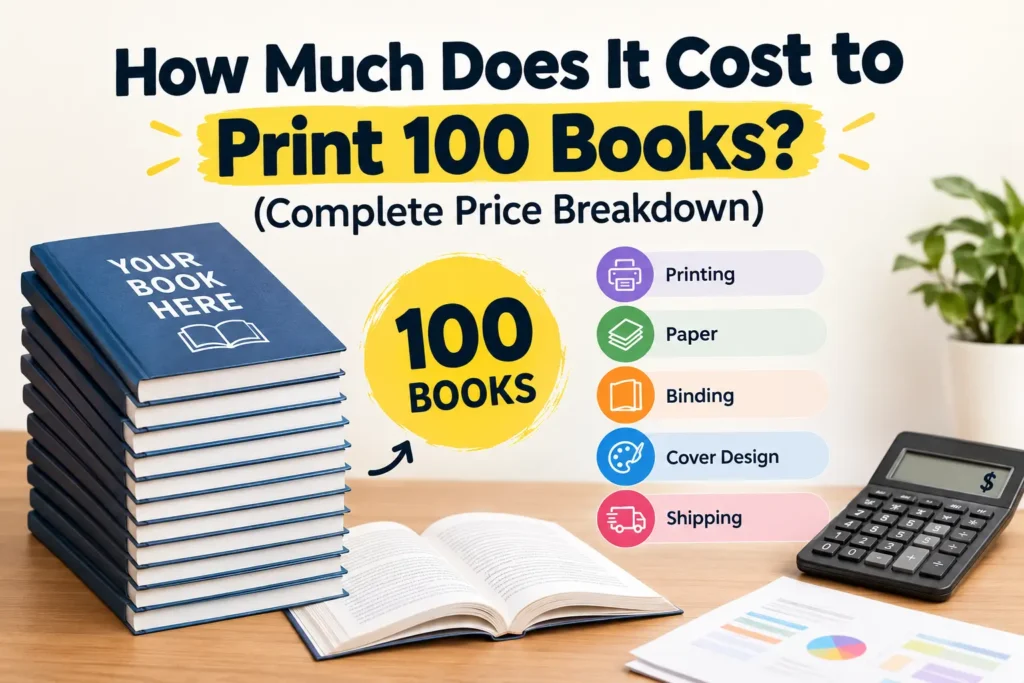
Anywhere from $500 to $2,500. I know, that’s a ridiculous spread. But a 250-page black-and-white paperback usually runs about $500 to $900 for the batch, and the same book as a hardcover jumps to $1,200 to $2,200. Delivery is extra, $50 to $200, and it’s the line people forget until the invoice lands.
Why so wide? Because “print my book” can mean nearly anything. Picture a thin poetry collection. Now picture a 320-page hardcover memoir with photos on every other page. Ask a printer to quote both and the numbers end up thousands apart. So the real question is what your book costs, and a handful of choices settle that.
I’m sticking to 100 copies since that’s where most first-timers begin. Other formats and quantities are in our complete guide to book printing cost. Below you’ll find prices for a 100-copy run, what ordering more really saves, what shipping adds, and how many books you need to sell to come out ahead.
[ADD: one or two sentences about your own first print run, or why you wrote this]
Cost to print 100 books by type
| Book type | Typical specs | Cost per copy | Total for 100 |
| Paperback, text only | About 250 pages, 5.5 x 8.5 or 6 x 9 in, color cover | $5 to $9 | $500 to $900 |
| Hardcover, text only | 250 to 320 pages, cased binding | $12 to $22 | $1,200 to $2,200 |
| Full-color paperback | 120 to 250 pages, color throughout | $9 to $25 | $900 to $2,500 |
| Children’s picture book | 32 pages, full color | $5 to $15 | $500 to $1,500 |
| Spiral-bound workbook | About 80 pages | $5 to $8 | $500 to $800 |
Printing only. Proofs, shipping and file fees are extra.
Color is where budgets die. That’s the reason cookbooks are so pricey to make. Picture books break the pattern, though. Thirty-two color pages sounds like a lot, but it’s barely any paper, and 100 copies can cost less than a thick hardcover.
Don’t treat any of these as gospel. Paper prices shift, freight shifts, and a printer with a packed schedule will quote you more than one whose presses are sitting idle. Get a real quote before you build a budget around a number from a website. This one included.
Bulk discounts: 50, 100, 250, 500 and 1,000 copies
Print more, pay less per book. Your total climbs, of course, and a cheap unit price means nothing when the boxes are stacked in your garage.
The prices below are for a 200-page, 6 x 9 black-and-white paperback.
| Copies | Cost per copy | Total printing cost |
| 50 | $6.50 to $9.00 | $325 to $450 |
| 100 | $5.00 to $7.50 | $500 to $750 |
| 250 | $3.80 to $5.50 | $950 to $1,375 |
| 500 | $3.00 to $4.50 | $1,500 to $2,250 |
| 1,000 | $2.20 to $3.50 | $2,200 to $3,500 |
A thicker book sits toward the top of each range, a thinner one toward the bottom.
Why small runs cost more per book
A press needs the same prep whether it’s printing 50 books or 50,000, and the printer divides that cost across whatever you ordered. Small order, big slice per book.
Offset printing, the method for large runs, involves making plates, getting the ink right, and burning through paper on test sheets. Hours of skilled work, every time. After that, extra copies are close to free, which is how 3,000 books can come out near $2 each.
For 100 copies, nobody bothers. The job goes on a digital press that’s ready almost immediately. Setup is cheap, but you pay more per page.
Is 250 copies a better deal than 100?
Per book, sure. The unit price falls about 25%, from roughly $5.00 to $7.50 down to $3.80 to $5.50. But the total almost doubles, going from $500 to $750 up to $950 to $1,375. Those extra 150 books work out to about $3.00 to $4.20 apiece.
Got buyers lined up? Good deal. Just hoping people will show up? That’s a gamble. And ordering 500 only because the unit price looks nice is how garages fill up with books. Before you order, know where the other 400 are going.
From 500 to 1,000 copies you save about $0.80 to $1.00 a book. Go past 1,000 and you’re in offset territory, where the math is different again.
Getting bulk quotes
Email each printer one time and ask for 100, 250 and 500 copies, same specs for everyone. Then compare landed cost per copy, meaning printing plus delivery to your door. It tells you much more than the sticker price does.
What moves the price at 100 copies
Four decisions do most of the damage. Page count is a fifth, and it gets its own section further down. For more on trim size, paper and binding, see the main guide.
Binding. A hardcover costs two to three times a paperback at this size. For a first book, I’d go paperback. Gift books are the exception, like a family history or a wedding album, where a solid cover is half the appeal.
Color pages. Full color on every page can double or triple the total. If you’ve only got a few images, ask about a color insert: a short run of glossy pages bound into the middle of a text book. Not every printer offers one, and hardly any advertise it.
Trim size and paper. 5.5 x 8.5 and 6 x 9 inches are cheapest because printers stock paper for them. Plain 50 to 60 lb stock is fine for most books. Heavier or coated paper costs more.
Cover finish. Matte or gloss is standard. Foil, embossing and spot UV all add money, and foil with spot UV can hit $1.50 to $4.00 a copy at this size. That’s $150 to $400 for the run.
Whichever printer you pick, get these itemized on the quote. If you don’t, you’ll never figure out why the price moved $200 between versions.
Hidden costs and shipping
Almost no final invoice matches the quote. Typical extras:
- Shipping: $50 to $200, depending on weight, distance and number of addresses.
- Proof copy: $15 to $80, and the top of that range includes postage.
- File setup: $25 to $150 at some printers; others fold it into the per-copy price.
- ISBN: about $125 in the US if you buy your own. A free one from a platform may tie the book to that platform.
- Design: a few hundred dollars up to a few thousand.
- Customs: with an overseas printer, import VAT or duties add 10 to 25 percent.
For a standard 100-copy paperback, figure an extra $65 to $230 over the print quote for shipping and a proof. ISBN and design are on top of that.
Shipping 100 books
A carton of 100 paperbacks can top 50 pounds. From a US printer, delivery usually costs $50 to $200, roughly $0.50 to $2.00 per book. Hardcovers weigh more, and sending to several addresses or overseas costs more again.
Bigger orders spread freight thinner. For 500 books, expect about $80 to $250, or $0.16 to $0.50 each.
Send it all to one address and ask for a landed price. And order a proof. Colors look different on a screen, and a margin that seems fine in a PDF can turn out lopsided on paper. Finding that out on one copy costs $15 to $30. Finding it out after printing 100 means you paid for 100 mistakes.
[ADD: a real proof or file problem you’ve run into, if you have one]
100, 200 or 300 pages
Paperback or hardcover comes first, but page count is next in line. These assume a 6 x 9 inch book with a text-only interior.
| Pages | Paperback, per copy | Paperback, 100 copies | Hardcover, per copy | Hardcover, 100 copies |
| 100 | $3.50 to $5.50 | $350 to $550 | $9 to $14 | $900 to $1,400 |
| 200 | $5.00 to $7.50 | $500 to $750 | $11 to $18 | $1,100 to $1,800 |
| 300 | $6.50 to $9.50 | $650 to $950 | $13 to $22 | $1,300 to $2,200 |
Each added 100 pages costs about $1.50 to $2.00 more per paperback, or $2 to $4 per hardcover. Trim 40 pages off a 300-page paperback and you keep roughly $60 to $80.
Your real budget for 100 books
These totals cover printing, delivery and a single proof copy.
| Project | Per copy | Printing | Shipping | Proof | Total | All-in per book |
| Paperback, 6 x 9, 200 pages | $6.25 | $625 | $120 | $20 | $765 | $7.65 |
| Hardcover, 6 x 9, 320 pages, cream paper | $16.00 | $1,600 | $150 | $25 | $1,775 | $17.75 |
| Paperback picture book, 8.5 x 8.5, 32 color pages | $7.00 | $700 | $100 | $15 | $815 | $8.15 |
ISBN, design and formatting aren’t in there. If your files need work, sort that out first.
50 vs 100 vs 250 copies, all-in
The per-copy price a printer quotes leaves out shipping and the proof. Put them back and you get this, along with the number of sales needed just to break even.
| Copies | Printing | Shipping and proof | All-in total | All-in per book | Break-even copies |
| 50 | $388 | $80 | $468 | $9.35 | 33 |
| 100 | $625 | $140 | $765 | $7.65 | 54 |
| 250 | $1,163 | $170 | $1,333 | $5.33 | 94 |
Same 200-page paperback throughout. Printing uses the midpoint of each range, shipping is $60, $120 and $150, and the proof is $20. Break-even assumes in-person sales at $14.99, leaving $14.26 after card fees (more on that in a moment).
At 250 copies a book costs you $5.33 instead of $7.65. Sounds great until you notice you’re spending $568 more and need 94 sales to break even, not 54. Fifty copies is the lowest-risk order at $468, though each book runs $1.70 more than at 100. My own view: skip 250 unless you’re honestly confident you’ll sell well beyond 94.
Break-even for 100 books
Lots of authors work out profit like so: “It costs $7.65, I sell it at $14.99, so I make $7.34 a book.” Nope. That overstates your profit. All 100 copies get paid for up front, and every sale carries its own costs.
Three numbers matter here:
- Upfront cost. Printing, delivery, the proof, and any ISBN or design you haven’t paid for. You owe it whether or not a single book sells.
- Selling price. What the reader hands over.
- Per-sale costs. Card or marketplace fees, postage and packaging, or a bookstore’s trade discount.
Take the per-sale costs off the price and you get net per copy. Divide upfront cost by that, and there’s your break-even.
Here’s the $765 paperback at $14.99:
| Where you sell | Per-sale costs | Net per copy | Break-even copies | Profit if all 100 sell |
| In person at events | Card fee of 2.9% plus $0.30 ($0.74) | $14.26 | 54 | About $660 |
| Your own website, you pay postage | $0.74 card fee plus $4.50 postage and mailer | $9.76 | 79 | About $210 |
| Bookstore at 40% trade discount | $6.00 discount | $8.99 | 86 | About $134 |
The fees and postage are ballpark guesses, so use your own. Sales tax and your time aren’t counted.
Two caveats. First, you won’t sell all 100. Keep 10 to 15 back for reviewers, giveaways and yourself, which leaves about 85 to 90. If bookstores are your only outlet, breaking even at 86 leaves you almost no wiggle room. Second, each extra $100 you spend up front (an ISBN you still need to buy, say) pushes break-even up by about 7 copies at event prices.
For the hardcover at $29.99 sold in person, you keep about $28.82 a copy, so the $1,775 order breaks even at 62.
Print on demand vs a 100-copy order
You can do both. They just serve different purposes.
Print on demand (POD), which is how KDP works, makes a book only when someone orders it. You pay a production cost, the platform takes its share, and you can buy author copies at cost. Nothing gathers dust in the spare room, and for online sales it’s tough to beat. The downside is margin. A 200-page paperback that costs around $3.50 in a large offset run might be $6.00 to $7.50 through POD. We go deeper in our print on demand vs offset printing piece.
A 100-copy run earns its keep when you’re selling face to face: a launch, a signing, a school visit, a craft fair, a local shop that needs copies by Friday. You often get more paper and finish options, and nobody takes a cut of your event sales.
Plenty of authors mix them, with a short run for events and local shops and POD for everything online. If KDP is on your list, our KDP paperback printing cost guide has the details.
How to spend less on 100 copies
Stay standard. Common trim size, paperback, text only inside. Put the money into the cover, since that’s what people judge first, and save foil and embossing for a second edition.
Have printers price 50, 100 and 250 copies together so you can see where the breaks fall. Collect three quotes with identical specs (trim size, pages, paper, binding, quantity) so the comparison is fair. Also check whether formatting and proofing come bundled, because that’s sometimes cheaper than buying each separately.
Choosing a printer for a short run
A quote that seems too good can mean dull colors and a spine that cracks the first time the book is laid open. Ask for a printed sample if you can. Read reviews that mention print quality, not only speed. Get an itemized quote (printing, shipping, setup, proofing) and a delivery date in writing. Digital short-run printers often ship in 7 to 10 business days. Hardcovers or special finishes can take up to four weeks, shipping included.
Within the US, printing locally generally means quicker delivery and no customs. Overseas can be cheaper, but you’re swapping money for time and risk. It also helps when someone explains trim size, paper and binding before you commit, which is how custom book printing works at The Author Central.
[ADD: a printer you used or a quote you actually received, with the real numbers]
The same expensive mistakes keep showing up: skipping the proof, sending files that aren’t print-ready, picking a hardcover because it looks nice and ending up with 80 unsold copies, and putting the whole budget into printing so there’s nothing left to tell people the book exists.
Is a 100-copy run worth it?
Often, yes. A hundred books is enough for a launch, review copies and a few local shops, and small enough that a typo won’t ruin you. With the $765 paperback above, about 54 in-person sales gets your money back, and everything after that is margin.
Can you sell 54? Depends how hard you push. But it’s a realistic goal, a lot more realistic than the 94 you’d need after a 250-copy run.
The short version
Expect $500 to $900 for a standard paperback and $1,200 to $2,200 for a hardcover at 100 copies, plus roughly $65 to $230 for shipping and a proof. Break-even depends on where you sell, so use your own per-sale costs.
Get itemized quotes at 50, 100 and 250 copies, order a proof, and budget for shipping from day one. The full picture is in our complete book printing cost guide. And if you’d like help choosing trim size, paper and binding before spending anything, The Author Central can walk you through its book printing services and give you a clear price first.