Book Writing
 Book Cover Design
 Book Editing
 Book Formatting
 Book Publishing
 Book Video Trailer
 Book Printing
 Audio Books
 Book Illustrations
 Author Website
 Amazon Page Optimization
 Book Marketing
 Fiction Writing
 Non-Fiction
 Autobiography
 Memoir
 Novel Writing
 Children's Book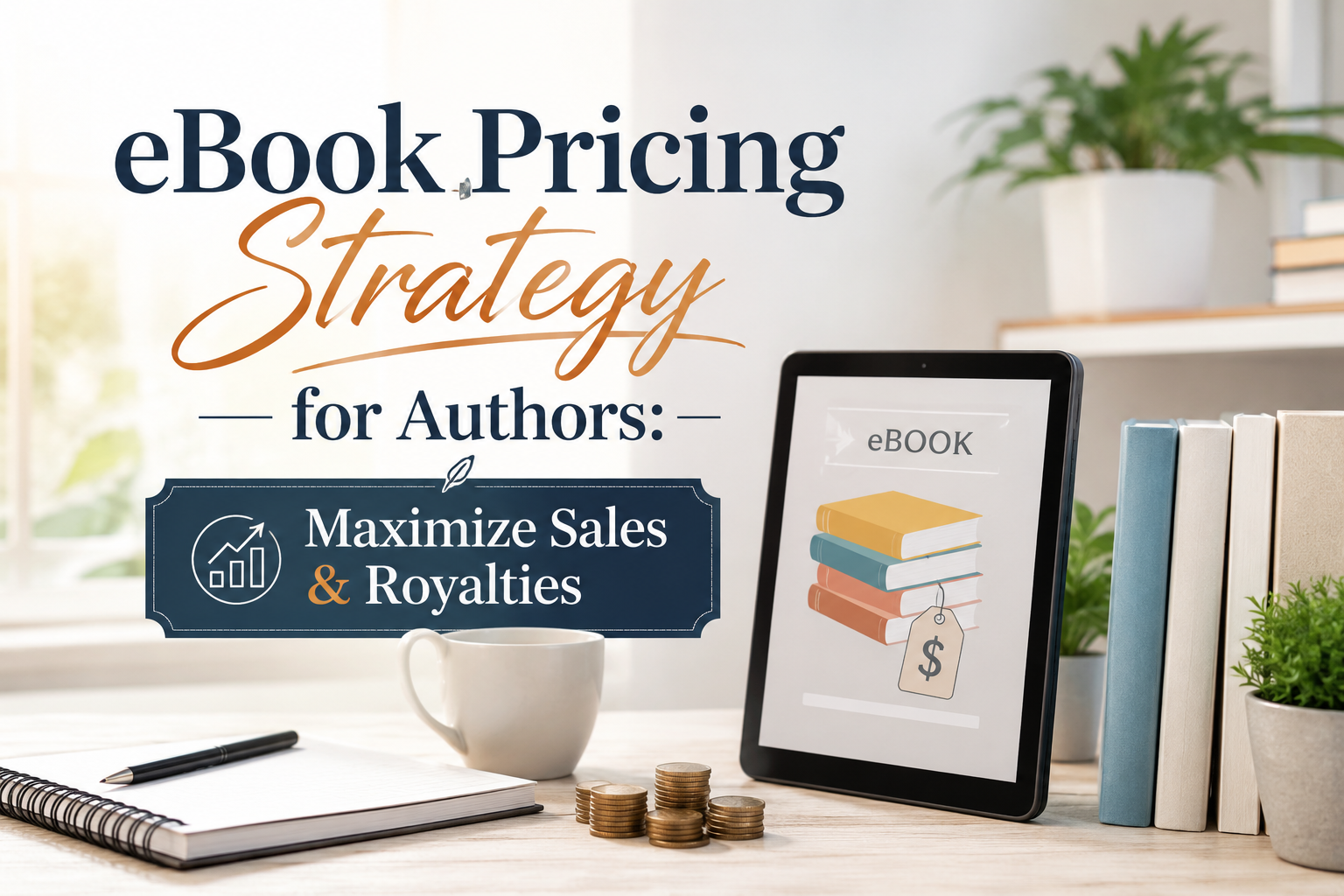
Ask any author who has been in the digital publishing space for a few years what they wish they had known earlier, and pricing comes up almost every single time. Not writing craft, not marketing, not cover design. Pricing. Because it turns out that the number you put on your book does a lot more work than most people realize when they are just starting out.
eBook pricing is one of those things that looks like a five second decision but actually has real consequences that play out over months. Set it too low and readers wonder what is wrong with the book before they even open it. Set it too high and you are competing against authors with ten times your reviews and a loyal readership already in place. Neither situation is great, especially when you are trying to build momentum from scratch.
The encouraging part is that this is not mysterious. Thousands of authors have already figured out what works in different genres, at different career stages, and with different goals in mind. The patterns are there. You just need to understand them well enough to apply them to your own situation rather than borrowing someone else’s strategy wholesale and hoping it fits.
Royalties First, Everything Else Second
Before you even think about what number to put on your book, you need to understand how the money actually flows. Because the royalty structure on platforms like Amazon KDP changes everything about how you should think about price points.
Amazon gives you a 70% royalty if your book is priced between $2.99 and $9.99. Outside that window, whether you go lower or higher, the royalty drops to 35%. That one fact alone should shape most of your pricing thinking.
Here is what that looks like in real terms. A book at $0.99 earns you somewhere around thirty five cents per sale. A book at $2.99 earns you just over two dollars. To match the income from a hundred sales at $2.99, you would need to sell roughly six hundred copies at $0.99. For most authors, especially those still growing their audience, that kind of volume difference is genuinely difficult to make up.
Kobo, Apple Books, and Barnes and Noble offer competitive royalty rates as well, usually in a similar range. If you are publishing on multiple platforms rather than exclusively through Amazon, you want to make sure your price point makes sense across the board rather than optimizing for one platform and accidentally shortchanging yourself on another.
What Your Price Tells a Reader Before They Read a Single Word
People make decisions about books the same way they make decisions about most things: emotionally first, then they find reasons to justify what they already wanted to do. The price tag is part of that emotional first impression, whether readers consciously acknowledge it or not.
A $0.99 book sends a specific signal. It says “low barrier to entry” and “try this with no risk.” That can work really well in the right context. But it also, fairly or not, carries a faint suggestion of lower confidence from the author’s side. Some readers will wonder why it is that cheap. They will still click buy because the risk is minimal, but their expectations going in are shaped by that number.
A book priced at $4.99 or $5.99 says something different. It says the author believes in what they made. In nonfiction especially, in business books, self help, and similar categories, readers actually respond better to a price that feels considered rather than desperate. They are buying the author’s expertise, not just their words, and a slightly higher price reinforces the idea that the expertise is real.
“Where things get tricky is above $9.99. At that point you are standing in the same price range as traditionally published books, and readers will unconsciously compare your production quality, your editing, and your cover to that standard.”
Independent authors can absolutely charge those prices, but they need to be confident they are delivering at that level.
Genre Has Its Own Economy and You Need to Know Yours
This is the piece that a lot of authors skip over because they are focused on their book specifically rather than the category it lives in. But your genre creates a kind of invisible market with its own pricing norms, and ignoring those norms usually costs you readers.
Romance readers, thriller fans, science fiction enthusiasts, they often read ten, fifteen, twenty books a month. They follow series obsessively. They have been trained by years of market patterns to expect lower prices, and they shop accordingly. Successful authors in these genres typically price between $2.99 and $4.99 and make their income through volume and series read through. The math works because readers come back again and again.
Nonfiction works differently. Someone buying a book about building a business, managing their money, or improving their health is thinking about return on investment, even if they would not use that phrase. They want to believe the book will be worth it, and a $7.99 or $8.99 price tag actually supports that belief rather than undermining it.
Launch Week Is Not the Same as Long Term eBook Pricing
A lot of authors treat their launch price as their permanent price, and that is a mistake worth avoiding. The goal at launch is almost never maximum royalty per sale. The goal is attention, reviews, and algorithmic momentum. Those things require different tactics than long term revenue optimization.
Many authors launch at $0.99 specifically to drive early downloads and generate reviews quickly. Once they have twenty or thirty reviews giving them social proof, they raise the price to where they actually want it to live. The lower launch price is not a reflection of the book’s worth. It is a strategy for getting the book in front of enough readers fast enough that the platform starts treating it as worth recommending.
For first books in a series, this approach works particularly well. Get readers into book one cheaply, deliver something they genuinely enjoy, and they will pay full price for every book that follows. The discounted first entry is really just the beginning of a longer relationship, and the economics across the series make the early discount worthwhile.
For standalones, move toward your target price relatively soon after launch. A book that stays permanently at $0.99 starts to look like it was never worth more, and that perception is hard to undo later.
KDP Select, Permafree, and Smart Discounting
Discounting is a tool, not a state of being. There is a big difference between running a strategic promotional sale and simply having a cheap book all the time.
Amazon’s Kindle Countdown Deal is genuinely useful because it lets you discount temporarily while still earning 70% royalties during the sale window, which is unusual and financially meaningful. Drop your $4.99 book to $0.99 for a weekend, promote it through newsletter swaps or BookBub or social media, get a sales spike, watch your ranking improve, then return to full price while keeping the visibility gains. That is a legitimate strategy with real upside.
Free runs through KDP Select work differently but can be just as effective. Thousands of people downloading a free book in a short period creates a kind of social momentum, and a percentage of those readers will leave reviews, subscribe to your email list if you have a call to action inside the book, or go on to purchase your other titles.
Wide authors sometimes make the first book in a series permanently free through a process called permafree. You set it free on other platforms, then request that Amazon match the price. When it works, it creates a continuous funnel of new readers who then buy the rest of the series at normal prices.
A mediocre trailer, or in this case a poorly considered pricing strategy, does more damage than no strategy at all. It signals to readers that you do not take your own book seriously. Whatever you decide on, commit to it intentionally rather than by default.
Testing Your Price and Paying Attention to the Results
Digital publishing gives you something traditional publishing never did: the ability to change your price anytime and see what happens. Most authors know this but do not use it deliberately. They set a price, leave it forever, and wonder why their income plateaus.
When you run a promotion and lower your price, do not just look at copy count. Look at total royalties earned during that window compared to a normal period. A weekend where you sold two hundred copies at $0.99 feels exciting, but if it earned you $70 and a regular week at $3.99 earns you $55 with ten sales, the math is closer than it looks. The goal is sustainable income, not impressive download numbers that do not translate to actual earnings.
If you are enrolled in Kindle Unlimited, page reads add another layer to this calculation. KU readers borrow rather than buy, and you earn per page read regardless of your listed price. Authors who ignore page reads when evaluating their eBook pricing strategy are missing a significant part of the picture.
Thinking Across Your Whole Catalog, Not Just One Book
Single book pricing is relatively simple. Catalog pricing is where things get genuinely interesting, and where the authors who treat writing as a long term business start to pull ahead of those who treat each book as a standalone event.
The approach that works for most successful independent authors is essentially a funnel. The first book in a series is the entry point, priced low or free to remove the barrier for new readers. The middle books sit at a comfortable mid range that balances accessibility with reasonable royalty income. The newest release can be priced at the top of what your genre supports because those readers are not price shopping anymore. They are fans.
Boxed sets offer a different kind of opportunity. Bundling three or four books together at a price that is slightly less than buying them individually gives late discovering readers an attractive entry point while still generating solid royalty income per transaction.
For nonfiction authors who create complementary books on related topics, cross promotion within your catalog works especially well. A reader who finishes your book on email marketing and finds you also wrote a book on content creation is already primed to purchase. Pricing that second book at a loyalty discount for existing readers builds goodwill and repeat purchase behavior.
$0.99
Entry point / Free
$3.99
Mid range balance
$5.99
Fan purchase / premium
eBook Pricing Is a Strategy, Not a Guess
The authors who build real, lasting income from digital publishing are not lucky. They are deliberate. They treat eBook pricing as something to be thought about, tested, revisited, and adjusted over time rather than something to be set once and forgotten.
Start with your genre norms. Understand your royalty structure deeply enough that you never accidentally leave money on the table through ignorance. Think about what your price signals to a reader who has never heard of you. Build a launch strategy that is different from your long term strategy. And check in on whether your pricing is actually working rather than just assuming it is.
Your book deserves readers, and the right price is part of how it finds them.