Book Writing
 Book Cover Design
 Book Editing
 Book Formatting
 Book Publishing
 Book Video Trailer
 Book Printing
 Audio Books
 Book Illustrations
 Author Website
 Amazon Page Optimization
 Book Marketing
 Fiction Writing
 Non-Fiction
 Autobiography
 Memoir
 Novel Writing
 Children's Book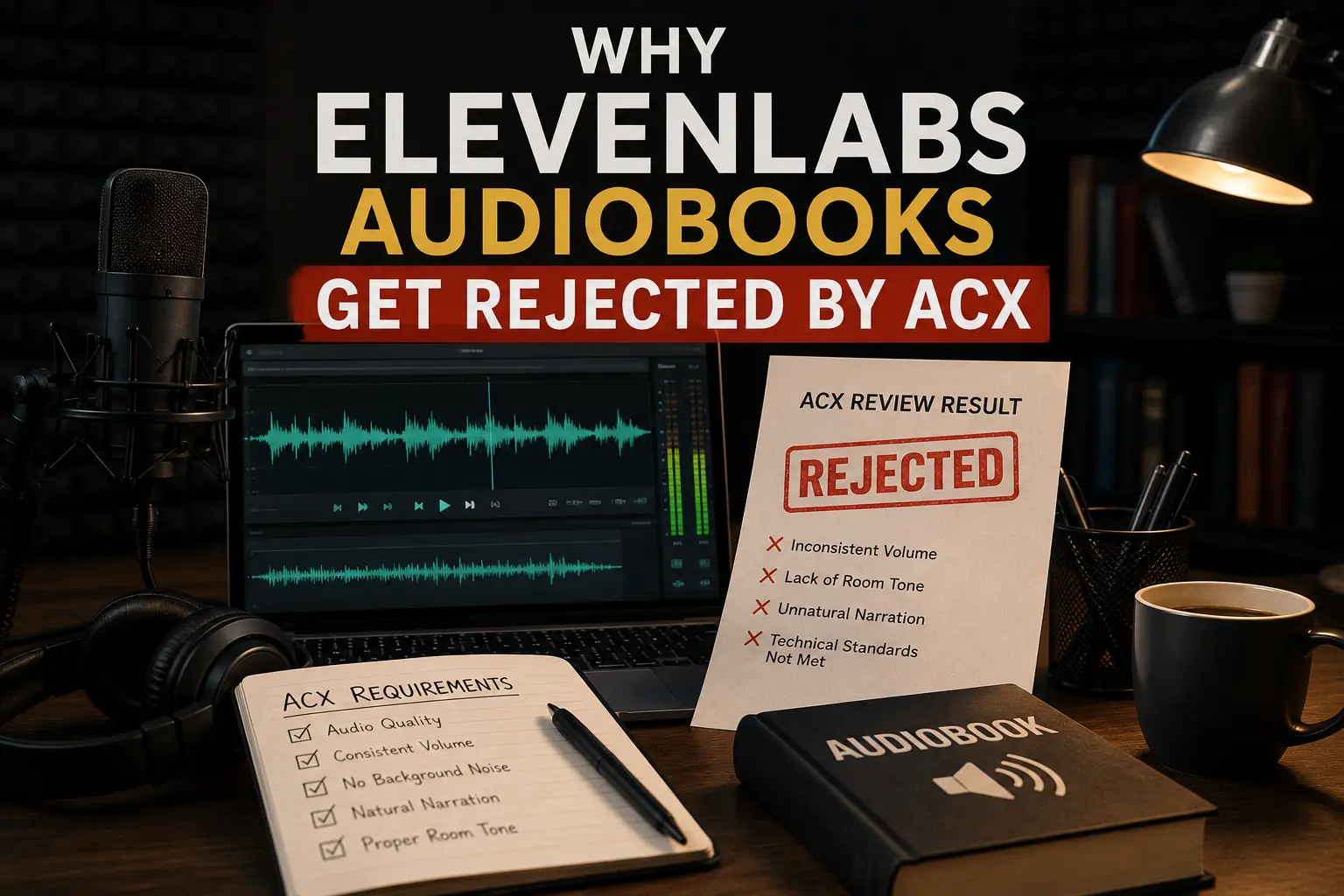
My buddy Taylor spent almost three weeks generating his audiobook using ElevenLabs. He was genuinely proud of it too, kept sending me clips saying “listen to this, sounds like a real person right?” Then he submitted it and got an ElevenLabs ACX rejection email within days. No detailed explanation, just a list of issues and a polite “please fix and resubmit.” He called me confused, a little annoyed, wanting to know what he’d done wrong when the voice sounded so clean to his own ears.
This has been happening to a lot of people lately, honestly more than you’d expect. So I figured I’d break down what’s actually going on, why ACX keeps bouncing these files back, and what you can do differently if you’re using AI voice tools for your own audiobook.
What ACX Is Actually Listening For
ACX has always had pretty rigid technical standards, this isn’t new or something that started with AI narration. They check volume consistency, background noise levels, proper RMS and peak measurements, and something a bit harder to quantify, whether the narration sounds natural to a human ear.
Now here’s where things get tricky with AI voices. Even really good ones, and ElevenLabs is genuinely impressive, they still stumble on stuff human narrators handle without even thinking about it. Breathing, for one. A real person naturally breathes between sentences in a rhythm that feels organic. AI voices either skip that entirely or place breaths in spots that feel just slightly wrong. Most casual listeners won’t consciously notice, but ACX’s reviewers are trained specifically to catch things like this.
The Technical Reasons Behind ElevenLabs ACX Rejection
A lot of people assume rejections come down to voice quality alone. Honestly, plenty of them are purely technical and have nothing to do with how good the narration sounds.
ACX wants your audio sitting within a specific range, roughly negative 23 to negative 18 RMS, with peaks staying under negative 3dB. Raw exports straight out of ElevenLabs, without any processing afterward, frequently miss this mark. People hear a crisp, professional sounding voice through their headphones and assume the technical side must be fine too. It often isn’t, not without extra work.
Room tone trips people up constantly as well. ACX expects a few seconds of natural quiet at the start and end of every chapter, not complete digital silence. AI generated files typically produce that dead, flat silence by default, and it actually sounds unnatural enough that reviewers flag it. You either need to record a bit of real ambient room noise separately or fake it convincingly with software, and a surprising number of people skip this step entirely without realizing it matters.
Mistakes I Keep Seeing People Make
After talking to a handful of authors going through this exact situation, some patterns keep showing up. Most cases of ElevenLabs ACX rejection trace back to the same handful of avoidable errors.
First one is skipping multiple listening passes for pronunciation. These tools are impressive, but they still mess up unusual character names, invented fantasy words, or regional phrases that don’t match a standard dictionary entry. If your book has a character named something like Zephyrine and you don’t manually correct the phonetics inside the tool, reviewers will catch that stumble almost immediately, particularly if it happens more than once across the manuscript.
Second, and this one is huge, is treating the raw ElevenLabs export as a finished file. It’s not. It’s closer to a first draft. Real audiobook production almost always runs the audio through mastering software afterward, adjusting levels, cleaning up small artifacts, and normalizing everything to hit ACX’s exact numbers. Skip mastering and you’re basically guaranteeing a rejection on technical grounds alone.
What Reviewers Are Actually Doing When They Listen
Something worth understanding here, ACX reviewers aren’t just running your file through some automated checker and moving on. There’s a real human listening at certain stages of review.
They sample sections throughout your book, not just the first minute or two. So if quality dips somewhere around chapter fourteen because you generated that batch in a rush, or used slightly different settings than earlier chapters, that inconsistency gets noticed pretty fast. This happens a lot with AI narrated books specifically, since people often generate different chapters across separate sessions, sometimes weeks apart, without keeping their settings perfectly matched.
Reviewers also listen for what people sometimes call the uncanny valley effect, where something sounds almost human but there’s this faint something that feels slightly off, even if you can’t immediately put your finger on what it is. This remains one of the genuinely hardest problems with current AI voice technology, and it’s behind a good chunk of ElevenLabs ACX rejection notices, even from creators who did everything else correctly on the technical side.
Practical Steps to Fix Things Before You Resubmit
Okay, enough about the problems. Let’s talk about actually solving this.
Start by running your whole book through proper audiobook mastering software. There are budget friendly tools built specifically for this that automatically adjust your file to ACX’s loudness and peak requirements, no deep audio engineering background required. This one step alone resolves a huge chunk of technical rejections on its own.
Next, actually sit down and listen to the entire book, beginning to end, not just a quick skim through a few chapters. I know that sounds exhausting for a twelve hour audiobook, but it’s really the only reliable way to catch pacing problems, awkward pronunciation slips, or emotional flatness that snuck in somewhere in the middle third. Most people only carefully review their opening chapter and assume everything after follows the same quality. It usually doesn’t.
Manually add real room tone if your files currently use pure digital silence between chapters. Small fix, genuinely easy once you know it’s something ACX checks for specifically.
Lastly, think about layering in small amounts of post processing to break up monotony. Some narrators use light compression along with manual pitch and pacing tweaks during emotionally heavier scenes, which helps avoid that flat, slightly robotic quality raw AI generation tends to produce. Takes more time upfront for sure, but it noticeably cuts down on the kind of rejections we’ve been talking about.
Wrapping It Up
Dealing with an ElevenLabs ACX rejection is frustrating, especially after sinking weeks into generating and organizing a full audiobook the way Taylor did. But once you actually understand what’s happening behind that rejection email, mismatched technical specs, inconsistent pacing, missing room tone, and that subtle uncanny valley quality AI voices sometimes carry, it gets a lot easier to fix before your next attempt. Taylor ended up remastering his file properly, fixed a handful of pronunciation issues manually, and resubmitted. Passed without a single note back that time. Annoying process the first time through, no doubt about it, but completely fixable once you know exactly what ACX is actually listening for.