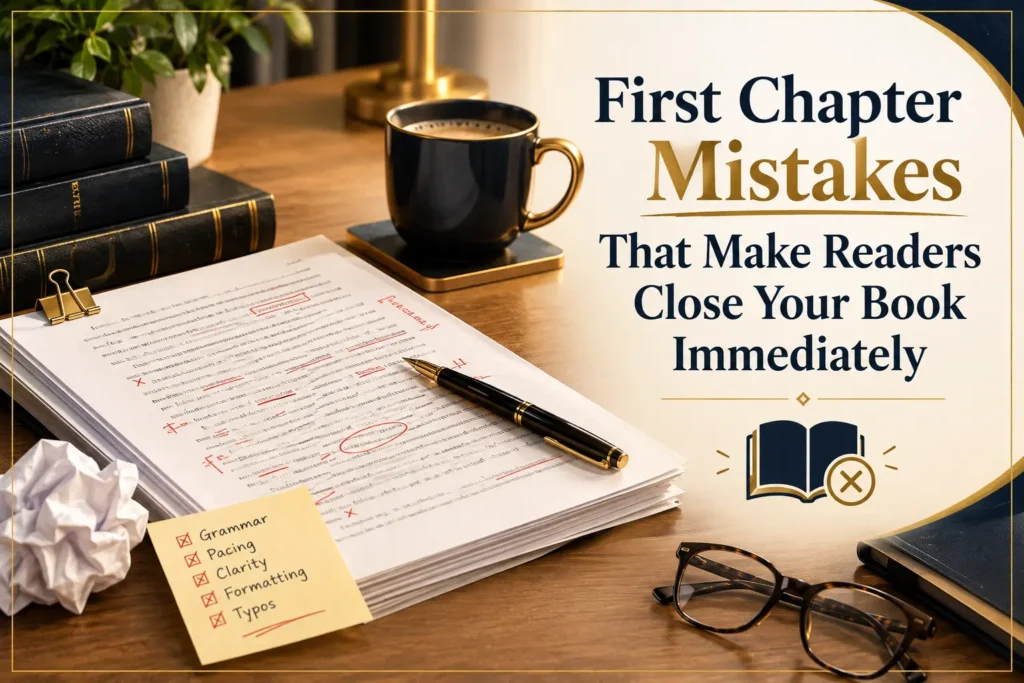
Readers quit a book when page one gives them nobody to worry about. Nearly all first chapter mistakes come down to that, and the fix is usually smaller than you’d think. You rarely have to gut the draft.
Writers often polish a first page for months and still lose people by paragraph three. The prose isn’t the culprit. The page just doesn’t hand a stranger anything to hold onto.
At The Author Central, our editing team reads openings like these every week, and the same pattern keeps showing up: the writing is fine, but the reader has nothing to worry about yet.
Why Readers Abandon Books Before Page Ten
Nobody owes your book a chance. A reader with a free sample on their e-reader can leave with one tap. An agent with a few hundred queries in the inbox can leave even faster.
So when people ask why readers abandon books so early, the honest answer is that leaving is free. They aren’t judging your talent. They’re asking something much simpler: is there a reason to keep going?
The first 10 pages of a novel have to answer that. Give the reader someone to follow, something that person wants, and something in the way. That’s the whole job. The lore, the history, and the clever subplot can wait their turn.
Don’t take my word for the speed of these decisions. Several agents describe it themselves in these literary agent interviews on Duotrope, and some say they know within the first few pages.

The Opening Chapter Mistakes That Cost You Readers
These opening chapter mistakes turn up in almost every critique pile. Very few of them are about sentences. They’re about what the reader knows, and cares about, by the bottom of page one.
Starting With Backstory
It feels responsible to explain things first. A childhood, a war, a kingdom’s tangled trade history. But readers forgive missing context much faster than they forgive nothing happening.
Say a fantasy draft opens with three pages on those trade wars. Now flip it: the book opens with a young woman hiding a forged tax seal while a guard’s footsteps stop outside her door. The trade wars still matter, and now the reader actually wants to hear about them.
Start where something is at risk. Then let backstory leak in one sentence at a time, only when the scene begs for it. Jane Friedman’s post on perfecting your first page is a useful companion here, and our guide to novel writing covers how the rest of the story should build from that opening.
Confusion Dressed Up as Mystery
A lot of writers hold information back on purpose, hoping it reads as intrigue. Sometimes it does. Often the reader just doesn’t know who’s talking or where they are.
Here’s my rough test. A mystery asks a specific question. Confusion asks nothing. “Why did she lie to him?” is a hook, while “wait, who is this?” is just fog.
Give readers solid ground first: a name, a place, a goal. Then hide one thing, deliberately, and only one.
A Scene Any Novel Could Have Opened With
Weather. Someone waking up. A character studying themselves in a mirror. Nothing is at stake in any of them, and readers can feel the engine idling.
Warm-up scenes aren’t wrong to write, since plenty of authors need them to find a voice. Just cut them before anyone else sees the draft. If you could paste your opening into a different book in your genre without changing a word, it’s too generic.
For more red flags like this one, see Writer’s Digest on avoiding red-flag mistakes on your first page.
Too Many Names, Too Fast
A dinner party can throw eight names at a reader inside two pages. Nobody holds that many, so they quit trying, and the story starts to feel like homework.
Introduce only the people the scene needs. Everyone else can be “the bartender” or “her brother” until the plot gives them a reason to have a name.
Tension That Never Shows Up
Slow openings are rarely short on action. They’re short on tension. A quiet kitchen conversation can grip you when two people want opposite things, while a car chase can bore you if you don’t care who’s driving.
Give every opening scene a small fight. Somebody wants something, and somebody or something says no.
A Voice That Hasn’t Arrived Yet
Plot takes a while to warm up, and voice is what holds a reader in the meantime. When an opening is overwritten, the narrator ends up sounding like nobody at all. Pile on enough metaphors and people are tired before the story has even begun.
Try reading page one out loud. You’ll hear the lines you’d never say to a friend, usually because they’re trying too hard. Mark them and rewrite until it sounds like a character thinking, not an author performing. If you want to go deeper on building a narrator people trust, our page on fiction writing is a good next stop.
How to Write a Strong First Chapter Without Waiting for Inspiration
Spotting the problems only gets you partway. What actually helps is a routine you can run on any draft, because sitting around hoping a better opening shows up is a slow way to revise.
A Cold Reader Pass for Spotting First Chapter Mistakes
You’re too close to your own pages, so borrow a stranger’s eyes. Here’s a quick way to catch first chapter mistakes in about ten minutes:
- Read your first page once, then close the file so you can’t peek.
- From memory, jot down who the main character is, what they’re after, and what’s in their way.
- Mark one spot that made you curious and one that left you lost.
- Find the first line where something is truly at risk.
- If that line isn’t on page one, think about moving your opening to it.
Next, hand that same page to a beta reader who knows nothing about the book and ask them the same questions. Compare notes. Wherever your answers and theirs don’t match, you’ve found what to revise.
Book Opening Hooks That Don’t Need Gimmicks
Good book opening hooks don’t need explosions or a shocking first line. They need a person under pressure. Of all the first chapter tips for novelists I could pass along, that’s the one I’d keep if I had to choose.
Three patterns hold up across genres:
- A decision with a cost: the character has to pick, and neither choice is painless.
- A disrupted routine: a normal day cracks in some small, specific way.
- A voice with a stance: the narrator lets slip an opinion that hints at something bigger.
Not sure how to hook readers in the first page? Choose one of these and settle into it before the first paragraph ends. Then add concrete detail so the moment feels lived in. Skip the gimmicks, too. Dream sequences and fake-out deaths top the list of first chapter writing mistakes to avoid, because readers feel cheated when the trick comes out.
A Quick Before and After
Take a contemporary drama. The weak version: “The morning sun crept over the hills as Maya woke up, thinking about the move she was dreading.” The stronger one: “Maya had until noon to tell her sister the family house was already sold.”
The first gives you weather, a bed, and a vague mood. The second gives you a person, a deadline, and a secret. It isn’t fancier, only more specific.
A good first line buys you a few paragraphs, though, not a whole chapter. The scene still has to keep the promise.
Your Next Step: Fix One Page Today
Please don’t try to repair every one of these first chapter mistakes in a single sitting. That’s how people burn out and abandon the draft. Run the Cold Reader Pass on page one today and rewrite only the part that fails.
Then send the new pages to two readers who haven’t seen your story and compare their answers with yours. Whether you’re still working out how to start a novel or polishing a final draft, fresh eyes save you weeks. If you’d like a professional read on your opening, our book editing team can show you exactly where readers drift.