Book Writing
 Book Cover Design
 Book Editing
 Book Formatting
 Book Publishing
 Book Video Trailer
 Book Printing
 Audio Books
 Book Illustrations
 Author Website
 Amazon Page Optimization
 Book Marketing
 Fiction Writing
 Non-Fiction
 Autobiography
 Memoir
 Novel Writing
 Children's Book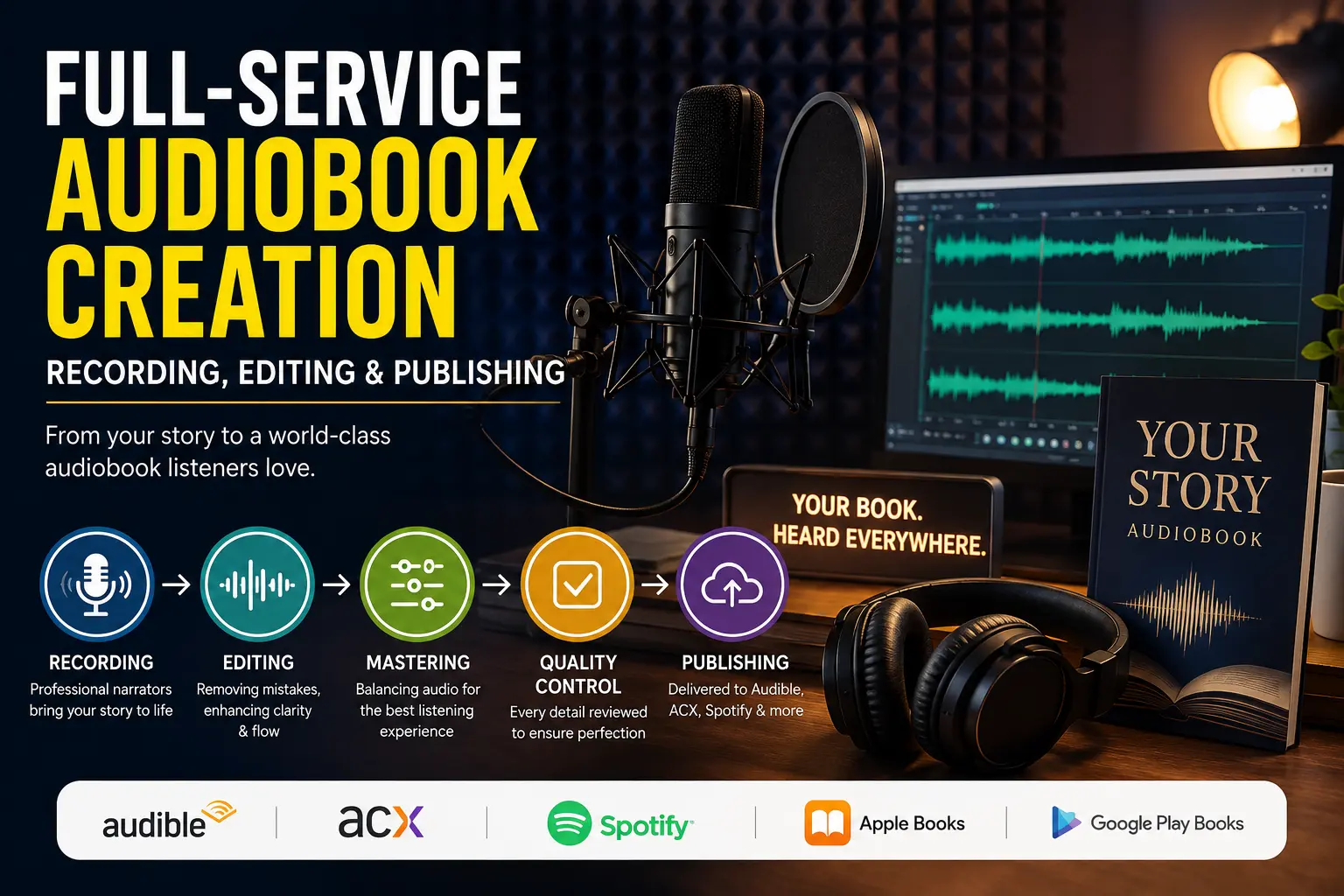
So I tried recording my own audiobook once. Bad idea, honestly, but I didn’t know that yet. Audiobook creation seemed simple enough in my head, just read the book out loud into a mic, right? Turns out I was wrong, and I found that out the expensive way. Three weeks, one cheap USB mic, and a stack of ruined takes later, what I had sounded like it was recorded inside a coffee can. That’s about when it hit me that this whole thing is its own craft, totally separate from writing the actual book, and it deserves way more respect than I gave it.
So let’s get into what full service audiobook creation actually looks like in practice, starting from someone sitting down in front of a microphone all the way to your book showing up on Audible or Spotify. Maybe you’re an author thinking about trying this for the first time. Or maybe, like me, you already tried doing it yourself and got burned. Either way, I think seeing why each stage matters will save you some headaches.
Reading Aloud Isn’t the Same Thing as Narrating
Here’s a mistake a lot of authors make, myself included at one point. They figure once the manuscript’s done, the audiobook’s basically already there too. Just read it, hit record, done. Nope.
Narrating well is an actual skill and it took me embarrassingly long to realize that. Pacing matters more than you’d think. So does tone. And if there’s dialogue in your book, good luck making every character sound distinct without it turning into some weird cartoon voice situation. There’s also this thing people forget entirely: most people listening to audiobooks are doing something else at the same time. Driving somewhere. Doing dishes. Walking their dog around the same block for the third time that week. So the narration has to hold up on its own without demanding the kind of attention a printed page gets.
Professional narrators just know this stuff instinctively, I guess from years of doing it. They know exactly when to slow down during an emotional scene, how to keep their energy from dying three hours into a session, how to make sure the villain doesn’t sound just like the best friend. I went back and listened to my own recording once, mostly to torture myself if I’m being honest, and by chapter three my voice had gone completely flat. Nobody tells you vocal fatigue is a real thing until you’re stuck living through it.
Recording Is Where Everything Either Works or Completely Falls Apart
This part gets underestimated constantly. A good recording doesn’t need some expensive studio setup, but it does need a reasonably quiet room, not much echo, a mic that isn’t picking up the neighbor’s lawnmower halfway through your big dramatic scene, and someone who actually understands gain staging (which, no, I did not understand at the time).
I’ve talked to a few narrators over the years about this, and they all basically say the same thing: fixing a bad recording afterward is way harder than just getting it right the first time around. Background hum, popping P sounds every other word, volume that drifts up and down between sessions, all of that turns into hours of extra work later that honestly didn’t need to happen in the first place.
The Editing Stage Nobody Really Talks About Enough
Once recording wraps, the real transformation happens here, quietly, in a way listeners never actually see. Honestly this might be the most underrated part of the whole process.
Editors go through it chapter by chapter. Cutting loud breaths. Removing random mouth clicks. Smoothing out the seams where one take ends and another begins. Making sure the volume doesn’t randomly shift halfway through chapter seven for no reason. When you listen to a professional audiobook and it sounds like it was recorded start to finish in one flawless sitting, that’s not luck. Someone spent real hours making it sound that way.
Then there’s mastering, which people mix up with editing constantly but it’s actually its own separate thing. Mastering is about meeting technical specs, and platforms like Audible, through their ACX system, are pretty particular about this stuff. Loudness levels, noise floor, file format, all of it needs to line up correctly or your file just gets bounced back during review. Which, trust me, is not a fun email to get after months of work.
Quality Control Catches What Everybody Else Missed
This step deserves way more credit than it gets. A good production team sits down and listens through the entire finished audiobook, sometimes two or three people doing this separately, just to catch anything that slipped past everyone else. Maybe a character’s name got mispronounced back in chapter four. Maybe there’s a tiny click during a page turn that nobody noticed the first five times through.
Small stuff, sure. But listeners notice every single time, without fail. And the moment a listener catches something technical like that, it yanks them right out of the story they were enjoying. A narrator told me once that a single mispronounced name early in a book generated more listener complaints than an actual plot hole in that same story. People will forgive a shaky plot twist. They will not forgive sloppy audio, apparently.
This, honestly, is the part that made me realize paying someone else to do this was worth every penny. DIY recording tools have gotten decent these days, sure. But catching every tiny mistake takes a trained ear, and frankly, a level of patience most authors don’t have left after spending a year or two writing the actual book.
Getting It Published Is a Whole Separate Challenge
You’d think after recording and editing you’d basically be done. Nope. Publishing an audiobook isn’t just uploading a file and walking away, unfortunately. There’s platform requirements, metadata, cover specs that need to match exactly, and a decision to make about exclusive distribution through Audible versus going wide across Spotify, Apple Books, Google Play, and whatever else is out there.
Going exclusive through ACX usually gets you better royalty rates, but you’re locked into fewer places to actually sell. Wide distribution spreads you across more platforms, though the cut per sale tends to be smaller. Neither one is just objectively better, it really depends what you’re going for and how much control you want over pricing.
A full service team usually just handles all of this without you needing to think about it much, which honestly is such a relief after everything else. They format your files correctly and submit them to the right platforms. They also make sure your description and keywords are set up so people can actually find your audiobook in a marketplace that’s completely flooded already. That discoverability piece alone trips up so many authors who assume publishing is the finish line.
What Happens After Launch Day Actually Matters Too
Getting published isn’t really the end, even though it feels like it should be by that point. Once your audiobook’s live, people still need to find out it exists. That might mean timing an announcement right, getting a few early listeners to leave reviews, or catching that visibility boost platforms sometimes give brand new releases in their first week or two.
Why Full Service Just Makes More Sense for Most Authors
Looking back at my own disaster of a first attempt, the real lesson was this: audiobook creation pulls in so many different skills at once that trying to handle it all myself wasn’t actually saving time or money. It cost me both, and I still ended up with something that didn’t represent my book well at all.
When you bring in a full service team, you’re basically getting three separate skill sets bundled together. You get voice performance, audio engineering, and someone who actually knows how distribution works behind the scenes. Almost nobody’s genuinely good at all three at once, and that’s fine. Authors are writers first. There’s no shame in admitting audio engineering just isn’t your thing.
I know a couple authors who went the DIY route and made it work out fine, and genuinely good for them. If you’ve got some background in audio already, or you’re willing to actually sit down and learn it properly, self recording can work. But for most of us, that time’s probably better spent just writing the next book instead.
Final Thoughts
At the end of the day, audiobook creation is one of those things where the invisible work matters just as much as what listeners actually hear. How you set up the recording, how carefully you edit it, and the small technical details of publishing it right, every piece of it plays a part in whether the whole thing actually works or falls flat.
If you’re thinking about turning your book into an audiobook, my honest advice is this: figure out early what you can realistically handle yourself and where you’re going to need help. Going full service with audiobook creation cuts out most of the guesswork and technical stress. Honestly, it just frees you up to focus on the thing you’re actually good at, telling your story. My second attempt, done properly this time with people who actually knew what they were doing, sounded nothing like that first coffee can disaster. And listeners noticed the difference too, which honestly felt pretty great after everything.