Book Writing
 Book Cover Design
 Book Editing
 Book Formatting
 Book Publishing
 Book Video Trailer
 Book Printing
 Audio Books
 Book Illustrations
 Author Website
 Amazon Page Optimization
 Book Marketing
 Fiction Writing
 Non-Fiction
 Autobiography
 Memoir
 Novel Writing
 Children's Book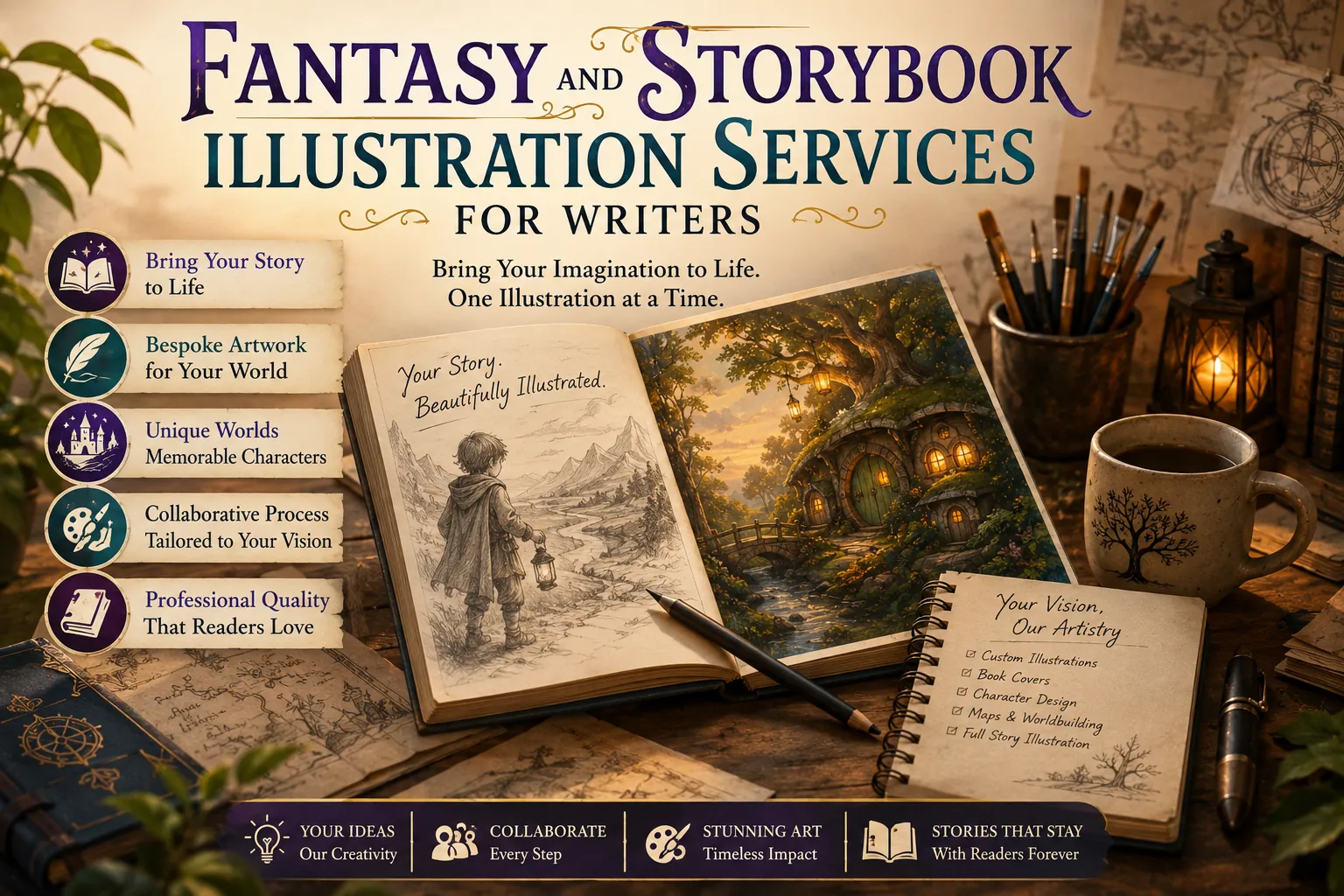
I have been writing fantasy stories since I was a teenager, filling notebooks with worlds that existed only in my head. For a long time I thought that was enough. Then I started looking into storybook illustration services and everything I understood about bringing a story to life shifted completely.
The World in My Head Did Not Match the Page
There is a particular kind of gap that fantasy writers know better than anyone. You can spend months, sometimes years, building a world with its own rules, creatures, light, weather, and geography. Every detail becomes clear in your mind. The forest at dusk feels vivid, the old tower has a defined shape, and even the sky before a storm carries a specific color unique to your world. And then you hand your manuscript to a reader and realize they are building something completely different in their imagination than what you had in yours.
That is not always a problem. Sometimes the reader’s version is wonderful. But when you are writing fantasy, when the visual world is as much a part of the story as the plot or the characters, that gap starts to feel like a loss. You want people to see what you see. Not a version of it. The actual thing.
That is what started me down the road of looking for proper illustration. Not because I thought pictures would replace the writing but because I understood finally that in fantasy, the visual and the written are not two separate things. They are the same thing told in two languages.
Why Fantasy Is Different From Everything Else
I want to explain this because I think it matters and not enough people talk about it honestly. Illustrating a contemporary story about kids in a school or a family dealing with something difficult is one kind of challenge. The illustrator is working from reality. They can look at references. They know what a school hallway looks like and what a kitchen table looks like and how grief sits on someone’s face.
Fantasy asks for something completely different. The illustrator has to build from scratch using only your words and their imagination as raw material. There are no reference photos for a six-limbed creature that lives in underground rivers and communicates through bioluminescence. There are no stock images of a city built inside a dead god’s ribcage. These things have to be invented, and inventing them visually while staying true to what the writer intended is a genuinely difficult and specific skill.
This is why I became so particular about which storybook illustration services I was willing to consider for my fantasy project. General illustration ability was not enough. I needed someone who thought in worlds, not just in images.
What I Got Wrong the First Time
My first attempt at finding illustration help for my fantasy book was not a complete disaster but it was far enough from what I needed that I ended up starting over entirely.
I found an illustrator through a general freelance platform whose portfolio was genuinely impressive. Clean lines, good color sense, confident character work. I hired them based on that and sent over my manuscript along with some notes about the world I had built.
The sketches that came back were competent. They were also completely generic. The characters looked like they could have come from any fantasy story, which is a real thing that can happen when an illustrator applies a standard approach to a genre that requires deep immersion in a specific world. The creature I had spent three pages describing came back looking like a slightly unusual lizard. The city looked like a European medieval town with some extra towers.
I tried giving more detailed feedback. We went back and forth a few times. The work improved at the margins but never became what I had imagined, and I realized the problem was not the execution, it was the foundation. This person had not really entered my world. They had illustrated around the outside of it.
What Changed When I Found the Right Kind of Help
After that experience I changed how I was searching entirely. Instead of looking for illustration skills generally, I started looking specifically for storybook illustration services that had a demonstrable history with fantasy and speculative fiction. What I was looking for were dragons that felt genuinely dangerous rather than decorative. The environments needed to carry a sense of history and weather. Characters, too, had to reveal their origins through their clothing and tools without relying on explanation.
That search took longer. I spent probably three weeks just looking at portfolios before I reached out to anyone. But when I finally found the right person, the difference was immediate and obvious. Her very first round of sketches for my main character showed someone who had actually read my manuscript rather than scanned it. Small details I had mentioned once in passing were in the image. The way the character held their coat against the wind matched something I had written in chapter two that I had honestly half forgotten.
That is what genuine engagement with source material looks like. And in fantasy especially, it makes all the difference.
What to Look for in Fantasy Illustration Specifically
World Consistency Across Every Image
This is something that matters much more in fantasy than in other genres. In a realistic story, visual consistency more or less takes care of itself because the real world is consistent. In a fantasy world you have invented, every illustration has to be consistent with every other illustration and with the internal logic of the world you have described in the text.
The light source in image three has to match the position of the suns you described in chapter one. The architecture in the background of a crowd scene has to reflect the same culture and history as the building you described in detail on page forty. Creatures have to look like they belong to the same ecosystem. The clothing has to follow the same rules of the society across different characters.
When I was evaluating storybook illustration services for my project, I paid close attention to how illustrators handled multi-image projects in their portfolios. Individual pieces can look great in isolation. What I wanted to see was whether an extended project held together as a coherent visual world from beginning to end.
The Ability to Invent Convincingly
This sounds simple but it is actually rare. Inventing something visually that does not exist and making it feel like it belongs in the real world, or in a carefully constructed fictional world, requires a specific kind of creative confidence that not every illustrator has.
The test I started using when reviewing portfolios was looking for original creature and environment design specifically. Not interpretations of dragons or elves that everyone has seen a hundred versions of but genuinely novel designs that the illustrator had invented themselves. If someone could invent convincingly in their own personal work, they had the foundational ability to invent convincingly inside my world.
Understanding Mood and Atmosphere
Fantasy lives and dies by atmosphere. A technically accurate illustration of a haunted forest that does not feel haunted has missed the entire point. The light, the color temperature, the way shadows fall, the level of detail versus suggestion in different parts of the image, all of these are tools for building the emotional experience that the writing is trying to create.
When I was looking at portfolios, I was not just asking whether the images were skillfully made. I was asking how they made me feel. Another question I kept asking myself was whether the darker scenes felt truly threatening or simply dim. I also considered if the magical moments felt genuinely wondrous instead of just visually flashy. Most importantly, I wanted to know if the images made me feel like I had stepped into a real place I had never seen before. Those emotional responses are the data you are looking for.
The Brief I Wrote and Why It Mattered
By the time I was ready to hire someone, I had learned from my previous experience that my brief needed to be thorough in a way that went beyond just describing the story. For a fantasy project, the world-building information is as important as the plot summary.
I created a document that outlined the physical rules of my world, including its astronomy, climate, construction materials, technology level, and the history shaping its visual culture. Each major character was then detailed carefully, not just in appearance but in movement and how their environment had shaped them over time.
Alongside this, I added a section describing how the magic should look and feel visually, something many fantasy writers overlook when defining their world.
I also included a substantial section on visual tone with references from other illustrated works, films, and paintings that captured something of what I was going for. Not to copy those things but to give the illustrator a directional sense of the emotional register I was working in.
The illustrator I hired later told me that brief was what made her confident enough to take on the project. She knew from reading it that I had done the work of understanding my own world clearly enough to communicate it.
How Long This Kind of Project Actually Takes
Fantasy illustration takes longer than most other kinds of book illustration and I think writers going into this process for the first time need to know that upfront so they can plan accordingly.
The invention stage alone, before a single finished piece is produced, can take weeks. Character design requires rounds of exploration before landing on something that feels right. Environment concepts need to go through multiple passes to find the version that captures both the practical details and the atmospheric feeling. Creature design especially can involve a lot of back and forth as you and the illustrator work toward something that feels genuinely original and right for your world rather than derivative of something that already exists.
For my project, which was a novel with chapter illustrations and a full cover, the total timeline from first conversation to final files was just under five months. That felt long while it was happening. Looking at the finished work now I understand completely why it took that long. That time was necessary for the illustrations to become what they are.
What the Right Illustration Did for My Book
I want to be honest and specific here rather than vague because I think specific is more useful.
Before the illustrations, my book was a manuscript that I believed in and that people who read it responded to well. After working with storybook illustration services that truly understood fantasy, my book became something that readers reacted to before they had read a single page. The cover alone generated more pre-release interest than anything I had done in my previous two self-published projects combined.
Inside the book, the chapter illustrations did something I had not fully anticipated. They gave readers a fixed point. A shared image. When a reader told me afterward that the scene at the bridge was their favorite moment, I knew we were talking about the same bridge. The illustration had made the world specific in a way that even good writing cannot fully achieve on its own.
One reader told me the book felt like something that had always existed and she had just finally found it. I do not think she would have said that about the manuscript alone. The illustrations were the thing that made the world feel discovered rather than invented.
What I Would Say to Any Fantasy Writer Considering This
Your world deserves to be seen. Not approximated. Not gestures toward. Actually seen, by someone who spent real time inside it and had the skill to translate what they found there into images that carry the same weight as your words.
Finding the right storybook illustration services for a fantasy project takes longer than finding illustration help for other kinds of books. The search is more specific, the brief needs to be more detailed, the collaboration needs to go deeper, and the timeline needs to be longer. All of that is true.
It is also completely worth it. When the work is done properly, the visual and the written stop being two separate things and become one experience. That is what fantasy is supposed to feel like. Not a story you read. A world you enter. Good illustration is one of the things that makes that possible.