Book Writing
 Book Cover Design
 Book Editing
 Book Formatting
 Book Publishing
 Book Video Trailer
 Book Printing
 Audio Books
 Book Illustrations
 Author Website
 Amazon Page Optimization
 Book Marketing
 Fiction Writing
 Non-Fiction
 Autobiography
 Memoir
 Novel Writing
 Children's Book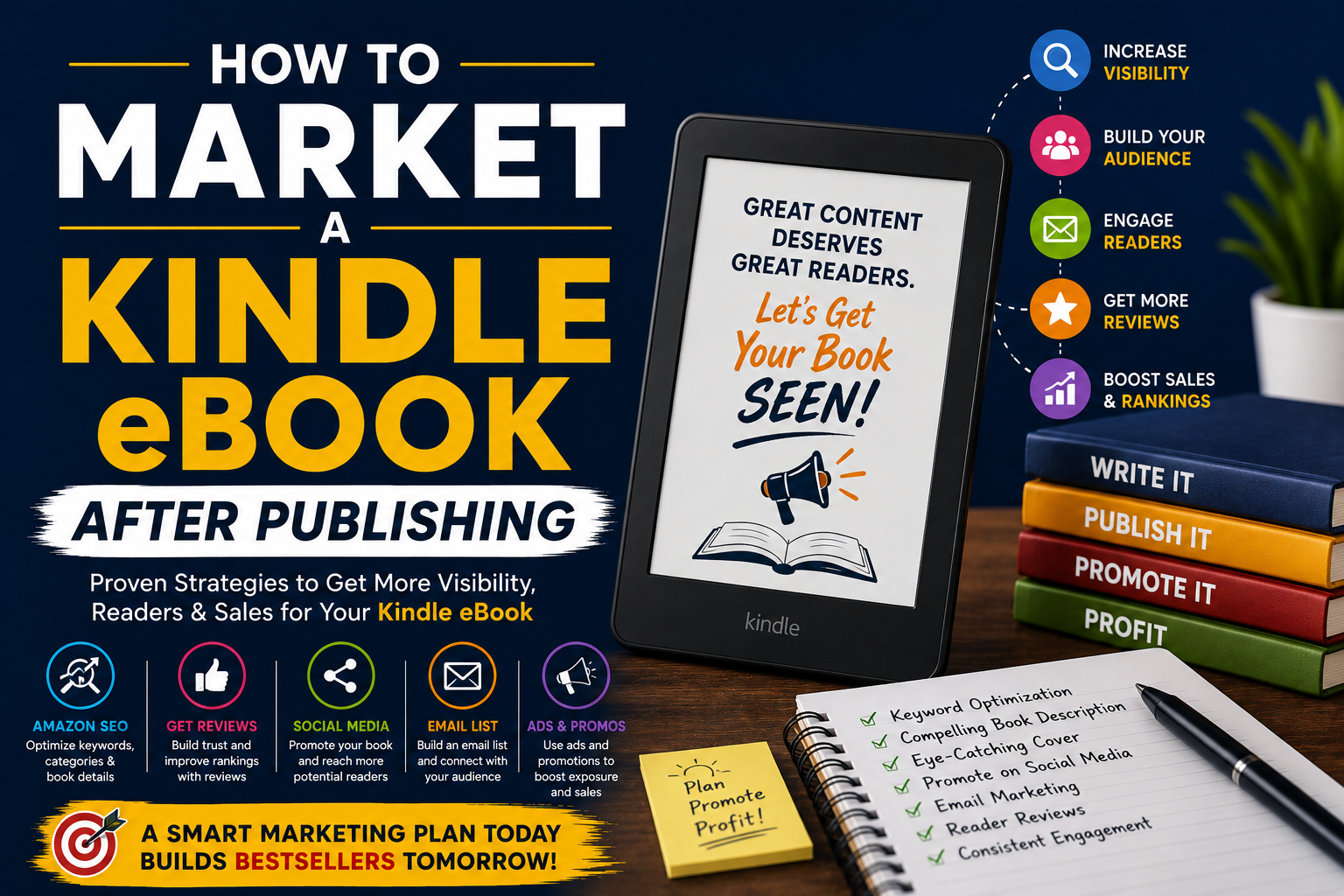
Nobody warned me that publishing my Kindle book was actually the easy part. I spent six months writing, editing, and getting the cover right, and when I finally hit publish I genuinely thought the hard work was done. I told my family the book was live, posted about it once on Facebook, and then sat back waiting for sales to roll in. For the first week I checked my KDP dashboard probably forty times a day. By the end of that week I had eleven sales, eight of which were people I personally knew. That humbling experience is what pushed me to actually learn eBook marketing from the ground up, and everything I am sharing here comes from what worked and what absolutely did not over the years that followed.
The uncomfortable truth is that Amazon will not market your book for you, at least not until you have already proven to its algorithm that your book deserves attention. You have to create that initial momentum yourself. Once you understand that, the whole marketing picture starts to make sense.
The Launch Window Matters more than most Authors Realize
The first 30 days after your book goes live are disproportionately important. Amazon’s algorithm is paying close attention to new books during this period. It is watching how many people click on your listing, how many of those clicks turn into purchases, how many people add it to their wish list, and how quickly reviews start accumulating. Strong early performance signals to Amazon that this book deserves to be shown to more people. Weak early performance pushes it toward obscurity faster than you would expect.
This means your eBook marketing efforts need to be front-loaded. Whatever you are going to do to promote your book, do the biggest and loudest version of it in that first month. Tell your email list on launch day, not a week later when you get around to it. Post on social media on launch day. Run your first promotional push in week one or two, not month three when momentum has already faded.
I learned this the hard way when I delayed my launch email by ten days because I was nervous about how the book would be received. By the time I sent it, my initial sales rank had already dropped and the window where Amazon was paying extra attention to my book had mostly closed. I never fully recovered that early momentum.
Build an Email List Before you Need it
If I could go back and give myself one piece of advice before I published my first book it would be this. Start building an email list now, not after you have a book out. An email list is the only audience you actually own. Your Facebook followers can disappear if the algorithm changes. Your Instagram reach can drop overnight. But an email subscriber chose specifically to hear from you and that relationship is yours regardless of what any platform decides to do.
You do not need thousands of subscribers to make a meaningful difference on launch day. Even 200 genuinely interested subscribers who open your emails can generate enough early sales to give your book a real start. When I launched my fourth book I had about 600 people on my list and the launch week was dramatically different from my earlier books, not because the book was better, though it was, but because 600 people found out about it on the same day and a meaningful percentage of them bought it within 48 hours.
The way to build your list as an author is to offer something valuable for free in exchange for an email address. A short related guide, a bonus chapter, a resource list, a mini course. Something that your ideal reader would genuinely want. Put a link to it in the back of every book you publish. Promote it anywhere you have an audience. Grow it slowly and steadily and treat the people on it well. That list will become the foundation of your entire eBook marketing strategy over time.
Amazon Promotions are Tools, Not Magic
KDP Select gives you access to two types of promotions. Free book days, where you make your book free for up to five days per 90-day enrollment period, and Kindle Countdown Deals, where you temporarily discount your book while showing the original price crossed out so readers can see they are getting a deal.
A lot of authors run these promotions and see nothing happen. A smaller group runs the same promotions and sees a significant spike in downloads, reviews, and sales rank. The difference is almost always whether they promoted the promotion or just turned it on and waited.
When you run a free book day or a Countdown Deal, submit it to eBook promotion newsletters in advance. Sites like Freebooksy, Bargain Booksy, Robin Reads, and BookSends will send your discounted book to their subscriber lists for a fee that is usually between fifteen and sixty dollars depending on the site and your genre. The better ones have hundreds of thousands of subscribers who have specifically opted in to hear about discounted Kindle books. When your promotion runs while one of these newsletters goes out, the combination of a discounted price and a fresh audience can genuinely move your rankings.
I ran my first Kindle Countdown Deal without submitting to any newsletters and got about twelve downloads. I ran my second one after submitting to three promotional sites and got over 400 downloads in two days. My ranking spiked, I picked up eleven new reviews over the following two weeks, and my regular sales at full price improved noticeably for about a month afterward. That experience made newsletters a permanent part of my eBook marketing approach.
Reviews are Marketing, Not Just Feedback
Getting reviews is not just about social proof, though that matters too. Reviews feed directly into Amazon’s algorithm in ways that affect your visibility in search and in the also-bought recommendations that appear on other books’ product pages. A book with 50 reviews is going to get shown to more people organically than the same book with 5 reviews, all else being equal.
The most reliable way to get reviews is to ask. I know that sounds too simple but most authors do not ask clearly or at the right moment. The right moment is at the end of your book, when the reader has just finished and is most emotionally engaged with what they read. A short note in your final pages that says something honest like “if this book helped you, leaving a review takes two minutes and means everything to an independent author” works better than any clever marketing tactic I have ever tried.
You can also build an advance reader team before each launch. These are people who agree to read your book for free before it publishes and leave an honest review when it goes live. Recruit them through your email list, through genre-specific Facebook groups, or through services like BookSirens. Going live with even eight or ten reviews already in place changes how new visitors perceive your book immediately.
Social Media Works Differently for Books than Most Authors Expect
Every author I know who tried to market their book on social media with a direct “buy my book” approach got almost nothing for their effort. The people who built real audiences on social media and successfully used those audiences for eBook marketing did something different. They shared their process, their thinking, their interests, their failures. They became someone worth following. The book was a natural extension of who they already were online, not an interruption.
This takes longer than most authors want it to. But it compounds in a way that direct promotion never does. An author with 3,000 genuinely interested Twitter or Instagram followers who trust their taste will outsell an author with 30,000 followers they bought or accumulated through follow-for-follow tricks every single time.
Pick one or two platforms where your ideal readers actually spend time and show up there consistently. Not with constant book promotion but with content they find genuinely useful or interesting. Make the book one part of what you share, not the only thing.
Goodreads is Underused and Genuinely Effective
A lot of Kindle authors ignore Goodreads because it feels old or because they are not sure how it works. That is a mistake. Goodreads has tens of millions of active readers who use it specifically to find books and track their reading. A well-maintained Goodreads author profile with your books properly listed, your bio filled in, and some engagement with reader reviews can drive meaningful traffic to your Amazon listings over time.
The Goodreads giveaway program is also a legitimate eBook marketing tool that many authors overlook. You can run a digital giveaway where Goodreads readers enter to win a free copy of your Kindle book. These giveaways get your book added to the want-to-read lists of everyone who enters, which then shows up in the activity feeds of their Goodreads friends. The network effect is real and the cost is low.
Beyond promotions, just be present on Goodreads. Rate and review books you have read. Answer reader questions if they come up on your book pages. Readers who discover you on Goodreads and see that you are a real engaged person who loves books tend to be more loyal long-term than readers who found you through a discount promotion.
Amazon Ads are Worth Learning but not Where I Would Start
Amazon advertising lets you pay to have your book appear in sponsored positions in search results and on other books’ product pages. When it works well it can be a genuinely profitable channel for eBook marketing. When it works poorly you spend money getting clicks that do not convert and wonder what you did wrong.
I would not recommend starting with Amazon ads until you have at least fifteen reviews and strong confidence in your cover and description. Ads bring traffic but if your listing cannot convert that traffic into buyers then you are just paying for people to look at your book and leave. Fix the conversion elements first. Get the reviews. Make sure your description is doing its job. Make sure your cover stops someone mid-scroll. Then run ads.
When you do start, keep your initial budgets small and test different keywords and ad types before scaling anything. Sponsored product ads targeting specific keywords are the most straightforward to start with. Target keywords similar to the ones you put in your KDP keyword fields and also target the ASINs of books similar to yours so your book appears on their product pages. Learn from the data before you spend significant money.
The Marketing Never Really Stops
This is the part that surprised me most when I got into eBook marketing seriously. I had assumed that once a book was launched and had some reviews and was ranking reasonably, I could move on completely and the sales would maintain themselves. Sometimes that is true for a while. But the authors whose backlists keep earning consistently are the ones who continue to give their books attention even after the initial launch excitement has passed.
Update your keywords every few months. Refresh your description if the conversion rate starts dropping. Submit to promotion newsletters occasionally to spike your ranking. Write your next book and cross-promote your back catalog inside it. Stay engaged with readers who reach out. Treat your published books as living assets that respond to ongoing attention rather than finished projects filed away.
The authors I know who have built real sustainable income from Kindle publishing all say the same thing when asked how they did it. They published more books, they marketed each one with genuine effort, and they kept learning. There is no shortcut that replaces those three things. But if you do those three things consistently, the results eventually stop feeling like a gamble and start feeling like a system that works.