Book Writing
 Book Cover Design
 Book Editing
 Book Formatting
 Book Publishing
 Book Video Trailer
 Book Printing
 Audio Books
 Book Illustrations
 Author Website
 Amazon Page Optimization
 Book Marketing
 Fiction Writing
 Non-Fiction
 Autobiography
 Memoir
 Novel Writing
 Children's Book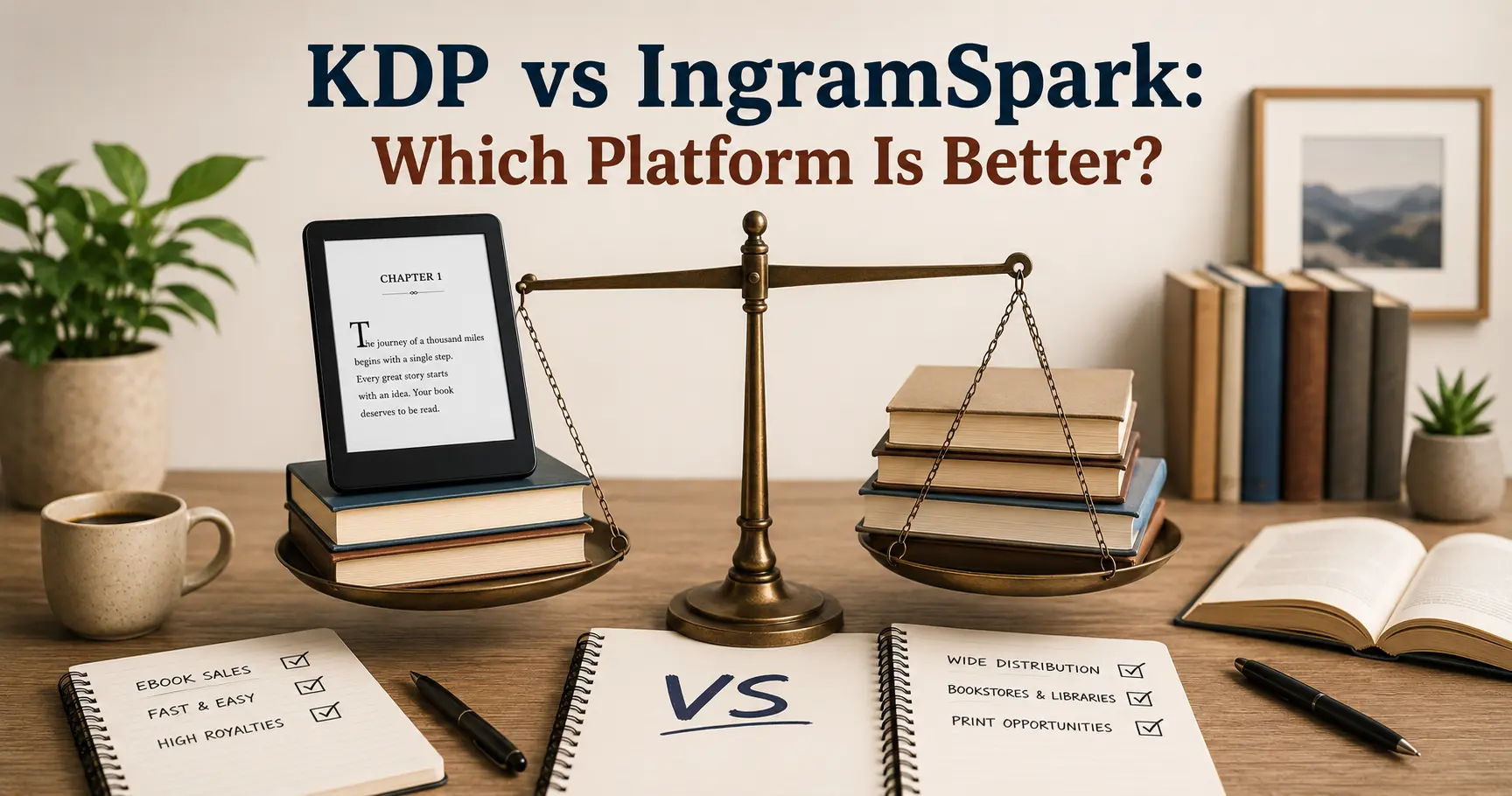
Two years ago I had a manuscript sitting on my laptop and absolutely no idea what to do with it next. My cousin, who’d self-published a memoir the year before, told me to “just use KDP, it’s easy.” My writing group insisted IngramSpark was the only serious option if I wanted my book taken seriously. So there I was, comparing KDP vs IngramSpark at 11pm with three tabs open and a cold cup of tea, trying to figure out who was right.
Turns out they both were, sort of. And also neither of them, depending on what I actually needed.
I’ve since published four books across both platforms, made every mistake you can make, and paid for a cover revision I didn’t need to pay for because I didn’t read the fine print. So let me save you some of that trouble.
What KDP Actually Gives You
Amazon KDP is where almost every self-published author starts, and for good reason. It costs nothing upfront. The dashboard, while not gorgeous, is straightforward enough that you can go from uploaded file to live book in a couple days. My first novel went live in about 30 hours, which honestly surprised me given how long everything else about writing a book takes.
The obvious appeal is reach. Amazon sells the overwhelming majority of books online in the US, somewhere in the range of 50 to 80 percent depending on whose stats you trust and which category you’re in. For ebooks that number climbs even higher. If your main goal is getting your book in front of buyers without jumping through hoops, Amazon puts you right where the traffic already is.
Royalties are decent too. Price your ebook between $2.99 and $9.99 and you’re looking at 70 percent royalties, which beats what most traditional publishing contracts offer by a wide margin. Print royalties work differently and land lower, but you’re not fronting any money to get there, which matters a lot when you’re just starting out and not sure your book will sell more than a dozen copies to your relatives.
Quick tip: KDP’s “expanded distribution” option sounds like it solves the bookstore and library problem, but it doesn’t really. Bookstores generally avoid ordering print books through Amazon’s channels because there’s no easy return policy for unsold stock, and plenty of indie shops just don’t want to funnel money toward Amazon in the first place.
Where KDP Genuinely Struggles
If part of your dream is walking into a local bookstore and seeing your title on the shelf, or having a library stock it for patrons, KDP by itself probably won’t get you there. This is the thing that frustrates new authors more than anything else. They assume Amazon equals everywhere. It doesn’t. Amazon mostly just equals Amazon.
What IngramSpark Does Differently
IngramSpark isn’t a retailer the way Amazon is. It’s a distributor, plugging your book into a network that reaches something like 40,000 retailers and libraries, including Barnes & Noble, independent bookstores, and university systems. This is usually the platform people in traditional publishing circles point toward when print distribution actually matters to you.
This is where the KDP vs IngramSpark comparison gets interesting for print specifically. IngramSpark supports returnability, which means a bookstore can order copies of your book and send back what doesn’t sell. That single feature changes everything about whether a store is willing to carry you. Without it, most physical retailers won’t bother.
It’s not free though. There’s a setup fee per title, usually around $49 unless they’re running one of their periodic promotions, plus revision fees if you need to change something down the line. I remember feeling almost offended by this when I first found out, coming straight from KDP’s zero-dollar model. It felt like a downgrade until I actually understood what the fee was buying: access and legitimacy that took Ingram decades to build.
Royalties tend to run lower here than KDP’s ebook cut, mostly because there’s an extra link in the supply chain. Ingram takes a share, then the retailer takes a share, and what’s left is yours.
Print Quality and How Your Book Gets Perceived
Something I noticed after switching one title from KDP print to IngramSpark: readers and even other authors sometimes treat IngramSpark-printed books as a little more “official” looking. Part of that comes down to trim size consistency and paper stock options that match what traditional publishers use. It’s not that KDP’s print quality is bad, it’s actually gotten pretty solid over the last few years. It’s more about context. Where the book physically ends up shapes how people perceive it before they’ve even read a page.
Costs, Control, and the Annoying Stuff Nobody Warns You About
Let’s talk about money, because eventually that’s what this decision comes down to for most people.
KDP costs nothing to publish. Your only real expense is ordering proof copies, which is just print cost plus shipping. You can update your file or cover as many times as you want, for free, instantly. That flexibility is genuinely useful if early reviewers point out a typo or you want to tweak your blurb after a slow first month.
IngramSpark charges you for setup and then again for revisions made after a certain window, typically 30 to 60 days, though their policies shift so it’s worth double checking before you commit. If you’re someone who tinkers, and I clearly am, those fees pile up. I redid my cover three separate times in my first year on the platform because I kept doubting myself, and by the third revision I was mentally kicking myself for not just getting it right the first time.
One thing IngramSpark does offer that KDP doesn’t: real control over your ISBN. You can buy and use your own rather than accepting the free one KDP assigns. That matters more than people realize, because a free KDP ISBN technically lists Amazon as the publisher of record for that edition. If you ever want to pivot toward a traditional deal or maintain full independence across retailers, that detail can bite you later.
A Strategy That Actually Worked for Me
Here’s a setup a lot of authors land on eventually. Publish your ebook through KDP so you get the higher royalty percentage and access to Kindle Unlimited readers, and publish your paperback separately through IngramSpark for the wider print reach. You end up juggling two dashboards and two sets of files, which is a bit of a headache, but it plays to each platform’s strength instead of forcing one tool to do a job it’s not built for.
I did exactly this with two of my nonfiction books. Ebook sales came almost entirely from Amazon regardless of what I did, so there was no reason to fight that. But print sales through libraries and a couple of local indie shops only happened because the paperback was distributed through Ingram. Those orders never would have come through KDP alone.
So Which One Should You Pick
If you’re new to this and don’t want to spend a dime before you’ve even sold your first copy, start with KDP. It’s low risk, fast, and a decent way to learn the mechanics of formatting, cover design, and metadata without financial pressure hanging over you.
If your manuscript is polished and you actually care about getting into physical stores or onto library shelves, IngramSpark is worth the cost. Once you understand you’re not just paying for printing but for decades of built relationships and infrastructure, the fee makes a lot more sense.
Plenty of authors skip picking sides entirely and just use both, treating them as complementary rather than competing. Honestly, if you’re planning to publish more than one book, that’s probably the smarter long game.
Ask yourself: Are you chasing online sales mainly, or do you actually care about bookstore presence? Can you afford IngramSpark’s fees right now, or does starting free matter more at this stage? Do you see yourself publishing multiple titles, in which case learning both systems early might save you a headache down the road?
A Few Questions Worth Asking Yourself
Sit with those for a minute. They’ll point you toward the right starting platform faster than any comparison chart, including this one, ever could.
Final Thoughts
The KDP vs IngramSpark debate doesn’t have to end with picking a permanent side. A lot of successful indie authors use both, letting each one handle the job it’s actually good at. KDP gets you fast, cheap access to the biggest online bookstore in the world. IngramSpark gets your print book into places Amazon just can’t reach.
My honest advice, earned through a fair amount of trial and error and at least one unnecessary cover redesign, is to match the platform to what you actually want rather than what sounds more impressive at a writers’ meetup. Your first book doesn’t need to check every box. It just needs to reach the readers you’re actually trying to reach, and once you understand what KDP vs IngramSpark really offers, you can stop guessing and start publishing with a plan that fits you.