Book Writing
 Book Cover Design
 Book Editing
 Book Formatting
 Book Publishing
 Book Video Trailer
 Book Printing
 Audio Books
 Book Illustrations
 Author Website
 Amazon Page Optimization
 Book Marketing
 Fiction Writing
 Non-Fiction
 Autobiography
 Memoir
 Novel Writing
 Children's Book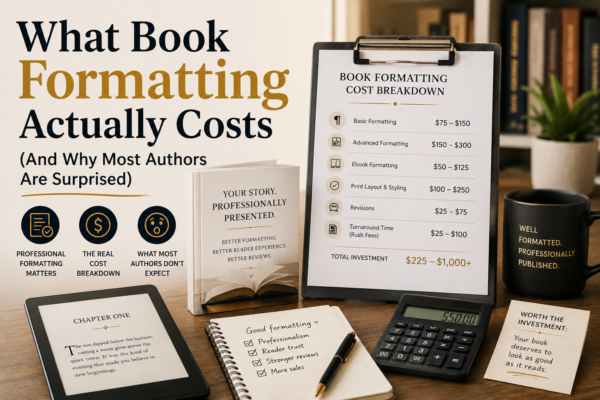
When I finally typed the last sentence of my manuscript, I cried a little. Three years of early mornings, late nights, and completely rearranged weekends were behind me. I sat back, exhaled, and then thought: now what?
Nobody warned me about the part that comes after writing. You pour everything into the words, and then suddenly you are zoomed into page 47 of a Word document wondering why the chapter heading there looks nothing like the one on page 12. That is when “professional book formatter” enters your Google search, followed immediately by one very uncomfortable question: how much is this going to cost me?
Let me save you the rabbit hole. Here is what formatting actually is, why it matters, and what you will realistically pay in 2025.
It Is Not Just “Making It Look Nice”
I used to think formatting was basically decoration. Slap on some nice fonts and call it a day. It is not. Not even close.
Book formatting is the process of turning a raw manuscript into a file that actually works. Correct margins, readable typography, consistent chapter styles, a table of contents that links properly, page numbers that do not randomly reset. And all of it has to meet the exact technical requirements of whichever platform you are publishing on.
Here is what catches most first-time authors completely off guard: a document that looks perfectly fine in Google Docs can fall apart the moment you upload it to Amazon KDP. The platform has its own requirements and it is not forgiving about them.
Good formatting is invisible. Nobody finishes a novel thinking wow, those margins were really something. But bad formatting gets noticed fast. Readers feel it even when they cannot name it. And sometimes they write about it in reviews.
Worth knowing
Self-publishing platforms like Amazon KDP have specific file requirements for both print and digital formats. A manuscript that looks perfectly fine in Google Docs can break completely when uploaded. Professional formatting prevents that headache before it ever starts.
Who Actually Hires a Formatter?
More people than you would think. And for more reasons than simply not knowing how InDesign works.
The First-Time Novelist
Great at storytelling. Zero experience with print margins or linked digital tables of contents. Formatting feels like an entirely different profession.
The Business Author
Publishing to build credibility in their field. Their expertise is the business, not typography. They need it done right in print and digital without spending weeks learning software.
The Memoir Writer
Writing something personal and permanent. They want the final product to feel real and polished, not something hastily assembled in Word over a weekend.
In every case the logic is the same. You did the writing. Let someone else handle the architecture. Think of it like building a house: you designed it, but you are probably not the one pouring the foundation yourself.
What Kind of Formatting Do You Actually Need?
The market has gotten a lot more flexible over the past decade. Here is a quick breakdown of what is out there:
| Service Type | What It Covers | Best For |
|---|---|---|
| Print Interior | Margins, fonts, headers, footers, chapter styles, page numbers | Authors publishing via KDP Print, IngramSpark, etc. |
| Kindle / Ebook | Responsive design, linked TOC, hyperlinks, EPUB/MOBI files | Authors targeting Amazon, Apple Books, Kobo |
| Print + Digital | Both print-ready PDF and ebook files from one manuscript | Authors covering all platforms without hiring twice |
| Design Add-ons | Custom graphics, drop caps, ornamental elements, cover integration | Authors wanting a premium, highly designed interior |
What Actually Drives the Price
Once you understand the variables, the quotes you receive will start making a lot more sense. Here is what moves the needle:
Length of the book
A 90-page novella is a completely different project than a 450-page fantasy novel. More pages means more time verifying that everything stays consistent all the way through. Most formatters price by page or word count for exactly this reason.
Complexity of the content
A clean fiction manuscript with standard chapters is the easiest thing a formatter will touch. Add images, tables, footnotes, or an index and the complexity climbs fast. Books with lots of special elements can run 30 to 60 percent more than a plain text-only project.
Experience level
Someone who has formatted 500 books for traditional publishers charges differently than someone in their first year. You are paying for speed, for problem-solving instinct, and for the confidence that the file will actually work correctly the first time you upload it.
How fast you need it
Rush jobs always cost more. If you need 300 pages formatted in three days instead of three weeks, you are asking someone to rearrange their entire schedule around your deadline. Most formatters charge a 20 to 40 percent premium for that kind of turnaround.
The extras
Cover integration, copyright page setup, ISBN placement, help uploading to publishing platforms. These get bundled into packages and can meaningfully shift the total cost. Honestly, if you have never navigated a publishing dashboard before, they can be worth every penny.
Real Pricing Ranges for 2025
Not theoretical numbers. What authors are actually paying right now. Use these as a budgeting baseline, not a firm quote.
How formatters typically charge:
Common for print formatting. Usually $3 to $8 per formatted page depending on how complex the book is.
The most common model by far. You know the total number upfront and can plan your budget around it.
Sometimes used for revisions or consultations. Typically $35 to $75 per hour.
Most services require a 25 to 50 percent deposit upfront, with the balance due when you approve the final files. Standard packages include two or three rounds of revisions.
Agency vs. Freelancer: Which Is Right for You?
Both paths can give you an excellent final product. The experience of getting there is just very different.
Formatting Agency
Individual Formatter
Figure This Out Before You Reach Out to Anyone
The biggest mistake authors make is reaching out to formatters before they have figured out what they actually need. That leads to vague quotes, scope creep, and a final invoice that surprises nobody except you.
Spend 15 minutes answering these questions first:
Your Pre-Hire Checklist
Once you have worked through that list, get quotes from at least two or three providers. Even if you already have someone in mind, comparison shopping will tell you very quickly whether the price is actually fair.
On portfolios
Always ask to see examples of their previous work, and specifically books in your genre. A formatter who has done a dozen romance novels approaches things very differently than one who specializes in academic textbooks. That genre match matters more than most authors realize going in.
The Bottom Line
Professional formatting is one of those investments that is easy to skip and genuinely hard to not regret skipping. It will not make your writing better. That part is entirely you. But it makes sure your writing gets the presentation it actually deserves.
For most authors that means somewhere between $300 and $1,200. That is less than most people spend on editing, and it is often the difference between a book that looks self-published and one that looks like it came out of a real publishing house.
Do your research, know what you need before you reach out, and do not skip the portfolio review. The right formatter is out there. And now you know roughly what to budget when you find them.
Ready to get your book formatted?
Start with a clear project brief, collect a few quotes, and check every portfolio. Your manuscript has earned a professional finish.