Book Writing
 Book Cover Design
 Book Editing
 Book Formatting
 Book Publishing
 Book Video Trailer
 Book Printing
 Audio Books
 Book Illustrations
 Author Website
 Amazon Page Optimization
 Book Marketing
 Fiction Writing
 Non-Fiction
 Autobiography
 Memoir
 Novel Writing
 Children's Book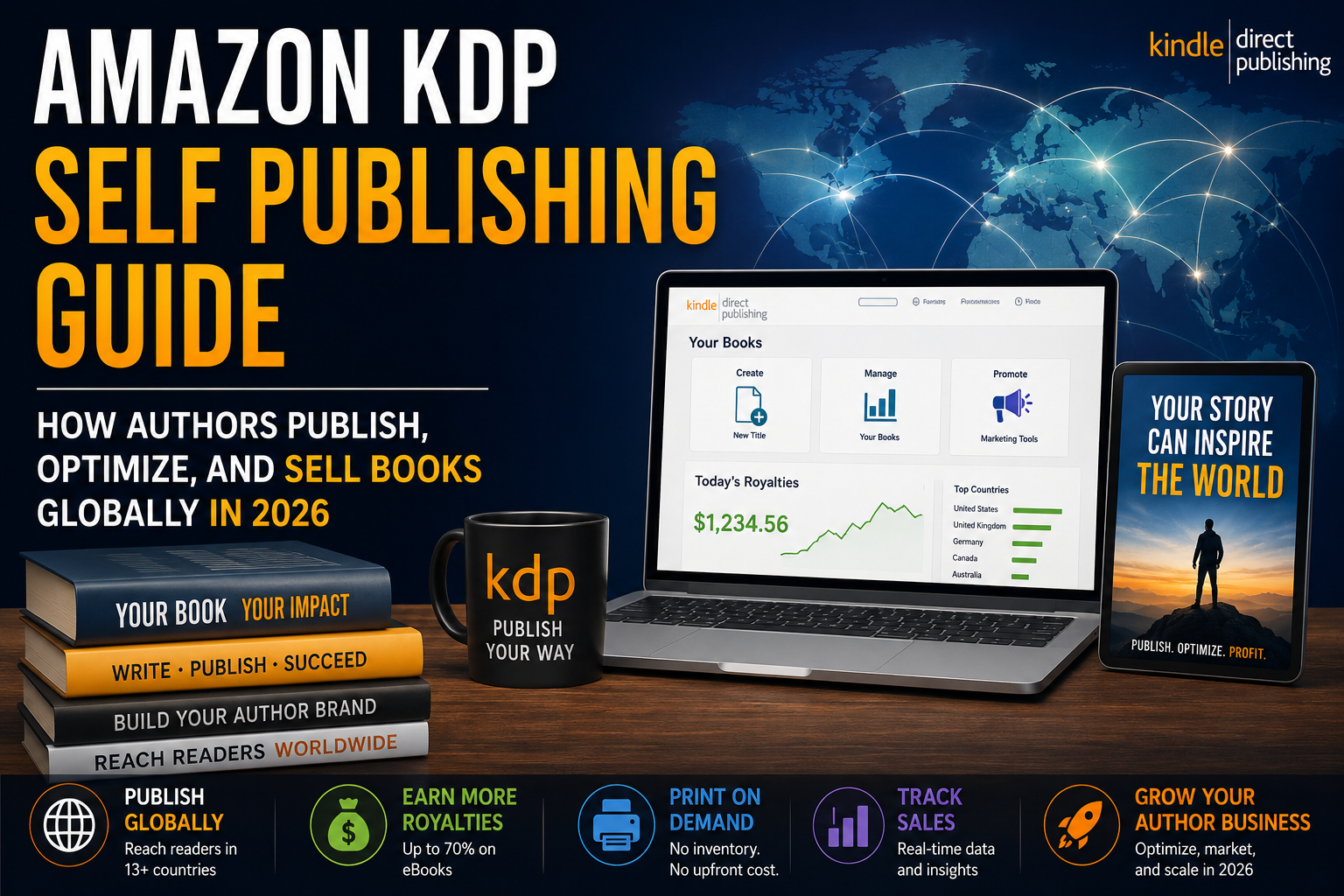
Let me be straight with you: a lot of what gets written about KDP online is either outdated, vague, or written by someone who’s never actually published a book. This guide is different. We’re going to walk through everything how the platform works, what the royalty math actually looks like, which mistakes cost authors real money, and what’s actually working in 2026. No fluff.
Whether you’re sitting on a finished manuscript wondering what to do next, or you’ve already published and things aren’t moving the way you hoped stick with me. There’s a lot here worth knowing.
So What Is Amazon KDP, and Why Should You Care?
Kindle Direct Publishing is Amazon’s self-publishing platform. You upload a manuscript, add a cover, pick a price, and your book goes on sale across Amazon’s global stores usually within 24 to 72 hours. No publisher approval. No agent. Nobody telling you your book isn’t right for the current market.
Here’s the part that still genuinely surprises people: Amazon controls around 67% of all eBook sales in the United States. That’s not a typo. Two-thirds of the digital book market runs through one platform. And KDP gives independent authors direct access to every single buyer on it.
What makes it worth your time in 2026 specifically:
Sell in 13+ Countries
Your book goes live in the US, UK, Germany, Japan, Australia, India, and more automatically, from day one.
Up to 70% Royalties
Traditional publishers pay authors 10–15%. KDP pays up to 70% on eBooks. That difference adds up fast.
Zero Upfront Cost
Print books are made only when someone orders them. No boxes in your garage. No money tied up in inventory.
Live Sales Dashboard
Watch sales come in as they happen. Every royalty, every page read updated in real time in your KDP account.
I want to be honest about something: KDP isn’t magic. It’s infrastructure. The platform gives you a shelf in the world’s biggest bookstore but you still have to write a book worth reading, package it well, and get it in front of the right people. What KDP does is remove every excuse for not trying.
The Three Formats and Which One Matters Most for You
KDP offers three ways to publish your book. Most authors should eventually use all three, but they work differently, and each one has its own quirks when it comes to pricing and royalties.
1. Kindle eBook
This is where most KDP authors start, and for good reason. Upload your manuscript, set a price, and readers anywhere in the world can buy and download it instantly. The royalty structure is simple: price your book between $2.99 and $9.99 and you keep 70%. Price it outside that window and you drop to 35%. Traditional publishers pay their authors somewhere around 10 to 15 percent of a much smaller cut. The difference speaks for itself.
2. KDP Paperback
A lot of readers still want a physical book. KDP’s print-on-demand paperback means Amazon prints and ships a copy every time someone orders — you never touch a box, never pay for inventory. Your royalty is 60% of your list price minus the actual printing cost, which varies based on page count, whether you’re using black or color ink, and which Amazon marketplace the sale comes from. I’ll say this plainly: run the math before you set your price. Don’t guess.
3. KDP Hardcover
KDP added hardcover print-on-demand a few years ago and it’s grown into something genuinely useful. Hardcovers cost more to print, so you need to price them higher — typically $18.99 to $34.99 — to keep a real royalty. The upside is that readers willing to buy a hardcover are usually buying it as a gift or because they really want the physical book on their shelf. Our full breakdown of KDP hardcover printing costs by marketplace covers every number you need before you decide on a price.
| Format | Royalty | Cost to Publish | Good For |
|---|---|---|---|
| Kindle eBook | 35% or 70% | $0 | Fiction, series, budget readers |
| KDP Paperback | 60% minus print cost | $0 | Most genres, gifts |
| KDP Hardcover | 60% minus print cost | $0 | Nonfiction, collectors, gifts |
How to Actually Publish on KDP Step by Step
The process is genuinely less intimidating than it looks from the outside. Here’s exactly what happens, from your first login to your book going live.
Set Up Your KDP Account
Go to kdp.amazon.com and log in with your Amazon account or create one if you don’t have one yet. Before any book can go live, you’ll fill out your tax information. US authors use the W-9 form. Everyone else uses the W-8BEN. You’ll also link a bank account for royalty deposits. It sounds like a lot, but it takes maybe 20 minutes total.
Format Your Manuscript Properly
KDP takes .docx, .epub, .pdf and a few other formats. For eBooks, a clean .epub or .docx renders well across every Kindle device. For print, your file needs to match your chosen trim size exactly with the right margins or things go wrong in ways that are painful to fix after publication. Formatting is genuinely where most first-time authors run into trouble. Don’t rush it.
Get a Professional Cover
KDP has a built-in Cover Creator tool. I’ll be blunt: don’t use it for your final cover if you’re serious about selling books. Your cover is doing a job catching someone’s eye in a search result, communicating genre, and making the book look like it belongs next to the bestsellers. A professional cover designer is worth the investment. For print, KDP gives you a template based on your page count and trim size.
Fill In Your Book Details
Title, subtitle, series name, author name, description, BISAC categories, and your 7 keyword fields. People skip through this section too fast. Every field here affects how Amazon decides to show or not show your book in search results. Write your description the way a copywriter would, not the way a librarian would. It has one job: get the reader to click “Buy.”
Decide on Your ISBN
KDP gives you a free ISBN for each format, but when it does, it lists itself as the publisher of record. That’s fine for most people starting out. If you’re building a real author brand or your own imprint, buying ISBNs through Bowker (US) or Nielsen (UK) gives you control over that detail. It’s not urgent, but it’s worth thinking about before you publish your tenth book and wish you’d handled it earlier.
Price It — Using Actual Math
For eBooks, choose between KDP Select (Amazon-exclusive, Kindle Unlimited access) or wide distribution. For print, think about expanded distribution. Whatever you do, base your price on real numbers: what does your royalty look like at $12.99 vs $14.99? What are comparable books selling for? Genre norms exist for a reason — readers have price expectations, and ignoring them costs sales.
Submit and Preview Before You Go Live
Upload everything, then use KDP’s previewer seriously, use it before you hit submit. For print, download the offline previewer and go through your book page by page. Things that look fine on screen sometimes look terrible in the actual printed layout. eBooks usually go live within 24–72 hours. Print books go through a separate review and can take up to 72 hours.
KDP Select vs. Going Wide The Real Trade-Off
This debate comes up in every author community I’ve been part of, and there’s a reason: both options have real merit depending on where you are in your publishing journey.
KDP Select: Betting on Amazon
Enrolling in KDP Select means your eBook lives exclusively on Amazon for 90-day windows (it renews automatically unless you opt out). In exchange, you’re in Kindle Unlimited the subscription service where Amazon pays you per page read. You also get promotional tools: Kindle Countdown Deals and Free Book Promotions.
If you write genre fiction — romance, thriller, fantasy, sci-fi KDP Select is often where the real money is. Kindle Unlimited subscribers read a lot, and page reads accumulate quickly for authors with multiple books in a series. I’ve talked to romance authors doing five figures a month primarily off KU page reads. It’s a real income stream, not a theoretical one.
Going Wide: Not Putting All Your Eggs in One Basket
Going wide means your eBook is also on Apple Books, Kobo, Barnes & Noble, Google Play Books, and wherever else readers buy digital books. The upside is that you’re not dependent on one platform. Amazon changes its terms, its algorithms, its payout rates and it does so without much notice. Wide distribution gives you a cushion.
If you’re a new author with no existing readership, start with KDP Select. The Kindle Unlimited audience gives you readers before you’ve built a following anywhere else. Once you have a few books out and loyal readers finding you, then have the wide conversation. A lot of experienced authors use Select for the first 6–12 months of a title’s life, then move it wide. That’s not a bad strategy at all.
How to Make Your KDP Listing Actually Findable
Here’s something nobody tells first-time authors clearly enough: Amazon is a search engine. People type things in the search bar, and Amazon’s algorithm decides what to show them. If your book isn’t optimized for that process, it might as well not exist.
Keywords — The 7 Fields Most Authors Waste
KDP gives you 7 keyword fields, and the most common mistake I see is filling them with single generic words like “romance” or “mystery.” Those aren’t keywords they’re categories. What you want are long-tail phrases that mirror exactly how readers search. Instead of “mystery,” try something like “cozy mystery small town female detective” or “amateur sleuth mystery with recipes.” That’s how real readers search.
Tools like Publisher Rocket or K-lytics exist specifically to help you find phrases with real search volume. Even Amazon’s own autocomplete just start typing in the search bar and see what it suggests is useful research. Do this before you publish. Changing keywords after launch helps, but getting it right the first time is better.
Categories — Small Pond, Big Fish
KDP starts you with two BISAC categories, but once your book is live you can request up to 10 through Author Central. The smart play is to find subcategories where the #1 bestseller has a lower sales rank meaning less competition. Hitting #1 in a subcategory gets you an orange “bestseller” badge on your cover image, which genuinely does increase clicks and conversions. Pick your categories like you’re choosing a fight you can actually win.
Your Book Description Is Sales Copy — Treat It Like One
The description on your book’s Amazon page is the last thing standing between a browser and a buyer. It gets indexed by Amazon’s search algorithm too, so it does double duty. Use HTML formatting in the description bold text, line breaks to make it readable on screen. Start with something that grabs attention in the first sentence. End with a reason to click buy right now. Look at the top-selling books in your genre and study how they write their descriptions. They’re not doing it by accident.
✅ One thing worth doing right now: Open the Amazon search bar and type the first few words of how you’d describe your own book. Watch what the autocomplete suggests. Those suggestions are real search terms from real readers. If your current keywords don’t match what you see update them.
KDP Royalties — What You Actually Take Home
I want to walk through the royalty math properly because this is where a lot of authors either leave money on the table or unknowingly publish a book that makes them almost nothing per sale.
eBook Pricing — The 70% Window
It’s simple: price your eBook between $2.99 and $9.99 and Amazon pays you 70% (minus a small delivery fee based on file size). Price it above or below that window and your royalty drops to 35%. For most fiction, landing in the $3.99–$6.99 range tends to be the sweet spot low enough to be an easy impulse purchase, high enough that the per-sale royalty is meaningful. Nonfiction can often support $7.99–$9.99 without resistance.
Print Royalties — Do the Math First
Print royalties work like this: 60% of your list price, minus the printing cost. The printing cost is where people get surprised. It’s calculated based on your page count, trim size, whether your interior uses black or color ink, and which Amazon marketplace the sale happens in. A 300-page black-ink paperback on Amazon.com has a completely different cost structure than the same book sold through Amazon.co.uk or Amazon.de.
Use KDP’s royalty calculator before you set your price it’s built into the dashboard. A 350-page color interior priced at $14.99 might leave you with less than a dollar per sale. The same book with a black ink interior at the same price might earn $3 to $4. That’s not a small difference over hundreds of copies.
For hardcovers, printing costs run higher, which is why KDP hardcovers typically need to be priced between $18.99 and $34.99 to produce a royalty worth having. Our full breakdown of KDP hardcover printing cost by marketplace is the most detailed guide we’ve written on the subject read it before you set your hardcover price.
| eBook Price | Your Royalty Rate | Royalty at $4.99 | Royalty at $9.99 |
|---|---|---|---|
| Under $2.99 | 35% | — | — |
| $2.99 – $9.99 | 70% | ~$3.45 | ~$6.93 |
| Over $9.99 | 35% | — | — |
Selling Globally — KDP’s International Reach
One of the things that still amazes me about KDP is that from day one, your book is available internationally. You don’t have to do anything extra. No separate submissions, no foreign publisher negotiations it just happens. Here’s where your book can sell:
- Amazon.com — United States (by far the largest volume)
- Amazon.co.uk — United Kingdom
- Amazon.de — Germany and the German-speaking market
- Amazon.fr — France
- Amazon.es — Spain
- Amazon.it — Italy
- Amazon.co.jp — Japan
- Amazon.com.br — Brazil
- Amazon.com.mx — Mexico
- Amazon.com.au — Australia
- Amazon.in — India
For eBooks you can either set a price for each marketplace separately, or let KDP convert your US dollar price automatically. For print books, the printing cost varies per marketplace so a book making you $4 profit per copy on Amazon.com might make you $2.50 on Amazon.co.uk. Check the numbers in your KDP dashboard per marketplace before you assume everything is working the same way everywhere.
⚠️ If you’re outside the US, this matters a lot: Amazon withholds 30% of your US royalties as tax unless you complete a W-8BEN form in your KDP account. The W-8BEN lets you claim your country’s tax treaty with the US, which reduces that withholding to 0% for most countries. This is not optional paperwork. Set it up before your first book goes live or you’re handing Amazon 30 cents of every dollar they owe you.
How to Actually Sell Your Book — Marketing That Works
Publishing the book is the easy part. This is where a lot of authors stall they hit publish, wait, and wonder why nothing’s moving. Here’s what’s genuinely working in 2026.
Amazon Ads — Paid Traffic Inside Amazon
Amazon Advertising puts your book in front of people who are already on Amazon looking for something to read. Sponsored Product ads appear in search results and on the pages of similar books. Start small a $5 to $10 daily budget and target a mix of relevant keywords and ASINs of books your readers also buy. Track your ACOS (advertising cost per sale) and adjust weekly. It takes a few weeks to get data worth acting on, but it’s the most direct lever you have for visibility on the platform.
KDP Promotional Tools — Use Them With a Plan
If you’re in KDP Select, you have two tools: Kindle Countdown Deals (time-limited discounts that keep your 70% royalty) and Free Book Promotions (up to 5 free days per 90-day enrollment period). Running a free promotion without a plan — just setting your book free and hoping usually doesn’t do much. The ones that work are timed to a newsletter blast, a BookBub feature, or some other traffic source that drives volume during those specific days. Free promotions create rank momentum that keeps working after the promo ends.
Your Email List — The Only Audience You Actually Own
Amazon can change its algorithm tomorrow. Instagram can tank your reach. TikTok might get banned in your country. Your email list is the one audience that none of that can take away from you. Even a small list 300 or 500 genuinely interested readers makes a measurable difference at launch. Start building it before your book comes out. A reader magnet (a free short story, a prequel chapter, bonus content) in your book’s back matter is the easiest way to grow it.
Reviews — The Thing Every Author Needs More Of
Reviews are social proof, and on Amazon they directly affect how many people buy your book. More reviews means more credibility means more sales it’s a real cycle. Ask for reviews in your back matter. Amazon also has a built-in “Request a Review” button in your KDP dashboard that sends an automated email to verified purchasers it’s fully compliant with Amazon’s terms, and it works. Use it for every book.
Mistakes That Actually Cost Authors Money
After working with hundreds of authors going through this process, these are the mistakes I see repeatedly and the ones that have the most real-world impact on sales.
- Skipping professional editing. KDP removes the gatekeeping. It doesn’t remove the need for editing. A book with typos on page 3 gets a one-star review, and that review lives there forever. Readers are not forgiving about this, and they shouldn’t have to be.
- Designing the cover yourself without design experience. I say this with respect: readers make snap judgments, and a cover that doesn’t look like it belongs in its genre loses sales before the description is ever read. This is one of the few places worth spending money.
- Launching without keyword research. If your keywords are generic, Amazon has no way to know who to show your book to. You’ll sit there with zero visibility wondering what went wrong. Research your keywords before you publish — not after.
- Setting a print price without checking the royalty calculator. Especially for hardcovers and expanded distribution. It is entirely possible to price your book at $12.99 and make $0.40 per copy. Run the actual numbers first.
- Expecting one book to generate passive income. The authors making serious money on KDP almost all have multiple books. Each new title you publish creates more entry points for readers and if they like one, they buy the others. A catalog of 3 to 5 books in the same genre compounds in ways that a single title simply can’t.
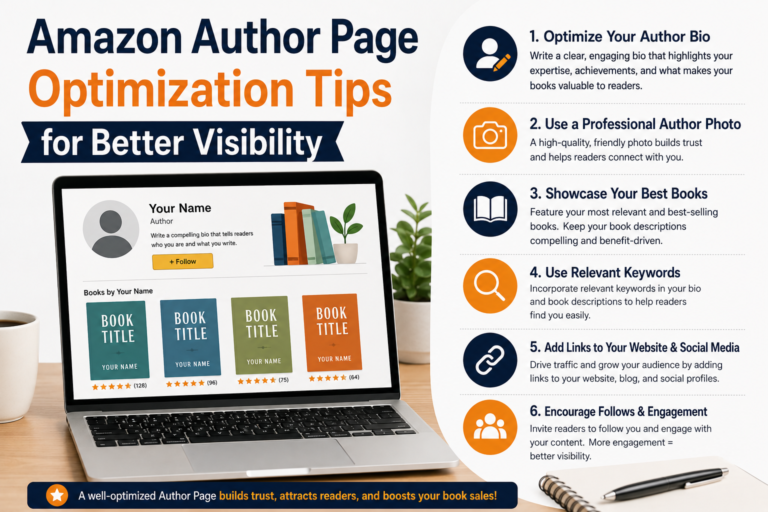
- Ignoring Amazon Author Central. It’s free. It takes 20 minutes. You get a proper author bio, a photo, a blog feed, and additional control over your book’s page. There’s no reason not to do it.
What’s Actually Changing on KDP in 2026
The self-publishing world moves. Here’s what’s worth paying attention to right now.
AI writing tools are now part of the landscape, like it or not. A lot of authors are using them for brainstorming, outlining, and first drafts. KDP requires disclosure of AI-generated content, and the quality bar hasn’t dropped readers still leave bad reviews for books that feel hollow or rushed, regardless of how they were produced. The tool doesn’t replace the craft.
Audiobooks have become too big to ignore. Production through ACX or Findaway Voices has grown a lot, and audiobook revenue is now a meaningful piece of income for authors who cover all three formats. If you’ve been putting off audio, the math is starting to favor doing it.
Series are winning over standalones by a lot. Amazon’s algorithm rewards series. Kindle Unlimited readers who love Book 1 immediately open Book 2. The lifetime value of a reader who discovers a series you’ve finished writing is dramatically higher than a reader who buys a standalone and moves on. If you’re plotting your next project, that’s worth factoring in.
KDP hardcovers are becoming a real revenue line. More indie authors are pricing a hardcover $5–$10 above the paperback and finding that gift buyers and collectors buy it. The production cost is the same for you Amazon still prints on demand — but the revenue per sale is meaningfully higher.
✅ What the authors doing well right now have in common: They’re using KDP Select for fiction launches, building a back catalog of at least 3–5 books in a series, running Amazon Ads consistently (not just at launch), and growing an email list. None of those things is complicated. All of them take time. The combination of all four is what separates authors who earn a real income from authors who wonder why their book isn’t selling.
Is Amazon KDP Worth It in 2026?
Yes. Without hesitation. But with honest expectations about what “worth it” means.
KDP is not a lottery ticket. It’s a publishing business with real infrastructure behind it zero upfront cost, global distribution, royalty rates that would have seemed impossible to an author ten years ago, and direct access to the largest book-buying audience on earth. What it doesn’t do is sell a bad book, make up for a weak cover, or replace marketing effort. The platform does its job. You have to do yours.
The authors I’ve watched build sustainable careers on KDP share a few things: they take the craft seriously, they treat the publishing side like a real business, and they keep publishing. One book is a start. Five books is a catalog. A catalog is an income.
Start with this guide, go deeper on the specific pieces that apply to where you are right now, and don’t wait for everything to be perfect before you hit publish. Every author who’s selling well today had a first book that wasn’t their best work. That’s how it goes.
The Author Central Team
We’re publishing professionals, editors, and book marketers who’ve spent years helping independent authors go from manuscript to marketplace. We’ve seen what works and what doesn’t and we write about it honestly, without the hype.
📚 Keep Reading — Related Guides
- 🔗 Professional Book Writing and Publishing Services: Your Path to Success
- 🔗 Best eBook Ideas That Sell on Amazon in 2026
- 🔗 KDP Dashboard Walkthrough: A Beginner’s Step-by-Step Guide
- 🔗 eBook Pricing Strategy for Authors: Maximize Sales & Royalties
- 🔗 KDP Book Cover Design: Dimensions, Calculator, Templates & Upload Guide
- 🔗 How to Link Your Books and Build Authority on Amazon Author Central