
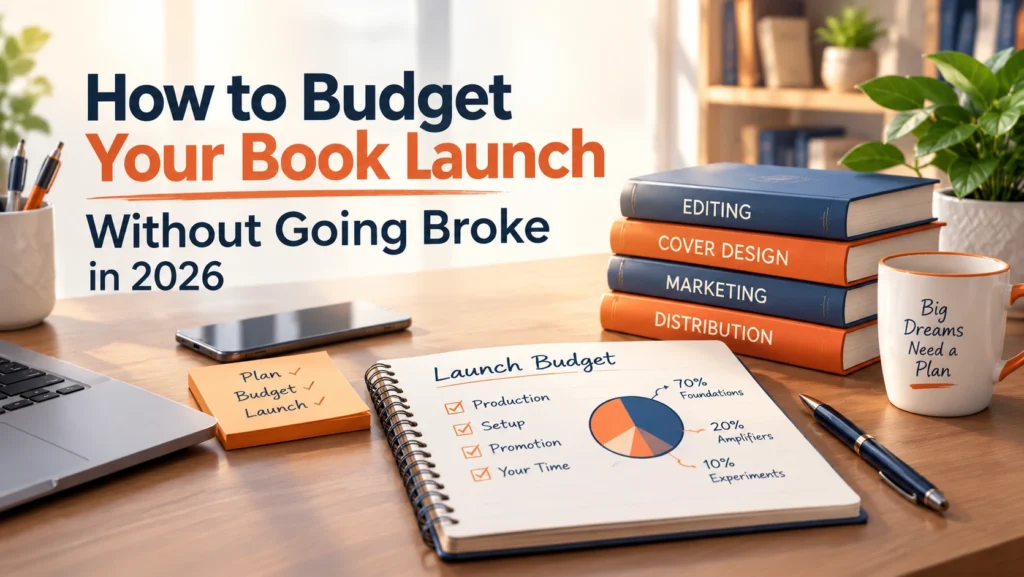
Pay for what readers see first, keep a little back for testing, and spread the rest over the 90 days before launch. That’s the core of a workable book launch budget, and it matters more than how big the pot is. A $500 launch with a sensible order of spending can beat a $5,000 one that was thrown around in a hurry.
Here’s how it usually goes wrong. An author books a $300 ad package, then realizes the cover looks like it belongs to a different genre and page one has a typo. The ads run anyway, and the money’s gone before anyone buys a copy. This guide shows you a split to copy, a timeline to follow, and a rule for knowing when to stop spending.
How Much Does a Book Launch Cost?
Anywhere from almost nothing to several thousand dollars, and the gap comes down to what you hand off. Swap edits with a writing group, launch to your own email list, and you can get by on very little. Hire an editor, a designer, a formatter and a publicist, and you’re in a different league.
Editorial Freelancers Association: current editorial rate chart
The useful question isn’t the total. It’s where the money actually goes, because most first-timers only price the obvious items.
Where self-publishing book launch cost really comes from
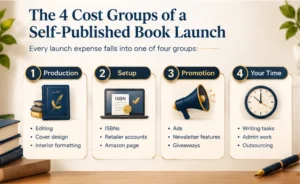
Almost every launch expense falls into one of four groups:
- Production: editing, cover design, interior formatting.
- Setup: ISBNs, retailer accounts, your Amazon page. KDP can assign a free ISBN, but it lists Amazon as the publisher, so decide whether that matters to you.
- Promotion: ads, newsletter features, giveaways.
- Your time: the hours you spend on jobs you could have outsourced.
Most budgets stop at production. Then promotion shows up and the self-publishing book launch cost doubles overnight. For a fuller breakdown, see our guide on how much it costs to self-publish a book.
A 70/20/10 Book Launch Budget You Can Copy
Here’s the rule I’d give any first-time author. Put 70 percent into foundations, 20 percent into amplifiers, and 10 percent into experiments. There’s nothing magic about those numbers. They simply stop you from buying promotion for a book that isn’t finished.
On $1,000, that means $700 for foundations, $200 for amplifiers, and $100 for testing. On $300, it’s $210, $60 and $30. The ratio holds even when the money’s tight.
Where the first dollars of your book launch budget go
Foundations are what a stranger judges in the first five seconds: the cover, the sample pages, the feeling that somebody cared. No ad fixes a book that looks unfinished. So this tier gets paid first.
- Editing, or at the very least a professional proofread
- A cover that fits your genre’s visual habits
- Clean interior formatting
Please don’t raid this tier to afford ads. Ads just send more people to a page that isn’t ready for them. Realistic price ranges are in our book cover design cost guide, and the Book Editing service page covers the editing side.
Amplifiers
Once the book itself is solid, amplifiers help more people notice it. That means an optimized Amazon page (description, categories, keywords), a simple author website, and maybe a short trailer. Each one makes the next step easier for someone who’s already curious.
Start with the Amazon page, since it’s usually the cheapest and the most visible. The Amazon Page Optimization service page explains what a strong one includes.
Experiments
The last 10 percent is for small bets. Trade newsletter mentions with another author, run a modest ad test, or try a short giveaway. Think of it as research, not a gamble.
When something works, you know where next month’s money goes. When it flops, you’ve lost a small amount you’d already set aside.
Low-Budget Book Marketing That Doesn’t Need Ad Money
Good low-budget book marketing costs effort more than cash. Two tactics give the best return, and both start weeks before launch day.
Line up ARC readers early
ARC stands for advance reader copy. Your ARC readers get the book before release and, ideally, leave honest reviews once it’s live. Recruit them from your email list, social accounts and reader groups about four to six weeks out, and give them a clear review date.
Send more copies than the reviews you’re hoping for, since some people won’t finish in time. Don’t pay for reviews, and don’t make a free copy depend on a positive one. Retailers have rules about this, so read them first. Amazon’s official review guidelines

Start a pre-order campaign with zero ad spend
A pre-order campaign gives early fans a link to click and gives you a date to build toward. Most self-publishing platforms, KDP included, let you schedule an ebook pre-order, so get that page live as soon as your files are final. Then share it with your list, your friends and your writing community.
A small bonus helps, as long as it costs you time instead of money. A deleted scene or a character profile works nicely. For help with the publishing side, there’s the Book Publishing service page.
Spreading Your Book Marketing Budget Over 90 Days
A book marketing budget works better when it isn’t spent in one week. Spreading it out gives you time to fix mistakes while they’re still cheap. Here’s a rough schedule:
- 90 to 60 days out: Finish editing and lock the cover. Most of your foundation money goes here.
- 60 to 30 days out: Build your Amazon page and pre-order page, and start recruiting ARC readers.
- 30 to 7 days out: Send out the ARCs, arrange newsletter swaps and schedule social posts.
- Launch week: Run your small tests and thank early readers in public.
- 30 days after: Look at what worked and write it down for book two.
Treat that list as your first book launch checklist. Print it, stick it above your desk, and cross things off as they get done. If you’d like help with any stage, there’s the Book Marketing service page.
Two Launches, Two Different Budgets
These two examples are illustrations, not real client results.
Maya, a memoir author with $500. She spends $350 on a proofread and a professional cover. Another $100 goes to a newsletter swap, and $50 to a tiny ad test. She also recruits about 30 ARC readers for free and builds a pre-order page with a bonus chapter.
Dev, a thriller author with $2,000. He puts $1,400 into editing, a custom cover and formatting, then $400 into an optimized Amazon page and a short trailer. His $200 ad test brings clicks but almost no sales. Because he’d written a stopping point beforehand, he pulls the ads and moves what’s left to a newsletter feature.
Neither author guessed their way through. They each let a written plan decide where the next dollar went.
Where Budgets Leak (and How to Stop It)
Even a careful book launch budget springs leaks. Three show up again and again:
- Paying for reviews: It puts your account and your credibility at risk.
- Running ads before any reviews exist: Shoppers hesitate on a page with no social proof.
- Buying “bestseller” packages: The promise rarely matches what you receive.
Write your stop rule before you spend
Before you put a dollar into experiments, answer two questions. What result would make you spend more? What result would make you stop? Write both down and hold yourself to them.
Without that line, a few “just one more try” ads can drain the whole plan. Why risk that when one sentence of planning protects you?
Your Next Step: Build Your Book Launch Checklist This Week
You don’t need a perfect plan, only a written one. Open a spreadsheet today and work through these steps:
- Write down the money you actually have available.
- Divide it 70/20/10 between foundations, amplifiers and experiments.
- List every task under its tier, including free ones like recruiting ARC readers.
- Add dates, counting backward from launch day.
- Put your stop rule next to the experiments tier.
Once that sheet exists, your book launch budget stops being a worry and starts working as a tool. If you’d like expert help with any part of it, the Contact page is the place to start.