Book Writing
 Book Cover Design
 Book Editing
 Book Formatting
 Book Publishing
 Book Video Trailer
 Book Printing
 Audio Books
 Book Illustrations
 Author Website
 Amazon Page Optimization
 Book Marketing
 Fiction Writing
 Non-Fiction
 Autobiography
 Memoir
 Novel Writing
 Children's Book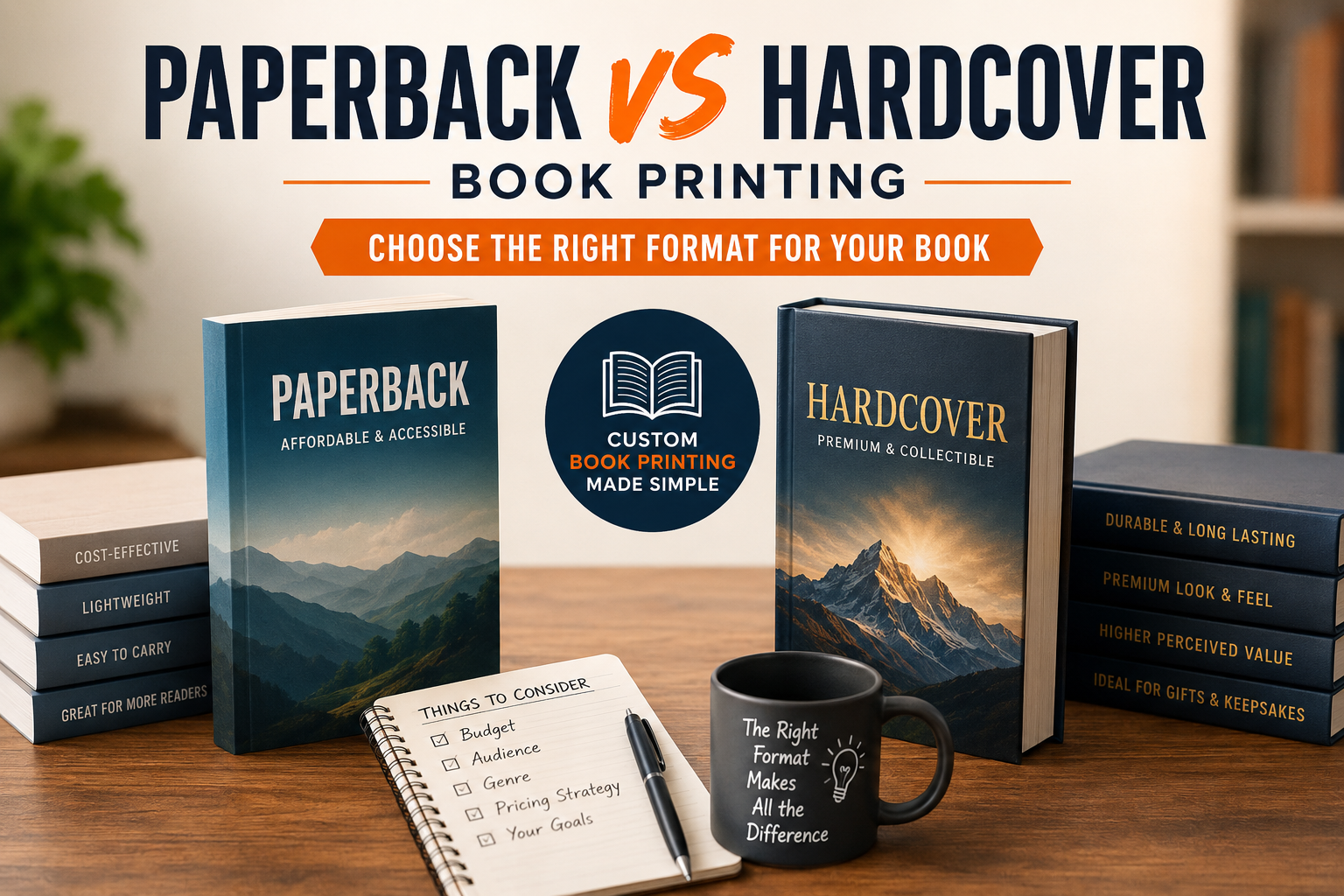
When I published my first book I spent about three days going back and forth on this one decision alone. Paperback or hardcover. It sounds like a simple choice but once you start pulling on that thread it connects to your budget, your audience, your genre, your pricing strategy, and your overall goals as an author. I had no idea custom book printing involved this many variables when I first started out. Back then, hardcover seemed serious and paperback seemed cheap, which almost led me to make my decision based on that simple assumption alone. Fortunately, taking the time to think it through changed my perspective completely and led me to a very different choice.
Let me tell you what I actually learned from going through this process more than once across multiple titles.
Why Most Self Published Authors Choose Paperback
Paperback is what most self-published authors go with and there are very good reasons for that. The cost per unit is significantly lower than hardcover. For a standard black and white paperback in the 200 to 300 page range you are usually looking at somewhere between two and five dollars per copy to produce depending on your quantity and your printer. Hardcover for the same book can easily run two to three times that amount. When you are self-funding your own print run that difference matters a lot, especially if you are ordering several hundred copies at a time. The lower production cost also means you can price the book more accessibly for readers, which generally means more copies sold.
I published my first non-fiction title as a paperback and I have never regretted it. The book was aimed at a general audience, people who were buying it because they wanted the information inside, not because they wanted something to display on a shelf. Paperback was completely appropriate for that audience and that purpose. The books looked clean and professional, readers never commented negatively on the format, and I was able to price it at a point where buying it felt like an easy decision rather than something people had to think about.
When Hardcover Feels Like the Right Fit
But here is where it gets more interesting. My second book was a different kind of project. It was something I had put considerably more time and care into, a more personal and ambitious piece of writing, and when I thought about how I wanted it to exist in the world, a paperback did not feel right. Not because paperback is inferior in any objective sense but because the book itself had a weight to it that I wanted the physical object to reflect. I went with hardcover for that one and the experience of holding the finished copies was completely different. There was something about the way it felt in my hands that matched how I felt about the work. That is not a financial calculation. That is an emotional one and it is a completely valid reason to choose hardcover if it aligns with your intentions for the book.
How Format Affects Perceived Value
Hardcover books also carry a perception advantage in certain contexts. Gift books, coffee table books, children’s books, and commemorative or limited edition releases tend to do better in hardcover because the format signals value. If you are selling at events or markets where people are buying a book as a gift rather than purely for themselves, hardcover often justifies a higher price point and buyers do not hesitate the way they might with a paperback at the same price. I tested this at a local book fair once with two of my titles, one paperback and one hardcover, and the hardcover consistently sold at its higher price without much resistance while the paperback attracted more buyers overall. Different books, different audiences, but it illustrated something real about how format affects perceived value.
Choosing a Format Based on Your Genre
The genre conversation is one you have to have honestly with yourself. Literary fiction, poetry collections, and personal memoirs often do beautifully in hardcover because readers in those spaces tend to value the physical book as an object. Business books, self-help titles, and practical guides tend to perform better in paperback because readers in those categories are focused on the content and are often buying multiple books at a time. Romance and genre fiction readers are almost universally paperback buyers because they read quickly and in volume and they are not looking for a keepsake, they are looking for their next story. Knowing your reader helps you make this decision from a sensible place rather than just going with whatever feels fancier.
Custom Book Printing Options Worth Knowing About
Custom book printing options have expanded a lot in recent years and this is genuinely good news for independent authors. You are no longer forced into a binary choice between basic paperback and full hardcover. Hardcover with a dust jacket is the classic option you think of when you picture a bookstore release. It looks premium and traditional and it photographs beautifully for promotional purposes. Hardcover with a printed case cover, where the design is printed directly on the boards without a separate dust jacket, is a slightly different look that is popular right now and feels more contemporary. Case laminate covers are durable, they do not slip off like a dust jacket can, and they have a clean modern aesthetic that works well for certain genres and styles.
Paperback Finishes That Elevate Your Book
Paperback also has more options than it used to. Standard coated cover with gloss finish is the most common choice. Matte finish paperbacks have become very popular and for good reason, they look sophisticated and feel nicer to hold. Soft touch matte is a step beyond that, it has almost a velvety texture and it genuinely elevates how a paperback feels in the hand. Not every custom book printing provider offers soft touch matte but it is worth asking about because the difference in perceived quality is noticeable even to people who are not particularly aware of book production details.
Interior Paper Matters More Than You Think
Interior paper is another variable that affects both formats. For paperbacks, cream paper is a popular choice for fiction because of how it reads, the off-white tone is gentler on the eyes over long sessions than bright white. For hardcovers, the paper choice matters even more because readers expect a certain quality when they pay the higher price. Thin, lightweight paper inside a hardcover feels wrong even if the exterior is beautiful. If you are investing in hardcover production, do not cut costs on the interior paper because readers will feel the inconsistency even if they cannot articulate exactly what bothers them.
Working Through the Pricing Reality
I want to talk about the pricing reality more directly because I think some authors romanticize hardcover without fully working through the numbers. When I did custom book printing for my hardcover title I paid considerably more per unit than I had for my paperbacks. That meant I had to price the book higher to maintain a reasonable margin. Higher price means you need to work harder to communicate the value to potential buyers. It also means your breakeven point on the print run is further away. None of this is a reason not to do hardcover, but it is a reason to go in with clear eyes and a realistic plan for how you are going to sell the copies you are investing in.
The Hardcover First Then Paperback Strategy
One approach that has worked well for me and for other authors I know is doing an initial hardcover release followed by a paperback edition later. You launch in hardcover, capture buyers who want the premium version and are willing to pay for it, establish the book’s presence and reputation, and then release a paperback edition six months to a year later that brings in readers who were interested but waiting for a more accessible price. This is actually how many traditional publishers approach major releases and there is no reason independent authors cannot do the same thing. It requires more planning and two separate interactions with your custom book printing provider but the commercial logic is sound.
How Print on Demand Changes the Decision
Print on demand has also changed how authors think about this decision. Years ago if you wanted hardcover books you had to order a large print run and manage the inventory yourself. Now many print on demand platforms offer hardcover as an option, meaning you can offer both formats through retail channels without holding any stock yourself. The per unit cost on print on demand hardcover is higher than a bulk offset print run but the risk is essentially zero because you are not paying for inventory upfront. For authors who are uncertain about demand or who simply do not want to manage boxes of books, this is a genuinely useful option worth exploring.
Making the Decision That Is Right for Your Book
The honest answer to paperback versus hardcover is that there is no universal right answer and anyone who tells you otherwise is oversimplifying. What there is, is a right answer for your specific book, your specific reader, your specific goals, and your specific budget. I have published in both formats and I have found real value in both for different reasons on different projects. The key is making the decision deliberately rather than defaulting to one or the other out of habit or assumption.
Before you finalize anything, hold some books in each format and think about how you want your reader to feel when they hold your finished book for the first time. Think about where you are going to sell it and who is going to buy it and what price they are likely to accept without hesitation. Think about what your production budget actually allows and do the math honestly. And when you are ready to get into the specifics, take your time comparing your custom book printing options because the range of quality and pricing across different providers is wide enough to make a real difference to your final result.
Your book deserves a format that serves it well. Take the decision seriously and you will end up with something you are genuinely proud to hand to people.