Book Writing
 Book Cover Design
 Book Editing
 Book Formatting
 Book Publishing
 Book Video Trailer
 Book Printing
 Audio Books
 Book Illustrations
 Author Website
 Amazon Page Optimization
 Book Marketing
 Fiction Writing
 Non-Fiction
 Autobiography
 Memoir
 Novel Writing
 Children's Book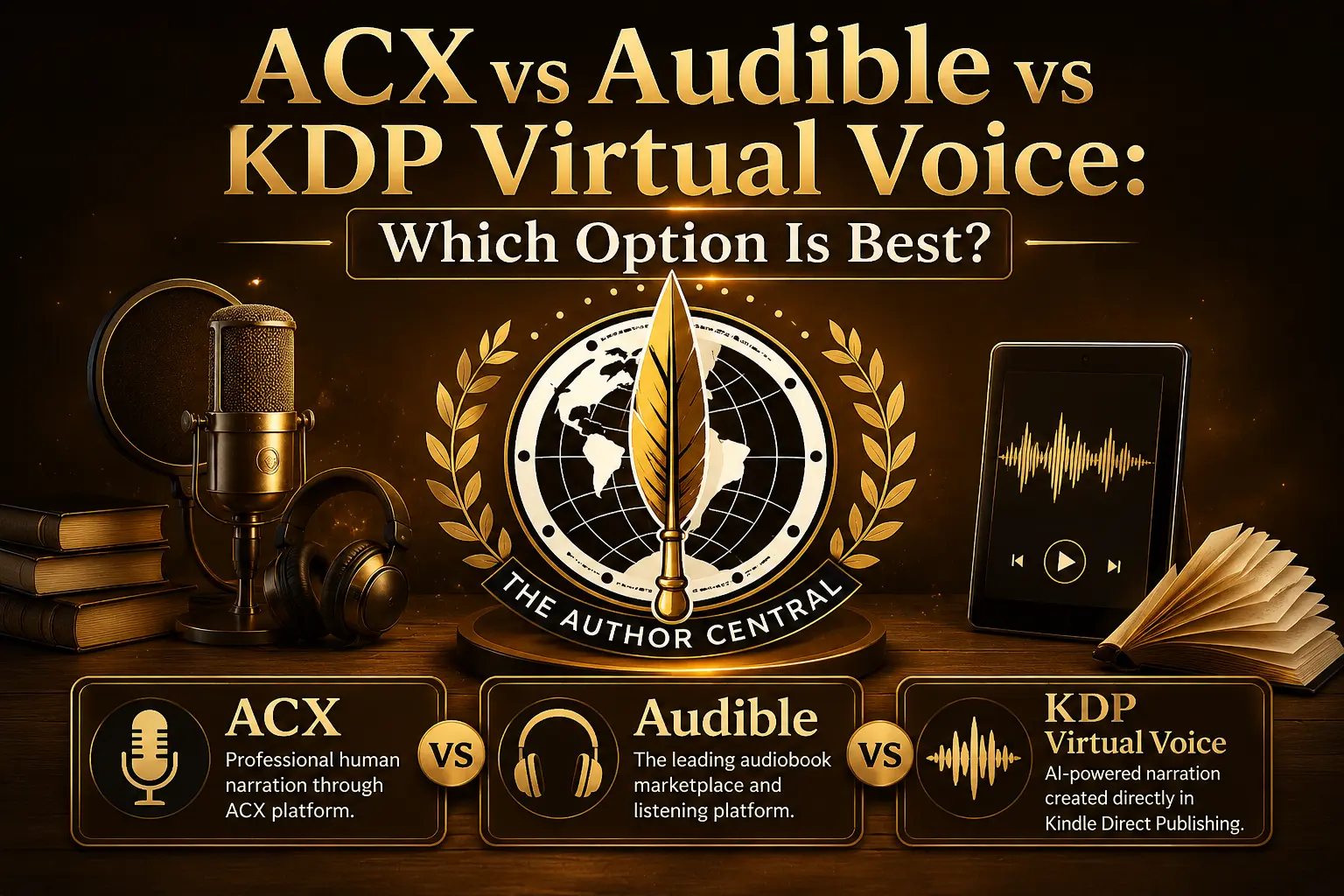
So I spent an embarrassing number of hours last spring trying to figure out how to get my book into audiobook format, and honestly, the ACX vs Audible vs KDP virtual voice question nearly broke my brain before I got any clarity on it. Every blog post I found either oversimplified things or was clearly written by someone who’d never actually used any of these platforms themselves. I want to save you that headache. This is what I actually learned, including the stuff that surprised me.
Let’s start with something that tripped me up for way longer than I’d like to admit. ACX and Audible aren’t competing options in the way people talk about them. ACX is where the audiobook actually gets made. Audible is mostly where it ends up being sold once it’s done. KDP virtual voice is the real alternative here, because it’s Amazon’s built in AI narration tool inside Kindle Direct Publishing, and it works completely differently from the ACX process. Once you understand that distinction, the whole comparison makes a lot more sense.
What Each Platform Actually Does
I’ll be honest, when I first started researching this, I assumed I was choosing between three equal options. That’s not quite right, and figuring that out saved me a lot of confusion.
ACX: The Traditional Route
ACX, which stands for Audiobook Creation Exchange, is the platform where the vast majority of professionally narrated audiobooks come from. You upload your manuscript, then either narrate it yourself, hire a professional narrator, or pay for a full production package. Once everything’s recorded and approved, ACX pushes the finished audiobook out to Audible, Amazon, and iTunes.
What you get with this route is quality, plain and simple. A good narrator doesn’t just read your words, they perform them. I remember listening to a mystery novel a few years back where the narrator’s voice work for one particular character was so good that I actually went back and reread parts of the physical book just to compare. That’s the kind of experience human narration can create, and it’s genuinely hard to replicate any other way.
But here’s the part nobody loves talking about: the cost. If you’re paying a narrator per finished hour, and most do charge that way, you could easily spend several hundred dollars on a shorter book or a few thousand on something longer. There’s also the royalty share option, where you split earnings with the narrator instead of paying upfront, but that comes with its own trade offs since you’re giving up a chunk of long term income. On top of the money, there’s the waiting. Production timelines can stretch out for weeks, sometimes months, especially if your narrator has a full schedule or you go through several rounds of revisions to get the tone right.
Audible: Not Really a Separate Choice
I keep coming back to this point because I think it’s the single most misunderstood part of the whole comparison. Audible isn’t something you pick instead of ACX. When your book finishes production through ACX, Audible is usually the main place it gets listed for sale. So when people frame this whole thing as ACX vs Audible vs KDP virtual voice, what they’re actually asking is simpler than it sounds. Do you go the traditional route through ACX, which naturally lands you on Audible, or do you use Amazon’s newer AI tool built into KDP instead?
That’s the actual decision. Everything else is just details.
KDP Virtual Voice: The New Option
KDP virtual voice showed up as Amazon’s response to a pretty obvious problem. A lot of authors wanted audiobooks but couldn’t afford the time or money that traditional narration demands. Virtual voice uses AI to generate narration straight from your existing Kindle ebook file, and right now it’s free for eligible titles enrolled through KDP. No auditioning narrators, no studio bookings, no waiting around for files.
The tradeoff is that the technology, while impressive, still isn’t quite there yet for everything. I’ve noticed the voices have improved a lot even in the last year or so, but they still struggle with the kind of emotional nuance and character differentiation that a skilled human narrator brings naturally. For something like a business book or a how to guide, that limitation barely matters. For a novel packed with dialogue between a dozen different characters, it can start to feel a little flat, maybe even distracting if you’re really paying attention.
Comparing the Practical Differences
Once you actually sit down and weigh ACX vs Audible vs KDP virtual voice side by side, a handful of practical factors end up mattering more than anything else. Cost, speed, quality, and how much creative control you want.
Cost is probably the factor that decides things for a lot of authors right away. ACX production, whether you’re paying upfront or splitting royalties, involves either real money out of pocket or giving up future earnings. KDP virtual voice costs nothing. If you’re a newer author who wants to test whether audiobooks are even worth pursuing for your genre, that difference alone might make the choice for you before you even look at anything else.
Speed matters more than people expect too. I waited close to two months once for a narrator to finish a project because their schedule got backed up, which wasn’t anyone’s fault exactly, but it was still frustrating when I had a launch date I was hoping to hit. KDP virtual voice, by comparison, can generate a finished audiobook in a day or two once your title is enrolled. That kind of turnaround is hard to compete with if timing matters to you.
Quality still tips toward ACX for most fiction, at least in my experience. I tested a few chapters of a friend’s thriller through KDP virtual voice out of curiosity, and while the narration was clean and perfectly understandable, it didn’t build tension the way a human narrator would during the scarier scenes. For genres like romance, thriller, or fantasy, where the performance really is part of the product, that gap is still noticeable enough to matter.
And then there’s control. With ACX, you can audition different narrators, give specific direction, request retakes if something doesn’t sound right, and really shape the finished product until it matches your vision. KDP virtual voice doesn’t offer that same flexibility. You’re choosing from Amazon’s available AI voices, but you’re working within their system rather than directing a performance.
Quick takeaway:
KDP virtual voice wins on cost and speed, making it a smart starting point for nonfiction or content where performance matters less. ACX still wins on quality and control, which makes it the better long term choice for character driven fiction where narration style shapes the reader’s experience.
Which One Should You Actually Pick
This is where I’ll skip the pros and cons list format and just tell you what I actually think, based on what I’ve seen work for other authors.
If you write nonfiction, run an online course, or publish anything where the narration style isn’t central to the reader’s experience, KDP virtual voice is genuinely worth trying first. It costs nothing, it’s fast, and for informational content, most listeners care more about clarity than performance anyway.
If you write fiction, especially in a genre where audiobooks are a massive part of the market, and romance and fantasy readers are famous for this, I’d lean toward ACX even with the higher upfront cost. Readers in these genres tend to have high expectations for narration quality, and a flat sounding AI voice might hurt your reviews more than the money you’d save helps your bottom line.
There’s also a middle ground a lot of authors are quietly using right now. Start with KDP virtual voice to get an audiobook version live fast and cheap, see how it performs, then invest in a professionally narrated ACX version later once you know there’s actual demand. That way you’re not gambling money on narration before you’ve confirmed people even want to hear the book.
A Real Example Worth Mentioning
A friend of mine writes cozy mysteries, which is a genre where narration style genuinely shapes the reading experience since so much of the charm comes from distinct character voices. She used KDP virtual voice for her first three books just to have something available for audio listeners. Sales were decent, nothing amazing, but a few reviews mentioned the narration felt a bit robotic, which stung a little given how much work she’d put into the writing itself. For her fourth book, she saved up and went through ACX with a narrator who specialized in cozy mystery style performances. According to her royalty reports, listener engagement jumped noticeably, enough that she’s now planning to eventually redo the earlier three books with human narration as well.
That story doesn’t mean KDP virtual voice is a bad option. It just shows how much the right choice depends on your genre and what your specific readers expect going in.
Other Things Worth Knowing
Something people often overlook when weighing ACX vs Audible vs KDP virtual voice is the exclusivity terms attached to ACX contracts. ACX offers both exclusive and non exclusive distribution deals. Exclusive pays a higher royalty rate. But it locks your audiobook into Audible and Amazon only. If you want your book available on Spotify or Kobo down the line, you’ll need to go non exclusive. Your royalty percentage drops as a result, though.
KDP virtual voice sidesteps this whole issue. That’s because it’s tied directly to your Kindle edition and distributed through Amazon’s own ecosystem. That simplicity is genuinely appealing if you don’t want to deal with contract fine print. It also means less flexibility later, though. So if you decide you want your audiobook available somewhere other than Amazon, you may run into limits.
Worth remembering: AI narration technology keeps improving, sometimes faster than people expect. A virtual voice narrating your book today might sound noticeably better a year from now. That’s because Amazon regularly updates its underlying models. Titles already enrolled may benefit automatically too. And that happens without any extra work on your part.
Final Thoughts
There’s no single right answer buried in the ACX vs Audible vs KDP virtual voice debate. It really comes down to your budget, your genre, and how much control you want over the final product. If you’ve got the budget, and you’re writing character driven fiction, ACX is still worth it. It delivers a level of polish that AI narration hasn’t fully caught up to yet. If you’re working with a tighter budget, or you need something published fast, KDP virtual voice makes sense instead. It’s also a solid choice when clarity matters more than performance. The tool keeps getting better every year too.
Honestly, if you can swing it, try both. Put out a KDP virtual voice version first to gauge interest. Pay attention to how listeners respond. Then decide whether investing in full ACX production makes sense for that particular book. Audiobooks aren’t slowing down anytime soon. And having options like these means authors at pretty much every budget level finally have a real shot. Their work can actually reach listeners’ ears now, no matter where they’re starting from.