Book Writing
 Book Cover Design
 Book Editing
 Book Formatting
 Book Publishing
 Book Video Trailer
 Book Printing
 Audio Books
 Book Illustrations
 Author Website
 Amazon Page Optimization
 Book Marketing
 Fiction Writing
 Non-Fiction
 Autobiography
 Memoir
 Novel Writing
 Children's Book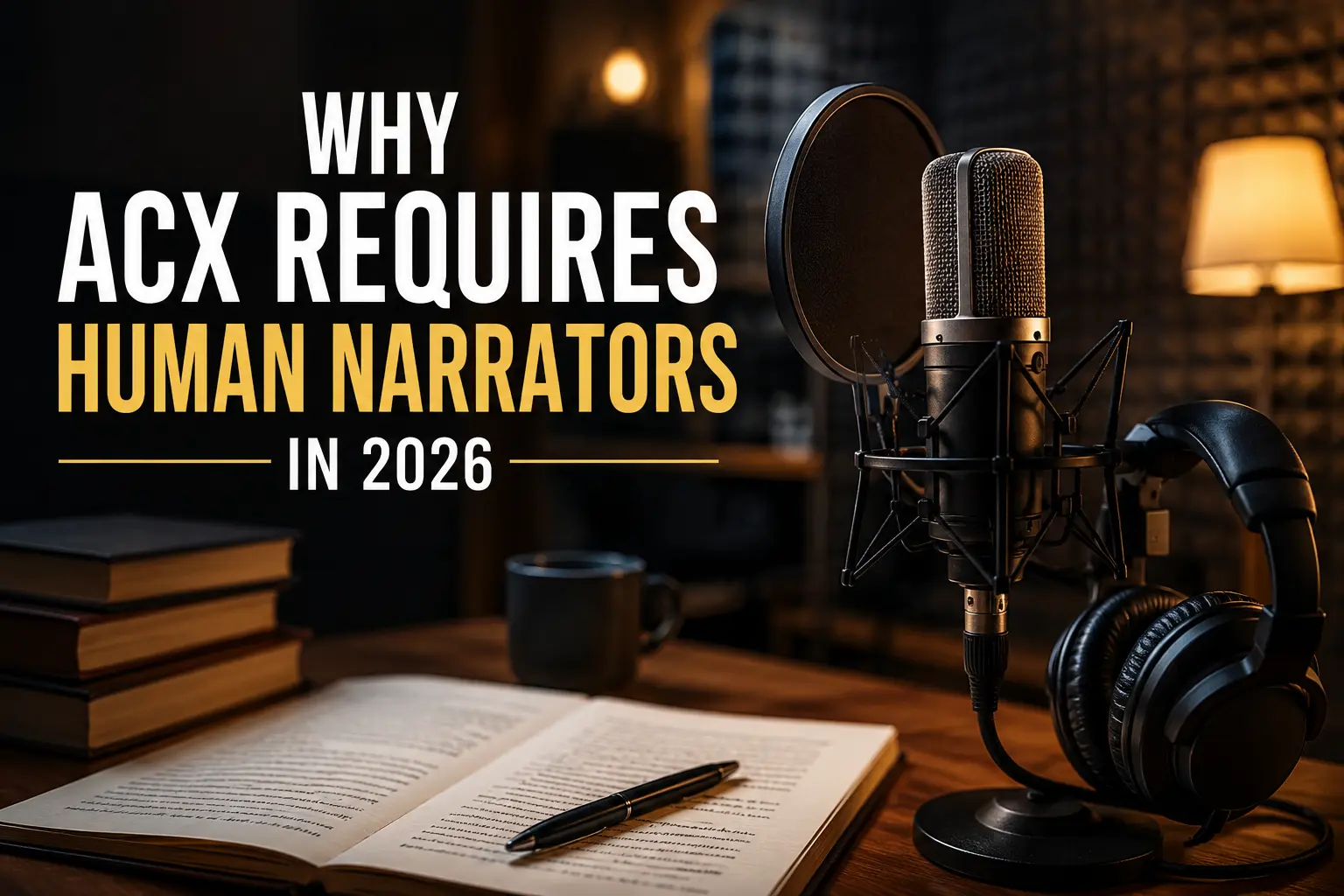
I keep running into the same confused question from authors lately, and it always comes down to ACX human narrators still being non negotiable on Audible. Which honestly surprises people, because if you scroll through any publishing forum right now, half the posts are about AI voices sounding “basically perfect.” So naturally, folks assume the human narration requirement must be some outdated rule nobody enforces anymore.
It’s not outdated. It’s very much still enforced, and I’ve watched authors learn this the hard way, usually after they’ve already spent time and money assuming otherwise.
I’ve spent a good chunk of this year helping writers get their books into audio format. This exact question comes up almost weekly. Sometimes it’s a nonfiction author trying to save money. Sometimes it’s a novelist who just doesn’t understand why Audible is being so particular about something that “sounds fine” to them.
So let me walk through why the policy exists. I’ll cover what it means for your specific situation. And I’ll get into your realistic options if Audible is where you want to land.
The Short Version
Audible still requires a real person behind the mic if you want your book in the general catalog. There are two exceptions, and only two. Amazon’s own virtual voice tool covers certain Kindle titles, and there’s a narrator voice replica program where an actual narrator agrees to let their voice get cloned for future projects. That’s it. Everything else, if you slap an outside AI generated track on your book and call it human narrated, you’re breaking the rules. It doesn’t matter how good the AI sounds, and it doesn’t matter how convinced you are that nobody will notice.
Audible didn’t build its whole business on convenience. It built it on performance. Listeners aren’t just tolerating a voice reading their book to them, they’re choosing Audible specifically because narrators bring something to the material that a flat reading never could.
And this isn’t just Audible being stubborn for no reason. It comes down to trust and, honestly, brand identity. A good narrator catches the joke before you do. They know when a line needs a half second of silence to land right. They understand that a whispered threat and a shouted one carry completely different weight, even if the words on the page are identical.
An author I talked to last spring learned this the expensive way. She ran her manuscript through a text to speech tool, uploaded it, figured she was done. Got rejected. Tried again with slightly better settings, thinking maybe the issue was audio quality. Rejected again. Eventually she hired an actual narrator, and her sales just… shifted. Reviews started mentioning the narration specifically, by name even. That kind of feedback basically never happens with synthetic audio, at least not the way it happens with a narrator who really gets the material and makes it their own.
What a Narrator Is Actually Doing That AI Still Can’t Fake
People underestimate this constantly, so let’s slow down on it for a second, because I think this is the part that actually explains everything else.
A narrator reading your book is making dozens of tiny judgment calls per page that you never see written down anywhere. Where to breathe. When to let a sentence sit a beat longer than normal. How to make two characters sound distinct without turning it into a bad impression. Whether your protagonist’s sarcasm needs a slight edge or a softer touch depending on the scene, and whether that edge should soften by chapter twelve once the character has grown a little. None of that comes from the manuscript itself. It comes from a person who has actually felt grief, or awkwardness, or comic timing, and knows how to translate that into voice without you ever having to spell it out in stage directions.
AI has gotten shockingly good at the surface stuff, pitch variation, rhythm, even convincing pauses in the right places. But there’s still something missing underneath it, and listeners pick up on it even when they can’t articulate exactly what’s off. You know that feeling when an audiobook sounds technically fine but just a little flat, like the narrator is reading at you rather than telling you something? That’s usually the tell, and it’s remarkably consistent across different AI tools no matter how advanced they claim to be.
This is really the whole reason ACX human narrators are still the expectation rather than some legacy rule nobody follows anymore. Audible isn’t selling you an audio file. It’s selling an experience, and that experience depends on someone who understands story the way another human does, not the way a model trained on speech patterns does. There’s a reason certain narrators develop dedicated fan followings who will buy any book just because that person narrated it. Nobody has a favorite AI voice model the same way, at least not yet, and I doubt that changes anytime soon.
What This Actually Means for You
Okay, so practically speaking, what do you do with all this information once you understand the landscape.
If your plan is wide release on Audible with real royalty potential and long term visibility, you need to budget for an actual narrator. That part isn’t optional. Costs swing a lot depending on genre and narrator experience and whether you go royalty share or pay per finished hour, but set aside real money, or be ready to give up a decent chunk of royalties instead. A ten hour novel with a royalty share narrator might cost you nothing upfront but half your royalties forever. The same book with pay per finished hour might run several thousand dollars but you keep full royalties going forward. Neither option is automatically better, it depends entirely on your cash flow and how confident you are in the book’s sales potential.
Here’s the thing though, that investment usually pays for itself in ways that are hard to measure on a spreadsheet. A great narrator can turn a solid book into something people specifically recommend because of how it sounds. I’ve seen authors pick up entire new pockets of readers who found them through Audible first and never even touched the print version. Some readers genuinely prefer audio as their primary format now, and for them, the narrator basically is the book.
If money really is the wall you’re hitting, and your book leans more functional than performance driven, say a straightforward how to guide or technical manual, there are other roads. Findaway Voices allows AI narration as long as it’s disclosed properly during publishing. Google Play Books and Kobo have gone even further and accept synthetic voice pretty openly, no disclosure hoops required in some cases. Those are legitimate options for certain kinds of books. They just won’t land you in Audible’s main catalog, so keep that in mind before you commit to a workflow that assumes otherwise.
Actually Finding a Narrator Without Losing Your Mind
This part is more fun than people expect once they get into it, so don’t dread it too much, even though the first search can feel overwhelming with how many options exist.
Skip the resume, at least at first, and just listen to sample auditions. A narrator can have a beautiful résumé and still be completely wrong for your book if their natural tone doesn’t match what you’re going for. A cozy small town romance needs a totally different energy than a gritty thriller, obviously, but people still forget this and pick based on credentials alone, then wonder why the finished product feels mismatched.
Pay close attention to dialogue if you’ve got multiple characters talking. Can they keep voices distinct without turning it into something that sounds like a cartoon? Listen for how they handle tension, if you can find a sample that shows it, and notice whether their pacing changes during action scenes versus quiet reflective ones. And honestly, just ask for a custom audition using a passage from your actual book. Most professional narrators expect this request and won’t be offended by it. It tells you more in thirty seconds than any generic demo reel will, because you get to hear your actual words in their actual voice before committing to anything.
Talk to them directly too, even just a quick call or a few messages back and forth. You want someone who gets your book’s tone and audience, not just whoever’s available and fits your budget. That collaboration piece matters more than most first time authors realize going in, and a narrator who asks thoughtful questions about your characters upfront is usually a good sign of how seriously they’ll take the project.
Where Things Seem to Be Headed
I’d be lying if I said this was frozen in place forever. Regulation is moving fast. The EU’s disclosure rules for synthetic audio kick in later this year. This is nudging every platform toward clearer labeling, no matter where you publish. Amazon has also been quietly widening its own approved AI pathways. More official options will probably show up eventually. Outside AI narration stays off limits for now, though.
But right now, and probably for a while yet, ACX human narrators are still the requirement. You need them if you want your audiobook in Audible’s main catalog. Skip that and you risk disclosure trouble or getting flagged during review. The tech keeps improving, no argument there. But the emotional texture a real narrator brings is still what keeps people loyal to Audible specifically. It’s the reason they don’t just download whatever audio file is cheapest.
Until that changes in some fundamental way, planning around human narration isn’t just about following rules. It’s about giving your book the best possible shot at actually connecting with listeners.
Budget for a real narrator if Audible is genuinely your goal, because the ACX human narrators requirement isn’t going anywhere soon. Treat finding the right narrator as part of the creative work itself, not some annoying box to check.
Conclusion
If you’re an author trying to sort out your audiobook plan this year, here’s the honest version. Budget for a real narrator if Audible is genuinely your goal. The ACX human narrators requirement isn’t going anywhere soon, at least not in any obvious way. Treat finding the right narrator as part of the creative work itself, not some annoying box to check. The right voice can genuinely change how people experience your book, sometimes more than the writing itself. And if cost is the real obstacle right now, other paths exist. Just don’t confuse them with landing your book fully narrated in Audible’s main catalog.
Either way, knowing this upfront saves you from a rejected upload and wasted weeks. It lets you actually plan instead of guessing your way through a process that has clearer rules than most people assume.
📚 Keep Reading — Related Guides
🔗 Can You Publish an ElevenLabs Audiobook on ACX?
🔗 ACX vs Audible vs KDP Virtual Voice: Which Option Is Best?
🔗 Complete ACX Audiobook Publishing Guide for Beginners
🔗 How to Publish an Audiobook on Audible Without Rejection (coming soon)
🔗 11 ACX Submission Mistakes That Get Audiobooks Rejected (coming soon)
🔗 How to Get Your Audiobook Approved on ACX (coming soon)