Book Writing
 Book Cover Design
 Book Editing
 Book Formatting
 Book Publishing
 Book Video Trailer
 Book Printing
 Audio Books
 Book Illustrations
 Author Website
 Amazon Page Optimization
 Book Marketing
 Fiction Writing
 Non-Fiction
 Autobiography
 Memoir
 Novel Writing
 Children's Book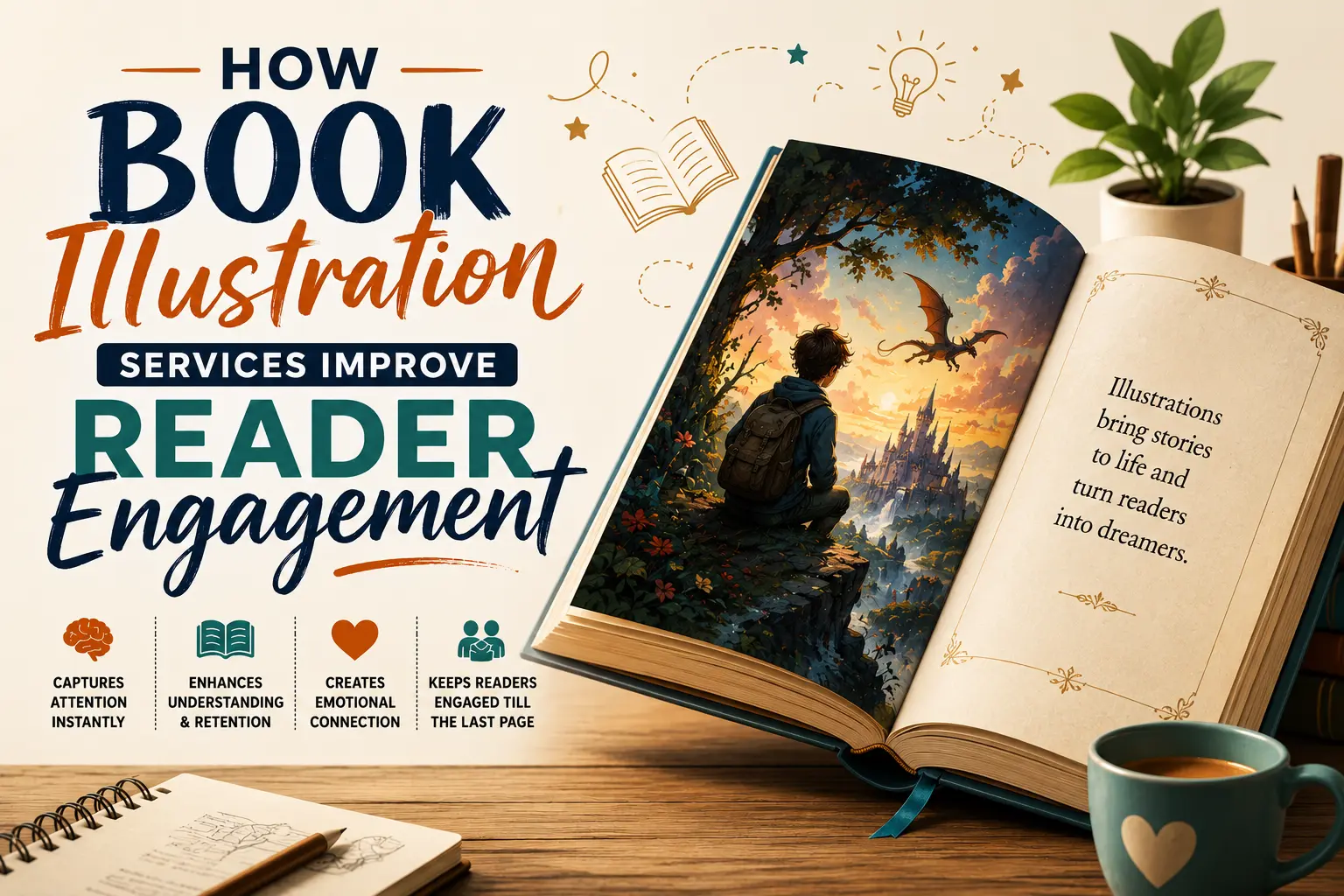
I was at a small bookstore a few years back with my younger cousin. She completely ignored probably fifty books before suddenly stopping in front of one and refusing to move. She had not read anything on the cover, not even the title properly. The artwork stopped her. Just the picture. That moment really showed me the power of book illustration. It stuck with me more than I expected it to, and I think about it a lot when people ask me why illustration in books matters as much as it does.
Honestly getting someone to sit down and read anything these days is already a small miracle. Everyone has a phone in their hand, something streaming in the background, seventeen tabs open. So when a book genuinely holds someone’s attention start to finish, something real is working in its favor. In my experience, and from talking to a lot of readers and authors over the years, the artwork inside a book is doing more of that work than most people stop to credit it for.
Before Anyone Reads a Word
That First Impression Happens Fast
Here is something I noticed after paying attention to how people behave in bookstores and libraries. Readers form an impression of a book before they have processed a single sentence. The cover obviously, but also what the inside looks and feels like when they flip through it quickly. The layout, the spot art, the way pages breathe or feel cluttered. Book illustration is already shaping how someone feels about a reading experience before they have committed to it.
I spoke to a children’s book author a while back who had two editions of the same story. First edition had okay reviews, nothing that set the world on fire. Second edition came out with proper full illustrated spreads throughout. Same story, same words, completely different reader reaction. People started calling it magical. Started saying it was the kind of book they wanted to read to their kids every night. The text had not changed by a single word.
Why Visual First Impressions Stick
That is not luck. That is what happens when visual storytelling and written storytelling are actually working together instead of one just sitting politely next to the other. Our brains hold onto images in a way they do not always hold onto sentences. A reader who flips through a beautifully illustrated book for thirty seconds has already formed an emotional relationship with it before they have read anything meaningful. That relationship either pulls them in or it does not, and the artwork is doing most of the deciding.
What Children’s Books Taught Me About All Books
The Artwork Is Not Decoration It Is the Story
Children’s publishing is where you see this most clearly because there is nowhere to hide. A children’s book with weak illustration is a weak book, full stop. The artwork is carrying so much of the emotional weight that you feel its absence immediately.
But what I find more interesting is what great children’s illustration teaches you about books for every age group. The best illustrators in that space are doing things that are genuinely sophisticated. A character whose expression tells you something the text is not saying out loud. A background detail on page four that becomes meaningful on page nineteen. Visual jokes layered in for parents who have read the same book forty times and need something to keep them sane.
Why Families Return to the Same Books for Years
That kind of craft does not disappear in value just because the reader gets older. It just gets applied differently. The principles are identical. Show the reader something the words alone cannot deliver. Give them a reason to look carefully. Make the act of reading feel like discovering something rather than just receiving information.
I grew up in a house full of books and the ones I remember most vividly, the ones I could describe to you right now in reasonable detail, all had strong visual identities. The ones that got read until the spines cracked and the corners went soft. My mum still has a few of them on a shelf and I still pick them up when I visit. That is not a coincidence and it is not nostalgia doing all the work.
Nonfiction and the Moment Things Click
When Dense Information Finally Makes Sense
There is this assumption that illustration is mostly a children’s thing and that serious adult readers, particularly nonfiction readers, do not really need it. I think that assumption is wrong and I think most people who read a lot already know it is wrong even if they have never said so directly.
I spent time a couple of years ago reading through several books on the First World War. Dense, serious, well-researched books. I was getting through them fine but I kept feeling like I was understanding events in a loose approximate way rather than really grasping them. Then I picked up one that had illustrated maps throughout, detailed visual breakdowns of key moments, diagrams of trench systems. Everything I had been reading about for weeks suddenly became clear in a completely different way.
Going Back to Reread With New Eyes
I went back and reread sections. Not because the writing had been unclear but because now I had a visual framework to hang the information on and I wanted to go through it again with that framework in place. That is what book illustration does in nonfiction at its best. It does not make the content easier in a dumbed down sense. It makes it actually accessible in the way the author probably intended it to be understood. There is a real difference between those two things and readers feel it even when they cannot name it.
The Gift Book Angle Nobody Talks About Enough
Why People Buy Illustrated Books for Each Other
Walk through any bookshop in December and just observe what people are actually picking up and carrying to the register. It is not plain text paperbacks with nothing going on visually. It is illustrated editions, art books, beautifully produced books on cooking or travel or architecture, annotated classics with artwork woven throughout.
A book can be a beautiful object. When it is, people give it to each other. They display it. They pick it up again months later because it is sitting there looking good on a shelf and they feel like spending time with it. Book illustration is a big part of what makes a book feel like something worth owning rather than something worth reading once and passing along.
The Bet That Usually Pays Off
I have genuinely bought books as gifts because of how the artwork looked before I was even fully sure the recipient would love the subject matter. I was betting on the visual experience being enough to win them over. That bet has paid off more times than it has not. There is something about a beautifully illustrated book that feels considered and personal as a gift in a way that a plain paperback sometimes does not, even if the plain paperback is the better written of the two.
The Actual Process of Working with Illustrators
Questions a Good Illustrator Always Asks
A lot of people who have not done it before assume working with professional illustration services means you send over a manuscript and then wait for finished pictures to show up. That is not really how the good collaborations work and I think the difference matters a lot for the final product.
The best illustrators ask questions that go well beyond what does this scene look like. They want to know who is going to be reading this. They want to understand what feeling should be sitting in a reader’s chest when they close the book. They ask about the emotional center of the story and about what the author is most afraid of getting wrong. Those conversations shape visual decisions that look technical on the surface but are actually about something much deeper.
How Color and Style Decisions Get Made
Color temperature is one example. Whether a book feels warm or cool emotionally has a lot to do with palette choices that happen early in the illustration process. Line weight changes whether something feels gentle or urgent. The amount of space around figures on a page affects reading pace in ways readers feel without noticing.
I heard an illustrator describe it once as setting the emotional weather of a book. That phrase has stayed with me because it is exactly right. A good illustrator is not just drawing scenes. They are deciding what kind of air the reader breathes while they are inside the book. An author who stays engaged with those conversations and pushes back when something feels off ends up with a much more unified final product than one who stays hands off throughout.
What Readers Say When Nobody Is Asking Them to Talk About Artwork
The Unprompted Responses That Say Everything
One of the things I find most convincing about the value of strong illustration is how often readers bring it up without being prompted. Look at reviews for well illustrated books and you will find people describing specific images in detail, talking about how a particular spread made them feel, saying things like I kept going back to look at the pictures again before moving forward.
These are not people who bought an art book. These are readers who came for a story or for information and ended up having an experience that was richer than they expected because the visual work was genuinely good. You do not get that response by treating illustration as a budget line to be minimized.
When a Book Feels Thin Without Anyone Knowing Why
Books where the artwork feels like an afterthought read exactly like that. Readers sense it even without being able to articulate what is missing. The book feels thin somehow, not in terms of page count but in terms of experience. There is a flatness to it that sits in the background of the whole reading experience and quietly undercuts everything else the book is trying to do. Getting book illustration right from early in a project rather than bolting something on at the end is the difference between those two outcomes and most readers can feel that difference even if they would never use those words to describe it.
Why This Keeps Mattering
The Books That Stay With People
The books that stay with people are almost never the ones that played it safe visually. The ones that get pressed into friends hands, that get bought again after an old copy falls apart, that parents read to children who then read to their own children someday, those books almost always have a strong visual life to them.
I think about my cousin in that bookstore again sometimes. She is older now and reads all kinds of things. But she still notices artwork first. She still picks up a book and flips through it before she reads the back cover. That habit was formed early and it has never left her. Readers like her are not a niche. They are most readers, and they are responding to something real every time a beautifully illustrated book stops them in their tracks.
What the Investment Actually Buys You
Reader engagement is really about memory and feeling. Whether a book leaves something behind in the reader after the last page. Illustration done well is one of the most honest and direct ways to make that happen because it gives people something to actually see and hold in their minds long after the specific words have faded.
That seems worth taking seriously. Based on everything I have seen and read and heard from people who make books and people who love them, it is one of the investments in publishing that tends to give back more than it costs. Not just in sales or reviews, though those matter too. But in the harder to measure thing, which is whether a book becomes something a reader carries with them for years after putting it down.