Book Writing
 Book Cover Design
 Book Editing
 Book Formatting
 Book Publishing
 Book Video Trailer
 Book Printing
 Audio Books
 Book Illustrations
 Author Website
 Amazon Page Optimization
 Book Marketing
 Fiction Writing
 Non-Fiction
 Autobiography
 Memoir
 Novel Writing
 Children's Book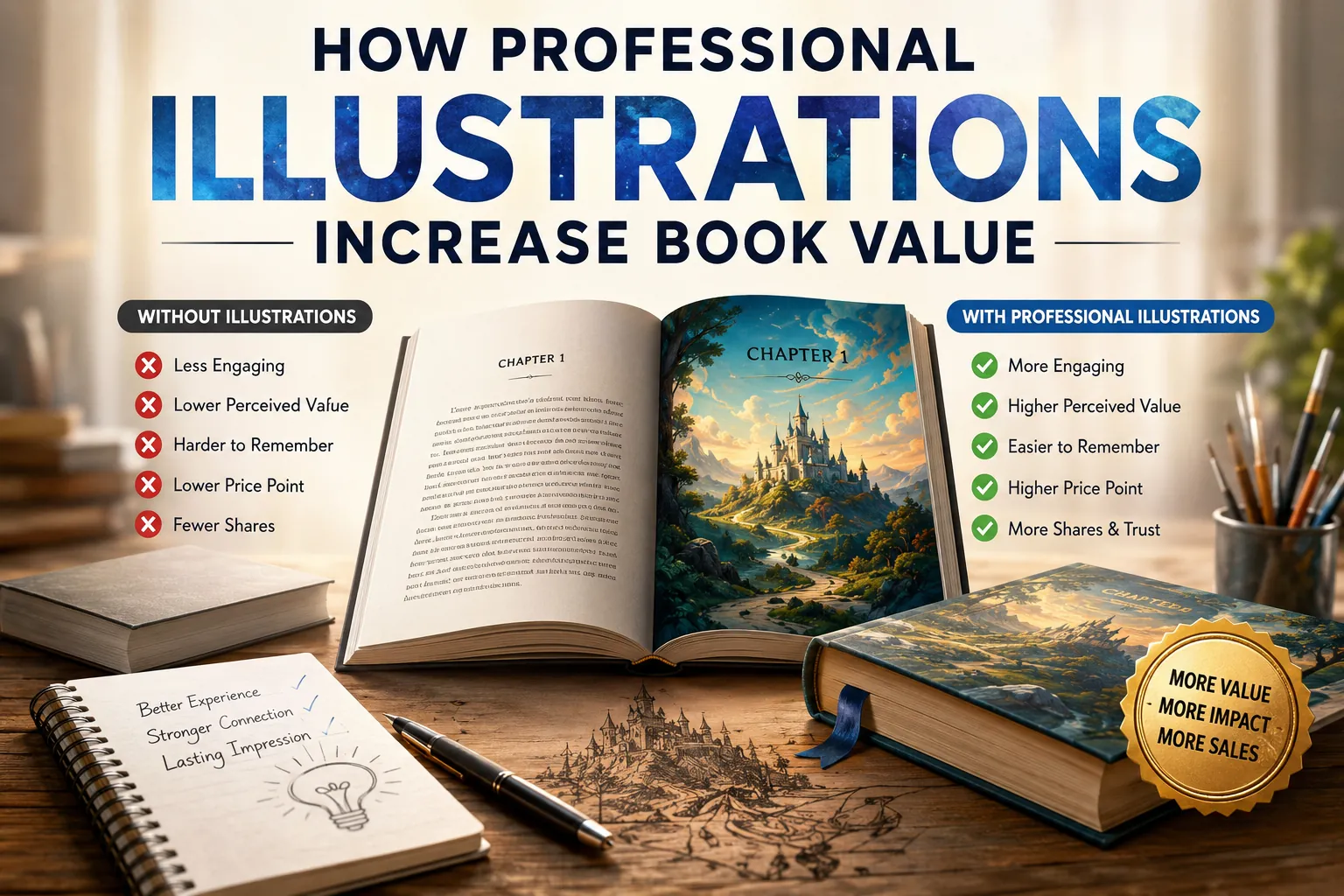
I never thought much about what made certain books feel more valuable than others until I started publishing my own. Professional illustrations were not even on my radar at first. I thought value came from the writing, the story, the ideas inside the pages. Turns out I was only looking at half the picture.
What I Mean When I Say Book Value
Before I get into the experience itself I want to be clear about what I mean by value because I think people hear that word and immediately think only about money. Book value is real in the financial sense, yes. A well illustrated book typically commands a higher price point and readers accept that price more willingly. But value also means something less tangible. It means the weight a book carries when someone picks it up. The seriousness with which it is taken. The likelihood that it gets recommended, reviewed, displayed on a shelf rather than buried in a drawer, returned to more than once.
I have experienced both sides of this. I published a book before I understood any of this and I published one after. The difference was not subtle and it showed up in ways I did not expect.
The Book I Published Without Thinking About This
My first independently published book came out about three years ago. I was proud of the writing. I had edited it carefully, paid for a professional proofread, and spent real time on the formatting. What I did not spend real time on was the visual presentation. The cover was something I put together myself over a weekend using a template. There were no interior illustrations. The whole thing looked clean enough on screen but when I held a printed copy it felt thin in a way that had nothing to do with the page count.
Sales were modest. Reviews were kind about the content but nobody ever mentioned how the book looked or felt. A few people told me they had recommended it to friends and I noticed that when they described it they always led with the story. Never with anything visual. At the time I thought that was fine. That is what I wanted anyway. The story to speak for itself.
What I understand now is that they had nothing visual to mention. The book had not given them anything to see. It was a reading experience only, which limited how far it could travel and who it could reach.
The Moment I Started Thinking Differently
A writer I knew online released a book around the same time mine came out. Our subjects were similar, our audiences overlapped, our writing was honestly comparable in quality. Her book outsold mine by a margin that was difficult to ignore. I bought a copy to understand why.
When it arrived I got it immediately. The cover was striking in a way that made me want to look at it before I opened it. The interior had illustrated chapter openers that set a mood before you read a single word of each section. Every visual element felt considered and intentional. The book felt like something that had been made with care rather than assembled with efficiency.
That experience sent me down a long road of research and eventually led me to understand something that changed how I approached every project after that. Professional illustrations do not just make a book look nicer. They fundamentally change what a book is and how it functions in the world.
Why Illustrations Change What a Book Is Worth
They Signal That the Work Was Taken Seriously
This is probably the most important thing and also the hardest to quantify. When a reader picks up a book and sees that real artistic thought has gone into every visual element, they make an immediate unconscious judgment that the content inside received the same level of care. It is not a logical conclusion necessarily but it is a deeply human one. We associate the quality of the container with the quality of what is inside.
Professional illustrations are one of the clearest signals a writer can send that they took their own work seriously enough to invest in it properly. Readers respond to that signal whether they articulate it consciously or not. It affects how they approach the reading experience, how much patience they bring to difficult sections, and how generously they interpret ambiguous moments.
They Create an Experience That Text Alone Cannot
Writing is one kind of experience. Visual art is another. When the two are working together well they create something that neither can produce alone. A reader who has both read a description of something and seen a skilled visual interpretation of it has encountered that thing more fully than someone who only did one of those things.
For nonfiction this means concepts land with more clarity and stay in memory longer. For fiction and especially for children’s books it means emotional connection happens faster and goes deeper. The image and the word reinforce each other in a way that genuinely increases the total value of what the reader receives.
They Give the Book a Longer Life
Books with strong visual identities get shared differently than books without them. People photograph them. They post about them. They display them. A book that sits beautifully on a coffee table or a classroom shelf has a kind of passive marketing presence that an unillustrated book simply does not have. Every time someone sees it in someone else’s space, curiosity is created without any effort or expense on the author’s part.
I have watched this happen with my own more recent work. I will see a photo on social media that has my book visible in the background of someone’s workspace or reading nook and realize that the book is doing work for me without my involvement. That only happens when a book has a visual presence worth including in a photo.
The Pricing Reality That Surprised Me
When I finally committed to working with an illustrator on my second major project I was nervous about the cost. Not because I could not manage it but because I was not yet fully convinced that the return would justify the investment. I had been telling myself for years that readers cared about content and that presentation was secondary.
What happened to my pricing when the illustrated version launched genuinely surprised me. I had been selling my previous book at a price point I felt slightly embarrassed to go above. With the new book I priced it meaningfully higher, not because I had decided to charge more but because the book felt worth more. It looked worth more. And readers agreed. The conversion rate, meaning the percentage of people who looked at the book and then actually bought it, was higher at the higher price than my previous book had achieved at a lower one.
That experience taught me something that I now think is one of the most practically important things a self-publishing author can understand. Professional illustrations do not just add to the perceived value of a book. They change the entire commercial context in which the book exists. They move it into a different category in the reader’s mind, a category where higher prices are normal and expected rather than questioned.
What Changes for Different Types of Books
Children’s Books
This is probably the most obvious category where illustration directly determines value and I do not need to spend a lot of time on it. In children’s publishing the illustration IS the book in many cases. A picture book without strong visual art is not a picture book at all. But what I want to add here from my own observation is that the quality gap between average illustration and genuinely skilled work is enormous in this category and readers, meaning parents and teachers and librarians who are making purchasing decisions, are more attuned to that gap than most writers assume. The bar is high and the reward for clearing it properly is significant.
Nonfiction and Educational Books
This is where I think the value argument is most underappreciated. A lot of nonfiction writers I know treat illustration as optional, something nice to have if the budget allows. What I have seen in my own work and in the work of others I have observed closely is that professional illustrations in a nonfiction book do something very specific and very powerful. They take abstract information and make it concrete. They give the reader’s brain a visual anchor for concepts that words can gesture at but not fully land. Educational books with strong illustration consistently outsell comparable titles without it, and they also tend to get adopted more readily by schools and educational programs because the visual support makes the content more teachable.
Fiction for Adults
This is the category where writers are most likely to dismiss illustration as unnecessary and I understand why. The dominant model in adult fiction publishing does not include interior illustration and many readers have never thought to want it. But chapter openers, maps, object illustrations, and other visual elements added thoughtfully to adult fiction create a sense of world that is genuinely different from text alone. Readers of fantasy and science fiction especially respond strongly to this. A map at the front of a fantasy novel is one of the oldest and most effective examples of illustration increasing reader investment in a story before they have read a single word.
What I Got Wrong About the Cost
I spent too long thinking about illustration cost as an expense rather than as part of the product. When you buy materials to manufacture something physical you do not think of those materials as an expense you are trying to minimize. You think of them as what the thing is made of. Illustration is part of what a book is made of. Treating it as optional overhead rather than as a core production cost led me to underinvest for longer than I should have and the books I made during that period reflect that.
The math also looks different when you think about it over the full life of a book rather than just the launch. A book that commands a higher price point, converts better, gets shared more, and stays in print longer will recover illustration costs that might look large upfront. Most of the writers I know who invested properly in professional illustrations for their books recovered that cost within the first year of sales. Several recovered it much faster than that.
What I Do Differently Now
I treat visual presentation as part of the manuscript development process now, not something I think about after the writing is done. When I am working on something new I am already thinking about what kind of illustration it needs and what that illustration needs to accomplish. By the time the writing is finished I usually have a clear enough sense of the visual direction that the brief I write for an illustrator is detailed and specific rather than vague.
I also budget for it from the beginning. Not as a line item I might cut if things get tight but as a non-negotiable part of what it costs to make the book properly. That shift in how I think about it has changed what I am willing to invest and the results have consistently justified that investment.
Professional illustrations are not a finishing touch you add to a completed book. They are part of what the book is. The writers who understand that earliest tend to build the most durable bodies of work, because every book they release looks like something worth taking seriously, and readers respond to that consistently over time.
If You Are Still Treating Illustration as Optional
I was where you are. I told myself the writing was what mattered and that serious readers would not be swayed by visuals. Some of that is true. Serious readers do care most about content. But serious readers are also people with eyes and aesthetic responses and limited time, and they make initial decisions the same way everyone else does, based on what they see before they read.
The writers I have watched build real sustainable audiences over the past few years are almost universally people who invest in the full presentation of their work. Professional illustrations are a central part of that. Not because readers are shallow but because a book that looks like it was made with full commitment invites a reader to commit fully in return.
That exchange, full investment from the writer meeting full investment from the reader, is what produces the kind of reading experience people actually talk about. And a book people talk about is a book that grows in value long after it is published.